


 Shkruar nga Pamfleti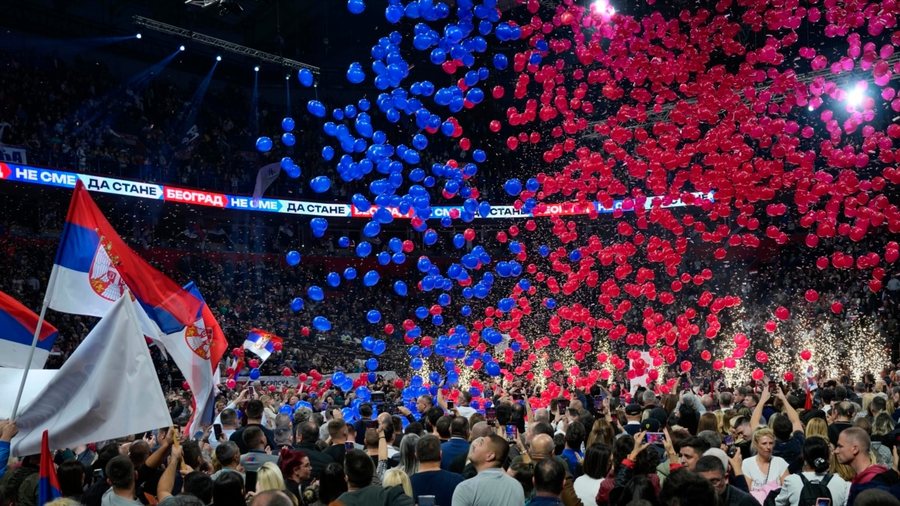
This weekend, voters in Serbia, for the third time in four years, will turn to the ballot boxes. The holding of parliamentary elections was prompted by the protests of citizens angry with the government's response to two consecutive armed attacks, one of them in one of the capital's schools where 19 students remain dead. President Vucic, former minister of Slobodan Milosevic, dressed in the mantle of a reformer, intends to further consolidate his control over the Serbian state.
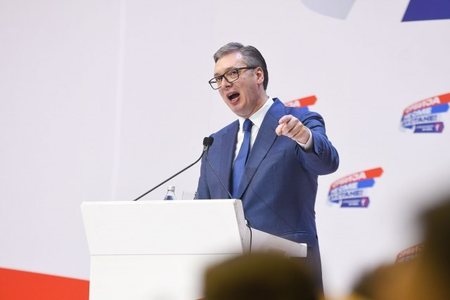
"For the triumphant victory of December 17! For a more convincing victory than ever before! We need to win over 50 percent of the vote, more than all of them combined. Let's defeat them so that Serbia has a future! These are the four most important years for our future!" declared Mr. Vucic during the election campaign.
According to democratic indicators, Serbia has long since, despite the declared pro-European orientation, continued to slide more and more towards autocracy with a position against the West.
In front of him, as the most serious political competition, is a diverse opposition, united for the elections under the slogan "Serbia against Violence", born from the protests
"(I expect) that all the opposition parties, or all the parties that are supported by those who strongly believe that this government should be replaced - form the new government, which will commit to the de-criminalization of the state, corruption, crime, to free the media and prepare the country for new elections... to determine the path of this country," according to opposition leader Dragan Gjilas.
The weekend elections are taking place in a tense atmosphere, after a campaign that European observers have assessed as unprecedented in terms of the level of negativity and fear, including the blackmailing of opposition candidates.
An observer delegation of the Parliamentary Assembly, which stayed in Serbia to assess the progress of the election campaign, said it was alarmed "by the inflammatory rhetoric, hate speech and pressure being used against opposition figures, journalists and civil society activists."
"Those who are against the government will choose the political change that is much needed after ten years of absolute power of President Vučić and his party. Those who will vote for the government vote for the status quo for various reasons – some because they don't think the (political) alternatives are better. Some because they are blackmailed," according to Mr. Srdjan Cvijič at the Belgrade Center for Security Policy.
But, according to Mr. Cvijič, the change in these elections can be made by the "silent majority" which, despite dissatisfaction with inflation and corruption, has often not voted, but has now woken up from the feeling of insecurity and a general violent climate in Serbia.
However, a recent survey conducted by the research group "Serbian New Political Thought" published in mid-November, shows a support of 39.2% for the political group led by President Vucic, under the slogan "Serbia dare not stop !". The opposition "Serbia against violence" ranks after him with 25.8 percent. The rest of the support goes to the right-wing pro-Russian parties or those close to President Vucic, such as the Socialists.
According to Mr. David Kanin, professor of European studies at John Hopkins University and former senior analyst of the US Intelligence Agency, the main issue in these elections is whether the opposition will manage to challenge the power of Mr. Vucic.
"It is very clear that President Vučić is treating these elections much more seriously than the previous elections. But the question is whether the pro-Western opposition... will be able to gain enough (support), especially in Belgrade, but also in other parts of the country to present a serious challenge to Mr. Vucic," says Mr. Kanin.
Under President Vučić over the last decade, Serbia has transformed into a country where the ruling party controls every aspect of the state, where rhetoric and interventions towards neighbors have brought back uncertainty and where the history of the wars in the Balkans has been subjected to revisionism and glorification.
But in economic and geopolitical terms, Serbia has benefited from its alliances, both with the United States and the European Union, as well as with Russia and China, like rarely any other country. The public in Serbia remains of a similar orientation; only 38.8 percent support Serbia's membership in the European Union and over 63 percent support Serbia's alignment with Russia, China and other BRICS member states.
As the only country in Europe that has not imposed sanctions on Russia and has continued to deepen cooperation with China, such a position has not harmed President Vučić's relations with the West, which aims to maintain stability in the tense Balkans while hoping to pull Serbia into his orbit.
"If the pro-Western opposition does well in the elections, then it will have more of a voice in discussions about foreign and security policy. President Vučić will continue with his policy balancing all parties, which he followed successfully. Regardless of what we think of his policies, he has been successful in dealing with the West, Russia, China and Turkey," says former CIA analyst Kanin.
For Mr. Cvijic, Sunday's elections have nothing to do with its ideological determination.
"The European Union is not at all on the agenda in these elections, as it was not even in the previous elections. This is because a large part of the pro-European opposition is disillusioned with the EU, seeing it as a supporter of President Vucic's regime. Whether this claim is true or not is another matter. Almost daily in the media close to the government there are doses of anti-Western propaganda and this has contributed to anti-EU sentiments in the country... But the EU is still synonymous with stability and economic progress for a large part of the people and I do not expect departure from the EU of any of the political groups, because that would be political suicide," he says.
Despite all the differences, the political race has a common denominator - the refusal of the political class in Serbia to accept the independence of Kosovo.
During the campaign, President Vucic alluded to a more favorable geopolitical moment that will enable Serbia to reclaim Kosovo. According to him, next year's elections in the White House could start geopolitical changes, which according to him would return Serbia to Kosovo.
"I have no doubt that we will be in a difficult and uncomfortable position, definitely. But do I think we can endure and save Serbia - and when I say save Serbia, I also think about Kosovo and Metohija in Serbia, I think we can regardless of how difficult it will be," declared Mr. Vucic during the show "Cirilica" on Serbian television TV Happy.
Opposition figures were equally forthright in their refusal to change their approach to Kosovo.
Miroslav Aleksić, the holder of the "Serbia against violence" list, said that for the opposition coalition, the Franco-German agreement for the normalization of relations between Kosovo and Serbia, which foresees the de-facto recognition of Kosovo's independence, is unacceptable.
And sometimes the positions on Kosovo were completely clear. In this electoral video of the People's Party of the former foreign minister, Vuk Jeremiq, he is restoring the church icon that symbolizes Kosovo kidnapped by the leaders of Germany and France.
However, analysts estimate that in relation to Kosovo, despite the harsh rhetoric, all parties would act in the same way as Mr. Vucic, whom the political parties in Serbia accuse of betrayal, in relation to the Franco-German plan.
"I think that none of them are honest about this matter... They understand that Serbia is surrounded not only by the EU but also by NATO member states and to go in a different direction would be madness," said Mr. Cvijic.
Analysts are of the same opinion that no major change in the approach to Kosovo is expected, even if pro-Western parties do well in the elections. /VOA


Lini një Përgjigje