


 Shkruar nga Pamfleti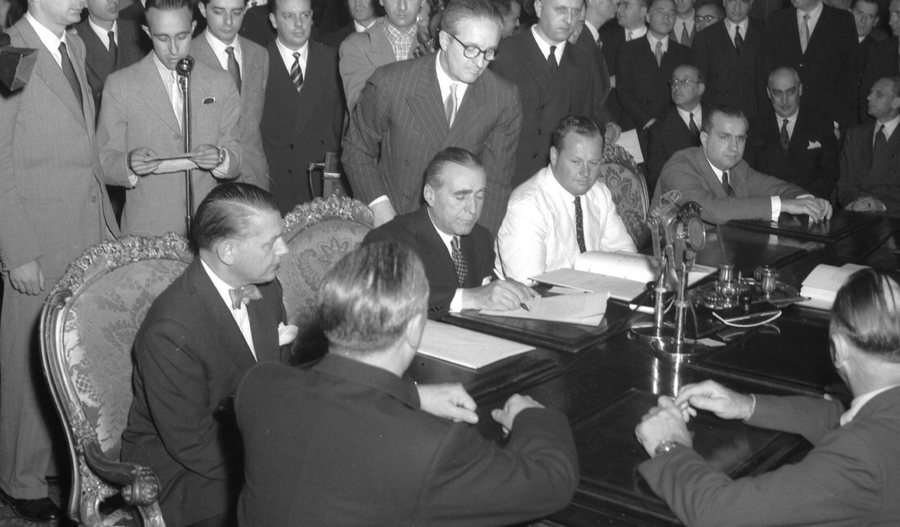
The Marshall Plan was an economic program to support the recovery of Europe immediately after the endmit of World War II. The plan provided for the allocation of several billion dollars to finance programs for the reconstruction and restructuring of the economy of the Old Continent, which kwas left destroyed by the conflict.
The plan was named after George Marshall, that of US Secretary of State during the Truman presidency, who was the first to spoke of the need of a grand plan for the reconstruction of Europe duringa speech given on June 5, 1947 a>. at Harvard University
On the Old Continent, World War II, exceptthat killed over 60 . ruinedmillions of people, left as a legacy countries and populations had lost infrastructure, factories and industries. The reconstruction byj of was a long job < a i=18>timelyand very complex.
This is because in the backgroundthere were new political tensions,të which can potentially slow downnin actions of governments or risking nis nin new wars. Meanwhile Europe suffersfrom division in /span>the Soviet Union. and on the other the United States on the one handthe respective spheres of influence of the two winning superpowers:, which matched blocks
The first kwas in hand Western Europe, the second Eastern Europe. So, the world was on the threshold of the Cold War. As in Washington yes also in Moscow, nd was the political value of reconstruction. European countries needed help badly,and alone were not able to find resources needed torecover.
Beginning of the Cold War i acceleratei plans of the US for a major reconstruction plan, which would be i able to bring back–the rise of economy European ss. A few billion dollars . /span>ropian towards political and social decay.
Knot the last, not only willa deprived the US of having stable allies, but would'u prefer communist parties in the West. The plan was draftedby officials of the White House, Treasury a> and other members of the Truman administration. ,
After the speech of Juneit 1947, nearly 14 billion dollars that will be invested in 3 > would separate recovery plans of the European economy. t long-termbased onshinthat would follow, and that4 years– a giant fund for the time of aboutthere was talk details were revealed. In particular, the first
The debateset in Congress were strong, and more finally, on April 3, 1948, the law was approved for the implementation of p lanit. Amounts disbursed by Washington u pourën into the Economic Cooperation Administration , a body specially created for the distribution of financial aid. A target major of the Marshall Plan, was concerned with the reconstruction of the infrastructure damaged by war.
In this way, European states would have the opportunity to rr< to trade and integrate the economies of theirs. Through this plan, the governments of the continent were encouraged not only to cooperate< /span> actions aimed at. in interdependent from each other national economiesmake' tindark, but also tookwere among them
The Marshall Plan lasted for 3 years a>. A total of 12.7 billion dollars were allocatedto < a i=10>3 installments until 1951. Most of went to Britain< a i=14>e Madhe, with a total of 3.2 billion dollars.
It was followed by France with 2.2 billion, West Germany with 1.4 billion< a i=4> dollars, andItalia with 1.2 billion. Meanwhile over 1 billion dollars benefited Holland =12>.
In total, 18 governments benefited from the Marshall Plan, such as those of< a i=4> Luxembourg, Belgiums, Austria, Denmark, Greece, Iceland, Ireland, Norway, Portugal, Sweden, Switzerland and Turkey.
Si all plans big, the Economic Cooperation Act, has rich over the years positive and negative evaluations. The first group includes the opinions expressed, especially a few years after the end of the program, by those who believe that the Marshall Plan has withoutsur success inthe recovery of the European economy.
This thesis is confirmed by the fact that between 1952–1953, the index of industrial productivity in Europe was higher than in the years before the Second World War. So with the money of data from the USA, the Old Continent a>the next economic boom without the need for help from Washington.bring with the infrastructure and industrial tools necessary to jable to providewas
Meanwhile in the second group, include many economists who think that the Marshall Plan, favori with të vërtet is recovery, but thanks to the low cost of labor. Therefore, there was no increase in income and no real revival of consumption.
Despite different opinions, the Marshall Plan remains undoubtedly one of the most important investment and economic recovery programs in history. So much so that it has entered the media jargon and political. that emergency is e customsme t'we turn to this clicheje of the political lexicon:< /span>.”lan MarshallPwe need a “Now
Similar was also the EU fund for the recovery of the European economies from the crisis caused by the pandemia.
But more than before, for Europe, =4>getting nearly 13 billion dollars in 3 years, meant connectis politicalewith US sphere of influence. From that moment on both sides of the Atlantic in a common political, ideological and cultural context. were included
With the Marshall Plan, the Washington government did not exporti only dollars and consumer goods that d from its factories, but also its economic, social and cultural system. / "Il Giornale" - Bota.al







Lini një Përgjigje