


 Shkruar nga Sokol Dodani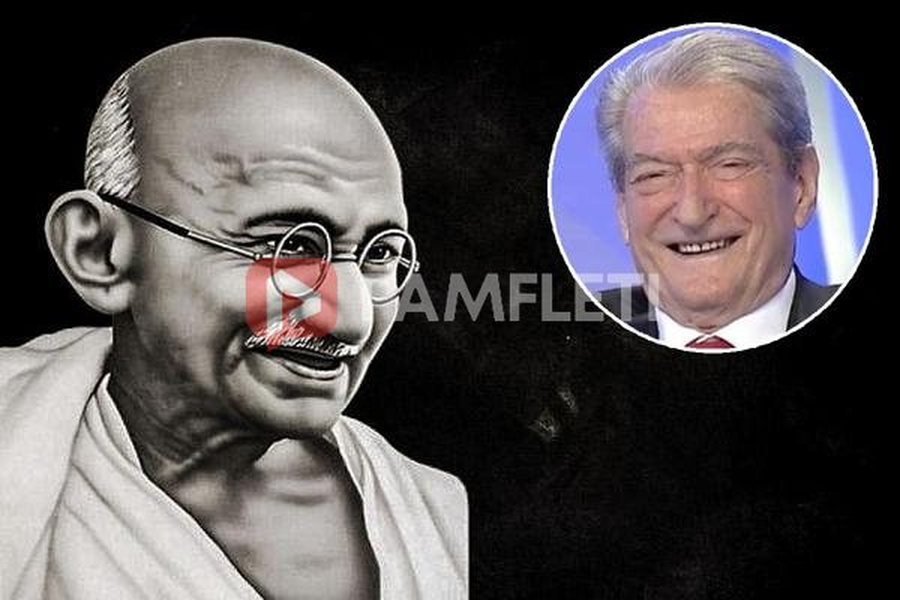
In the wake of the conspiratorial alibi, with poly agents, which both in form and content reminds of the follies and absurdities of the former dictator Hoxha, questions naturally arise, which Berisha has deliberately left in oblivion and for which we still do not have an answer public:
What happened to the so-called trial against the secretary of state in France?
What about the so-called trial in Great Britain?
In his chronic confusion, ex-Prime Minister Berisha has recently thrown nonsense words into the market, such as the theory of "Civil Disobedience".
Civil disobedience, recently used by former Prime Minister Berisha as a rallying call, is clearly seen to be proclaimed by someone who does not have the necessary historical culture to understand the meaning of these principles and, as usually happens in such cases, not only cannot build it as a mobilizing doctrine, but emptied this concept from its own interior.
A little history…
The term civil disobedience, taken from the tragedy of Antigone by Sophocles in Greek antiquity, was first used in the modern world in the writings of the American Henry Thoreau, but was applied as a full-fledged doctrine by Mahtma Ghandi in India.
On March 12, 1930 Mahtma Ghandi, 61 years old, left the meditative period in the Monastery (ashram) where he lived and, accompanied by his disciples, headed towards the Indian Ocean, which was 380 km away. This peaceful march was called the "salt march", as a symbol against the taxation system imposed by the establishment of the British empire.
India at that time had a population of 462 million and Gandhi's initiative was adopted by more than 300 million people.
The basic idea of this movement was to return to the fundamentals of Indian culture. To abandon clothing, fabrics, luxury objects, food or restaurants, hotels, western and mainly British clubs, and to base it on traditional Indian ones.
But if Ghandi was fully supported in his doctrine by more than 75% of the local population, the opposite happens with former Prime Minister Berisha, for whom we can safely say that he is unacceptable by more than 75% of Albanians.
Also, Ghandi was a good figure accepted by the entire world public opinion, while former Prime Minister Berisha is "Non-grata" from the USA, England, Canada and Australia as well as excluded from any contact from all European countries and even more and from all the political forces of the western democracies.
Ghandi was a clean figure and remained so until the end of his life, while former Prime Minister Berisha has a series of accusations of abuse of public funds, and not only that.
Ghandi lived in conditions of material modesty, while the assets of the former prime minister and his family are not counted.
Also, Ghandi was far from violence in any form of its manifestation, while the former prime minister appears in the television studio and declares in his stupidity, similar to the dictators of underdeveloped countries, that he is ready to kill on his orders.
In the event that Gandhi's activity left deep traces in the construction of India's institutions after the victory of independence, in contrast to the former Albanian prime minister, from whom we have the memory of the most tragic events of these 30 post-communist years and the misuse of national wealth, the confusion created in property rights, the incrimination of police bodies, the destruction of the justice system with the famous 6-month course of poplars, the corruption of the education system, etc., etc.
In the event that Gandhi served to create new horizons of hope for the Indian people, the former prime minister killed the hope of all those that the time of great changes at the beginning of the 90s made legitimate, turning PD from a party of hope into a band of hateful thieves.
His empty articulations, with the solemn promise that this time he is serious and will contribute just as seriously to the construction of democratic institutions and democracy itself in the Albania of the 80-year-old Berisha, really forces us to reflect on the folly of greatness and its consequences .
This mess resembles a scribble of a mentally ill person, who, surrounded by several other sick people, believe that they have the value of Da Vinci./ Pamphlet








Lini një Përgjigje