


 Shkruar nga Emin Azemi

The next boldest attempt to protect sovereignty in every corner of Kosovo was the repulse of a group of Serbian terrorists by the Kosovo police, this act proved that the country has institutional capacities and law enforcement for the extension of its sovereignty even where politics Vucic's destructive campaign had declared him "terra incognito". Perhaps this is where Edi Rama's malicious formulation "no man's land" comes from
The north of Kosovo resembles a part of the broken machine in the offices of geopolitical experiments, which is deliberately not repaired, or if it is repaired, it does not last long, because the experiment must continuously feed ambitions that have nothing to do with the real problems of the local Serbs. .
The absurdity that led to the division of Mitrovica does not require any detailed explanation to understand that as early as June 1999 there was a concrete plan of how a functioning Kosovo as a state should look, which began with the expulsion of Albanians from the north of Mitrovica and the placement in it of Serbs from all parts of Kosovo.
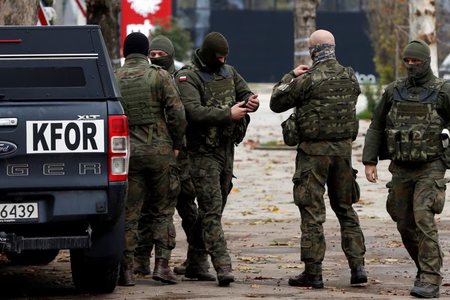
The Beirutization of Kosovo happened without the consent of the Albanians, and what still remains a puzzle is how this genocide could happen on the Albanians at a time when Kosovo was de jure protected by KFOR and administered by UNMIK.
In his book "Warriors of Peace" (published in 2004), Bernard Kushner better than anyone else explains the causes and consequences of what happened in the north of Kosovo from June 1999 until today and the role of the French KFOR in the deformation of the reality on the ground, which resulted in the division of Mitrovica into two parts.
However, the latest efforts of the Government of Kosovo are aimed at restoring sovereignty in this part of the country as well. Until two years ago, the north of Kosovo was on the electoral maps of Serbia, and the Belgrade regime unobstructed held elections there as if it were the territory of Serbia. But this map for the Government of Kurti was declared invalid.
In the north of Kosovo, the state symbols of Serbia, starting from flags, license plates, identification and travel documents, have strongly expressed not only physical, but also legal, constitutional and state presence of Serbia in that part of Kosovo.
It has been two years since this physical and state presence of Belgrade has been opposed by Prime Minister Kurti, and here begins the treatment of Kosovo not as an internal problem of Serbia, but as a problem of its citizens, regardless of ethnicity, religion, language, etc. Here begins the treatment of Kosovo in the spirit of a new reality created after 1999, a reality that was violently deformed by Serbia, indirectly helped by the former Albanian governors in Pristina.
The other most daring attempt to protect sovereignty in every corner of Kosovo was the repulse of a group of Serbian terrorists by the Kosovo police, this act proved that Kosovo has institutional capacities and law enforcement for the extension of its sovereignty even where politics Vucic's destructive campaign had declared him "terra incognito". Perhaps this is where the malicious formulation "no man's land" of Edi Rama comes from./ Pamphlet




Lini një Përgjigje