


 Shkruar nga Pamfleti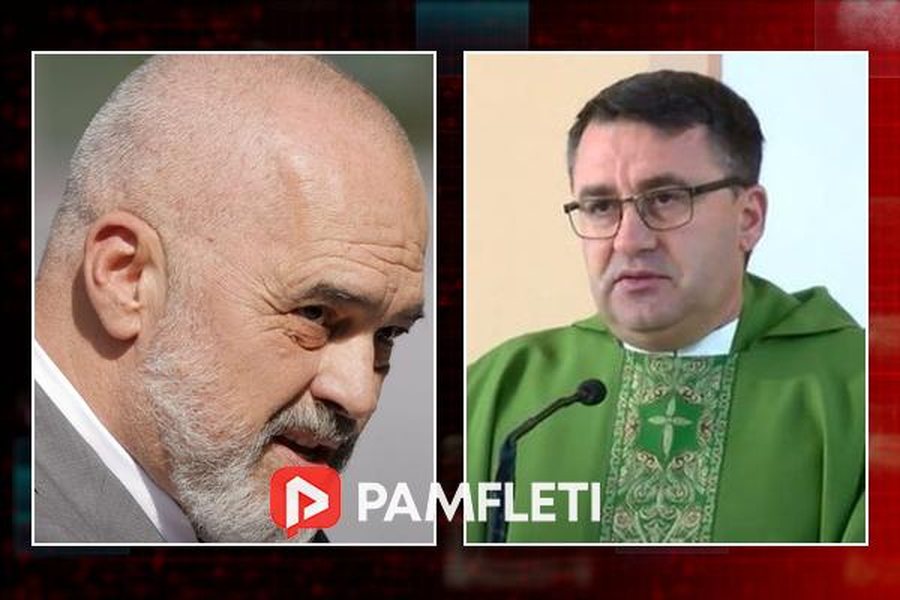
In the Republic of selective silence, a single parish priest incited the fury of a Prime Minister who cannot tolerate voices outside his political script...
For more than a week since the demolitions in Theth began, Edi Rama has remained silent and has not spoken a word. Even though there have been positions and accusations, not only from the opposition or interested citizens, but also from commentators who have supported him the entire time.
Just yesterday, the prime minister jumped up and didn't miss a beat to mock the parish priest of the Catholic Church of Shkodra, Dom Vlash Palaj.
As always in these cases, Babloku doesn't know anything, they are sending the videos to his phone "spontaneously".
Rama, after pejoratively calling the parish priest "priest", angrily attacked his words, which were said at Sunday mass.
But why was the Prime Minister so furious with the man who serves in the parish of Shkodra, which also covers the village of Theth?
Because, the voices coming from outside politics alarm a completely different environment than the one that has been created all these years around Rama and the majority. These voices coming from society, as has been observed in human history, serve as a precursor to developments and massive reactions from the people.
All these years we have seen Edi Rama become a priest, imam, priest, father, and even a Jewish rabbi, appearing with all religions and numerous clergymen, to whom, even though they have a theology school, passages from the holy books are read.
What Dom Vlashi said on Sunday was pure liturgy, it was his lecture during the ordinary mass.
At that mass, the parish priest of Shkodra returned to the events of the demolition of buildings, strongly criticizing Edi Rama and his government.
That speech was a slap in the face of Babloku's swollen face, and it seems to have hurt him a lot.
Referring to the holy books, Dom Vlashi said that governments have a duty to convince people and not oppose them. To talk to people and not clash.
A clergyman is a man who serves the people, so he has the duty to speak and represent them. To express in an educated and eloquent manner, the opinion of the believer. The word of a clergyman may in some cases be inappropriate, wrong, or even misunderstood. But it still constitutes a qualified opinion and is part of the philharmonic of voices in a free society. Only in closed societies and dictatorships, religion speaks with the voice of the state, the clergy are part of the ruling ideology. The Pope in the Vatican clashes day after day with all the world's governments, and for years the Catholic Church has been in controversy with high-ranking politicians; from Trump to Giorgia Meloni. No one takes it for drama, since the Pope is there to preach.
Why doesn't Edi Rama get upset when some religious leaders, jokingly talking about things that have nothing to do with religion, touch the core of Albanianness by attacking Gjergj Kastriot or Mother Teresa, as I asked Dom Vlashi?
Because Edi Rama is terrified by the voices that come from outside the opposition he has painted. Because he knows that these voices are the vanguard of the movement that will mark his end./ Pamphlet


Lini një Përgjigje