


 Shkruar nga Fadil Lepaja
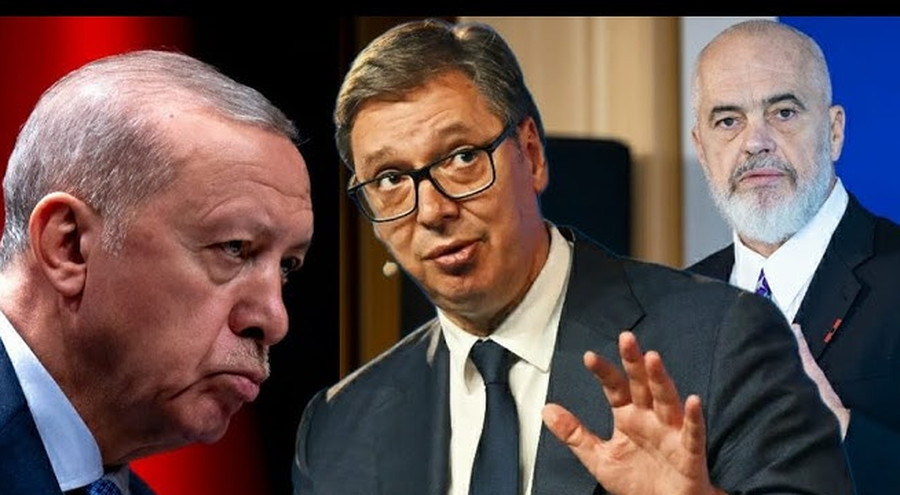
Edi Rama, politically allied with the authoritarian leaders of Turkey and Serbia, besides seeming to have lost his orientation, has also lost the media dominance with which he used to cover up his political confusion...
The protests in Serbia and Turkey are powerful examples of civic mobilization against authoritarian regimes, but they differ in motives, methods, and political context.
What is happening in Serbia, or Turkey, with the mass protests, with the shaking of the foundations of authoritarian, clerical-nationalist regimes?
Will this continue to spread in the region, will it become a model for all countries where the authoritarianism of individuals or oligarchs has stifled the free will of citizens?
Why is politics failing to address citizens' problems?
Has politics become the voice of interests and not of citizens?
While Serbia has been facing student protests for 5 months, with extraordinary civic solidarity; in Turkey the protests erupted last month and civic mobilization is more limited.
While in Serbia, the lack of politicians at the forefront of the protests has made the movement more massive and the clerical-nationalist regime's ability to use force smaller; in Turkey, this has not happened, as the protests are led by the party of Istanbul Mayor Imamoglu, turning the whole thing into a war between political rivals, between the democratic alternative and Erdogan's clerical-nationalist and neo-operando alternative.
In both countries, the protests have been fueled by deep dissatisfaction with corruption and authoritarianism.
In Serbia, protests began after a tragedy in Novi Sad, where a renovated train station collapsed, killing 16 people. The event exposed government corruption and mismanagement. In Turkey, the arrest of Istanbul Mayor Ekrem Imamoglu, a political rival of Erdogan, sparked massive protests despite the regime accusing him of corruption and terrorism. While the protests in Serbia are largely student-led and lack clear political leaders, in Turkey they are organized by the Republican People's Party (CHP), one of the oldest and most important parties in Turkey, founded in 1919 by Mustafa Kemal Atatürk, who was also the founder of the Republic of Turkey.
In Serbia, the motives include demands for transparency and accountability; while in Turkey, the protests are aimed at defending democracy and releasing Imamoglu. The methods in both countries include peaceful demonstrations, but in Turkey there have been clashes with police and the use of tear gas. Erdogan has banned rallies and arrested thousands of protesters, calling the movement “street terrorism.”
Vučić, on the other hand, has used propaganda and threatened protesters with legal measures, and has undertaken campaigns and covert activities to divide and compromise the student movement.
While the opposition in Serbia, especially the democratic one, does not have a clear political, principled offer, free from the interests of the oligarchs, and does not have any political weight, the situation in Turkey is different.
The protests in Turkey are being led by the Republican People's Party (Cumhuriyet Halk Partisi - CHP), a center-left party that upholds the values of democracy, secularism, and social justice, and which has played a leading role in Turkey's modernization and secularization process. It has a long history of promoting educational reforms, women's rights, and economic development, and is a more serious alternative to the neo-liberal ambitions of the regime in Turkey. In recent years, the party has gained widespread support in major cities such as Istanbul and Ankara, becoming a symbol of resistance to authoritarianism.
Surprisingly, Europe, or rather the EU, has not reacted loudly to these developments. The confusion in Europe is still great, after Trump's arrival in the White House. His influence on relations with Russia, and the war in Ukraine, seem to make the EU hesitant about opening new hotbeds of crises and especially its involvement in them. However, regarding the developments in Turkey, it has demanded respect for values, while regarding the developments in Serbia there has been relative silence.
Moscow and Washington, the ranking here is not accidental, even if they are involved in these developments, do not seem to intend to appear openly, letting their priorities be understood, but also encouraging with their "non-interference" in the new geopolitical alignments. How Albania is aligning itself in these global developments and their reflection in the region, is still completely unclear.
At a time when, under the strong influence of Turkey and other countries, for the Eid holiday, the large square in Tirana resembles more of an Islamic country than a European one, when the Churches are controlled by non-Albanian centers, and Albanian oligarchs, extremely influenced by often competing or opposing interests, have not gone further than legitimizing foreign geopolitical interests in the country, committing themselves to a balance and harmony between them and a benefit from each of them.
How possible this is in a country that aims to be open and secure, in a region with turbulence and strong confrontation of interests remains to be seen. In the past, different ideologies, especially religious ones, were neutralized by national renaissance, or the liberation war, while now Albanian nationalism, and even patriotism, do not seem to be dominant anywhere where Albanians are in the majority.
Edi Rama, politically allied with the authoritarian leaders of Turkey and Serbia, not only seems to have lost his orientation, but has also lost the media dominance with which he used to cover up his political confusion.
Will anti-corruption and anti-authoritarian protests also happen in Edi? It is difficult to say when the opposition is equally compromised regarding these values promoted by students in Serbia, who are successfully resisting getting involved in politics or accepting the leadership of political parties. Is this the strength or weakness of this student movement? Is it a revolution or a reform of politics? Let's see!/ Pamphlet


Lini një Përgjigje