


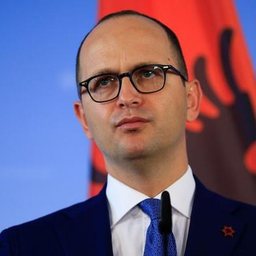
 Shkruar nga Ditmir Bushati
Regardless of whether the plan put forward by President Trump is implemented, the effects of the two-year war will be felt for a long time for several reasons.
Two years ago, Hamas launched a terrorist attack on Israel, which responded with an unprecedented military campaign. The death toll is dramatic, the material damage is immense. The resurgence of the conflict has fundamentally changed not only Israel and Palestine, but also the dynamics and balance of power in the Middle East.
President Donald Trump has presented a road map to break out of the deadly cycle. The peace plan offers compromises for both sides. Hamas must hand over all Israeli hostages, disarm, and give up governance. Arab countries will shoulder the burden of security and reconstruction in coordination with Israel. Israel has given up on annexing the West Bank and displacing Palestinians from Gaza. Gaza and the West Bank are recognized as part of the same political entity. Although it cannot be considered a done deal, the creation of a Palestinian state and the prospect of Israeli-Palestinian coexistence appear on the horizon.
Regardless of whether President Trump’s plan is implemented, the effects of the two-year war will be felt for a long time for several reasons.
First, Israeli politics underwent a dramatic shift, shifting to the far right and becoming more hostile to a two-state solution. This is reflected in the expansion of control over Palestinian territories and the growth of settlements.
Prime Minister Benjamin Netanyahu survived the trials and popular protests because attention shifted to the war. However, he continues to be blamed for failures on the security front. The governing coalition depends on far-right parties, which oppose President Trump’s peace plan. For Netanyahu, the release of Israeli hostages from Hamas is important, since the full implementation of the peace plan and the prospect of a Palestinian state on the horizon are beyond the imagination of the coalition he leads. Regardless of how events unfold, Netanyahu has cemented his legacy by defeating Hamas, Hezbollah, and Iran.
Second, the political landscape in Palestine has changed radically. Hamas seems willing to hand over governance to a third party, but it rejects the proposal for an international trusteeship to oversee Gaza. Accepting external control runs counter to what Hamas claims to represent: “the liberation of Palestine.” Taking the reins from the Palestinian Authority is an option, with all the weaknesses it presents.
Third, as peace talks progress, neither Netanyahu nor the various political actors in Palestine have clarity on the future governance of Gaza. The West Bank faces its own crisis, as a result of settlement expansion. 5 of the 21 ministers in the Israeli government are West Bank settlers, despite the fact that settlers make up only 5% of Israel’s population. Meanwhile, the Palestinian Authority is on the verge of collapse, unable to administer the West Bank.
Fourth, the military superiority demonstrated by Israel has led to a reorganization of forces in the region. Iran’s influence has been reduced as a result of Israel’s devastating strikes with direct consequences for Hamas in Gaza, Hezbollah in Lebanon, and the Houthi rebels in Yemen.
But there are side effects. After the Israeli attacks on Qatar, Saudi Arabia signed a mutual defense pact with Pakistan, which possesses nuclear weapons. Egypt and Turkey are conducting joint naval exercises in the Eastern Mediterranean. These are clear warnings to Israel.
Finally, it must be acknowledged that the core of the Palestinian people’s issue, or their right to self-determination, was marginalized by the Abraham Accords, brokered by President Trump in 2020, which aimed to normalize relations between Israel and the United Arab Emirates. The humanitarian catastrophe in Gaza and Israel’s attacks on Qatar call into question the Abraham Accords. The subsequent guarantees offered by President Trump to Qatar reflect his determination not only to preserve one of the greatest foreign policy achievements of his first term in the Middle East, but also to consolidate them through the process of normalizing relations between Saudi Arabia and Israel.
Clearly, President Trump’s plan offers a unique opportunity to end one of the greatest conflicts the world has known. However, the choreography of implementing the plan and building trust between the actors involved remains essential to ensuring a lasting peace in the Middle East.





Lini një Përgjigje