


 Shkruar nga Pamfleti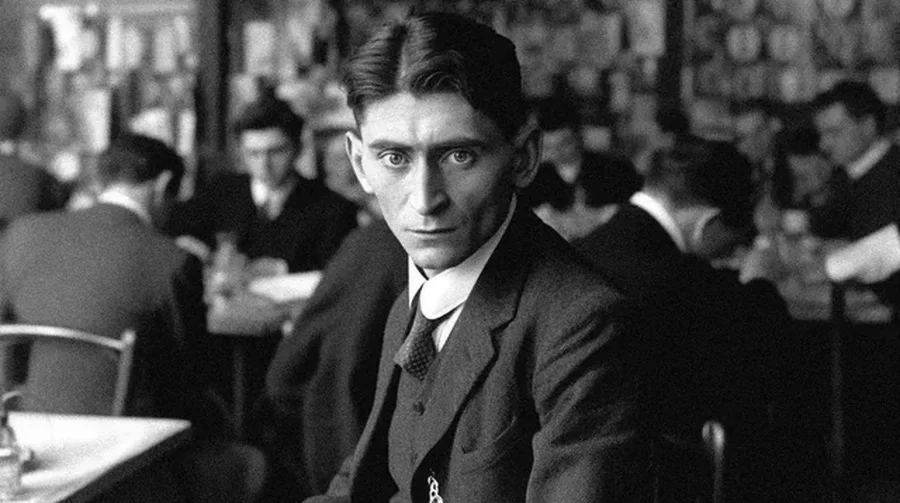
Kafka was born on July 3, 1883, 125 years ago, in Prague, which at that time was part of the Austro-Hungarian Empire, today the Czech capital. Today, Prague is proud of the great writer, but the city also benefits from the name Kafka.
Business with Kafka has always worked
Tourist area in Prague. It leads from the ring through the narrow alleys of the old part of the city. Souvenir shops line up next to each other. Among the goods, Kafka's name stands out. "We have t-shirts with Kafka's name, or mugs with his picture," says a souvenir seller. Business with Kafka has always worked, she says. But even in the Kafka museum, in addition to information about the life and work of the famous writer, all kinds of souvenirs are offered in memory of his figure. From reading markers with Kafka's portrait to a computer mouse with Kafka's signature.
Kafka was born into a Jewish family
On July 3, 1883, 125 years ago, Kafka was born into a Jewish family in Prague. After a difficult childhood and youth with a father who seemed to him often unjust and all-powerful, come studies in the branch of law and a job in an insurance company. This was just a profession to earn a living. Because what Kafka wanted to do was simply write. "When Gregor Samsa awoke one morning after restless dreams, he found himself in bed transformed into a terrifying insect."
Thus begins Kafka's story "Metamorphosis", in which Gregor Samsa continues his existence as an insect, increasingly worthless until he dies. A relief for Samsa's family. Kafka's stories seem dark, mystical, unreal.
Prague experienced the absurdity he describes during the years of communism
Kafka's literature is characterized by the great gap between the individual and society, explains Tvrdik. It's always about confronting a lonely man with a family environment, with an anonymous society, with a ruthless technocrat bureaucracy. Even the employee at the ticket office of Kafka's museum trembles when she remembers his literature: "I myself have read his stories and always put them aside with a feeling of horror. We have not faced this yet. I have the impression that the absurdity he describes, we experienced it in the years of communism."
But how is it possible that Kafka is so loved by tourists?
"In the 1990s after the fall of the Wall. Prague was rediscovered. a city, still in obscurity, shrouded in association with Kafka and his work. Apparently this awakened the interest to find out what it was like to live in this city distant. This is perhaps an explanation for the wave of tourists after the 90s. And the phenomenon of "likeable skull" is a discovery of modern, postmodern times.
Kafka died at the age of 40 from tuberculosis of the lungs in Kierling, Austria. But he will never die with the work he left behind, say his scholars and admirers./ DW






Lini një Përgjigje