


 Shkruar nga Pamfleti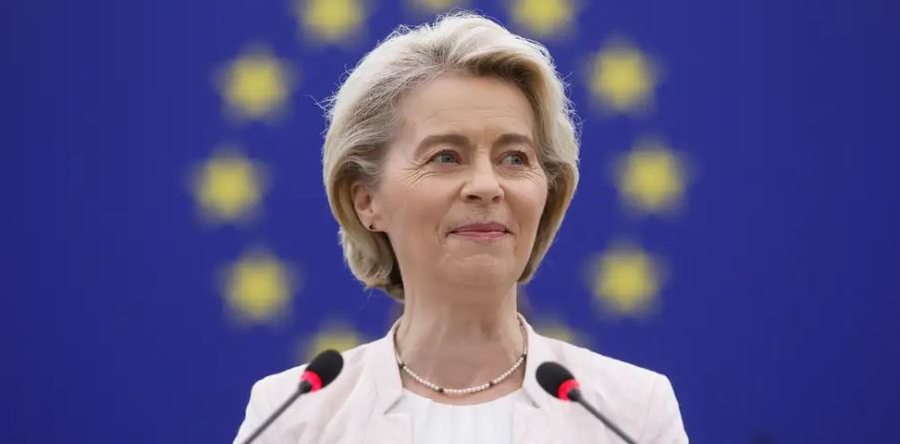
The President of the EU Commission, Ursula von der Leyen, visits the countries of the Western Balkans. The goal is EU enlargement and financial support for the region.
The three-day trip of the president of the EU Commission, Ursula von der Leyen, until the weekend, includes meetings with the presidents and prime ministers of Albania, North Macedonia, Bosnia-Herzegovina, Serbia, Kosovo and Montenegro.
According to the EU Commission, this is a trip during which, as in previous years, the focus will be mainly on the EU enlargement process and the so-called development plan for the Western Balkans.
The visit takes place before the publication of the progress reports for the aspirant countries to the EU during the enlargement process. The assessment of progress on the candidate countries' reforms will be published next week, according to the EU Commission's current plan.
The visit of the head of the EU Commission also offers the opportunity to express expectations and messages at the highest political level, Vessela Tcherneva from the European Council on Foreign Relations tells DW. Likewise, for the head of the von der Leyen commission, it is also an opportunity to listen, because there is skepticism in the region, that the accession process is proceeding properly and that the EU's offer is really reliable.
Prolonged talks and no sign of their ending
Six countries of the Western Balkans have been promised EU membership for 20 years. Today, these countries have advanced at different rates. Since last week, the EU and Albania have started talks on the substantive part of the membership. It will be continuously negotiated for 35 chapters, which define the justice sectors, in which Albania should adapt its system and EU legislation.
Montenegro and Serbia have started these talks since a decade ago. North Macedonia is still waiting for the opening of negotiations, while Bosnia and Herzegovina is missing some steps, which precede substantive talks. Until now, Kosovo is considered only as a "possible candidate for membership" - also because of the conflict with Serbia. Kosovo, which declared independence from Serbia in 2008, has not yet been recognized by five EU countries: Spain, Greece, Cyprus, Romania and Slovakia. As long as the relations between Kosovo and Serbia are not normalized, EU membership is impossible, because with the membership process, unanimous decisions must be taken regularly by all 27 EU member states.
Development plan for the Western Balkans
However, the EU supports the region. The so-called development plan is a six billion euro package for the period 2024 to 2027, consisting of four billion euro loans and two billion euro grants. The goal is for the countries of the Western Balkans to get closer to the European internal market before joining the EU. The EU Commission promises that the economy of the host countries will be strengthened and their economies will possibly double in the next decade. To receive the money, countries must present their reform agendas, which implement the recommendations of the EU Commission.
Milena Mihajlovic, co-founder of the Thinktank European Policy Center (CEP) in Belgrade, in a conversation with DW, evaluates the development pact as a first concrete example for the initiative of the gradual integration compiled in 2022. Other examples, in her opinion, will follow, such as in the sector of institutional cooperation. Mihajlovic expects the President of the Commission to insist on the resolution of regional conflicts such as the Belgrade-Pristina dialogue mediated by the EU. Progress in this direction is a basic condition for the circulation of EU money.
New geostrategic priorities
Precisely after the beginning of the Russian offensive war in Ukraine, in Brussels it is considered important in the geostrategic aspect, that the Western Balkans are admitted to the EU. EU Commission President Ursula von der Leyen said in September during a speech in Bled, Slovenia: "At a time of geostrategic rivalries a larger European Union gives us a stronger voice in the world."
However: This does not give these countries a "free travel ticket", emphasizes the expert Tcherneva, even if many leaders in the region can now remember that, due to the geopolitical situation, they no longer have to try very hard. This is expected to be made clear during von der Leyen's visits to the region.
The states of the Western Balkans must now show that they can make progress, emphasizes analyst Mihajlovic. And they must respond to positive signals from the EU: the EU, for its part, must try to avoid the skepticism of these countries, that despite the guarantees and programs, it is not really serious about the prospect of membership./DW




Lini një Përgjigje