


 Shkruar nga Pamfleti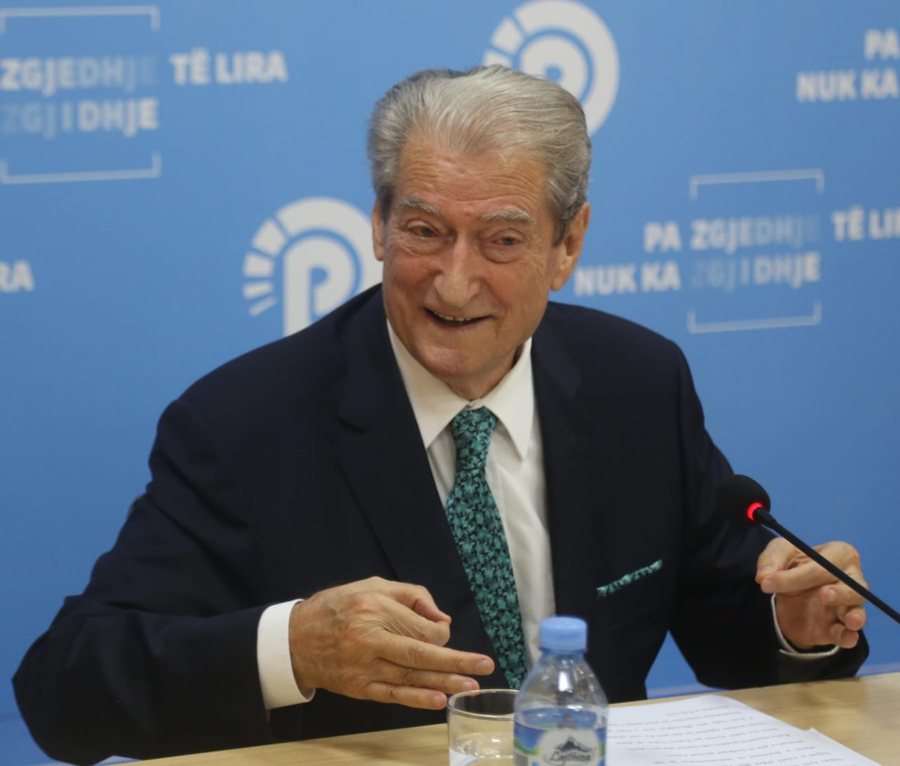
Former Prime Minister Sali Berisha did not appear on Tuesday at the Special Court of First Instance, where he was summoned to be questioned as a person under investigation for the privatization of the former "Partizani" sports complex.
He chose to make his defense in a media conference, where he described the investigative process as instigated by his political opponent, Prime Minister Edi Rama. Since Sunday, when the court announced the banning measure "forced appearance" and the ban on movement abroad, Berisha is treating the issue as a political battle of the opposition.
Berisha, who has dominated the country's political scene since 1991, is facing allegations of passive corruption for favoring his son-in-law, Jamambër Malltezi. Malltezi is also accused of corruption and money laundering in connection with the construction of a building complex in Tirana.
The 79-year-old MP leads the 'de facto' opposition, after an internal political battle to regain control of the Democratic Party, in which he was the founder and first chairman in 1991.
Two years ago, Berisha faced what appeared to be the end of his career, after he was declared "non grata" by the United States of America and expelled from the DP parliamentary group by his successor, Lulzim Basha. But after a political campaign within the party, Berisha managed to keep under control most of the membership and the parliamentary group.
According to political observers, the latest SPAK accusations constitute one of the biggest challenges for Berisha's political career, which will leave a mark not only on him, but also on the opposition.
Robert Rakipllari, director of news television News 24, told BIRN that Berisha is the main opposition factor and the SPAK investigation "will further damage the opposition divided into several factions". But he added that the investigation should not be prejudiced, but the process and the facts that will be presented should be seen.
"The SPAK investigation has political effects for the opposition and democracy, so far we have no evidence that the investigation has a political dimension," Rakipllari said.
"There are different interpretations regarding the measures against Berisha, such as the obligation to appear and the prohibition to go abroad, which need to be clarified further, but it seems that there is an excess of the MP's constitutional rights in this case," he added. .
Although Berisha has faced critical moments throughout his three decades in politics, analysts believe this is the biggest challenge of his long career after being declared non grata by the United States of America.
Challenge, which, according to Rakipllari, "he has not yet found the right approach to face".
Even for Luljeta Progni, journalist and researcher of political transition, the challenge with justice has come at the last stage of his political career, where, according to her, the time and recovery factor is no longer as possible as it was after 1997.
According to Progni, the accusations leveled against the former prime minister and his family have caused great damage to him as a politician and to the membership of the Democratic Party, which have not left him in the mud even in the most critical moments of his political history.
"Think for a moment of a former owner, who was never able to get the properties inherited from his ancestors, when he saw the list of Berisha's family assets, which are said to originate from the properties of his grandparents. Will he support the leader he has trusted in 33 years?!" she said.
Progni thinks, however, that there is a way to minimize the costs for the opposition.
"Berisha could fight the battle for "Nongrata" alone or the current battle in the face of accusations of corruption and favoritism of his family members and not take the Democratic Party with him to an inglorious end," she concluded. / BIRN



Lini një Përgjigje