


 Shkruar nga Pamfleti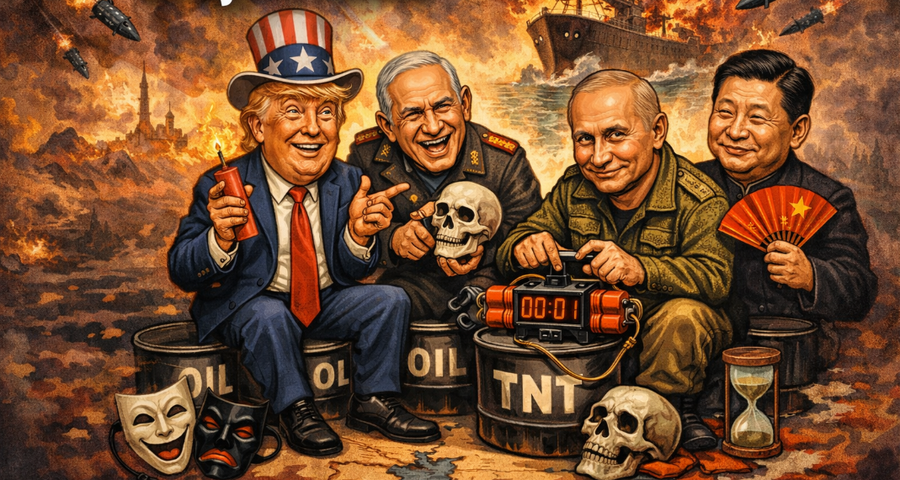
From Trump to Netanyahu, from Putin to Xi, the crisis in the Persian Gulf is increasingly resembling a dark farce where oil, missiles and the egos of leaders have replaced diplomacy...
The article published by Türkiye Today on March 20, 2026 is not a classic war analysis, but a black satire on how global politics is leading the Middle East towards a new explosion. A. Craig Copetas constructs the text as a theatrical performance, where the great powers do not behave as architects of the world order, but as lost actors in a scenario they no longer control.
At the center of this scene are Donald Trump, Benjamin Netanyahu, Vladimir Putin, and Xi Jinping, described as the protagonists of a "comedy of terror," where misunderstandings, threats, and political improvisation have become part of a game with real consequences.
The author symbolically places the entire drama on Kharg Island, the strategic Iranian oil terminal, turning it into the clearest metaphor for the crisis.
The message is brutal: when war approaches the region's energy arteries, it is not just Iran or Israel that is threatened, but the entire global balance.
Kharg is not presented simply as a point on the map, but as the node where a chain of reactions with military, economic, and geopolitical consequences could erupt.
And this is where the article hits home: the world is anxiously watching a scene where everything seems absurd, but nothing is funny.
Copetas treats this crisis like a Shakespearean farce, but beneath the biting humor lies a grave diagnosis for the international order.
According to this view, diplomacy is no longer producing clarity, but noise. Official statements, threats from leaders, military moves, and bombings are building an atmosphere where no one is in control.
In this picture, Trump emerges as the figure of constant improvisation, Netanyahu as the man pushing the scene towards escalation, Putin as the cold player of the crisis, while Xi as the observer who speaks little but weighs a lot. This is why the text works: it does not pretend to provide a cold chronicle, but to show how dangerous the international system becomes when it is guided by ego, fog and momentary calculation.
The strongest point of the writing is that it sees the world public no longer as a spectator, but as part of the stage. When missiles fly over the Middle East and when oil becomes a weapon of pressure, no one is left out of this drama. Markets are shaken, security is shaken, alliances are nervous and uncertainty crosses the borders of the region. So what on paper looks like a clash between a few states, in practice is a crisis that could hit everyone.
And here Copeta's satire becomes stronger than many formal analyses: because it strips power of its costume of seriousness and shows it as it is, a mechanism filled with ambition, fear, and confusion.
In the end, the article leaves behind a clear sense of unease. There is no clean solution, no happy ending, no guarantee that rationality will return in time. The only question that remains is whether the world is entering a phase where wars no longer start from strategy, but from absurdity. And this is perhaps the greatest fear: that the international scene will no longer be ruled by diplomacy, but by a dark theater where everyone plays hard, but no one knows how to get off the stage./ Pamphlet


Lini një Përgjigje