


 Shkruar nga Francisco Garcia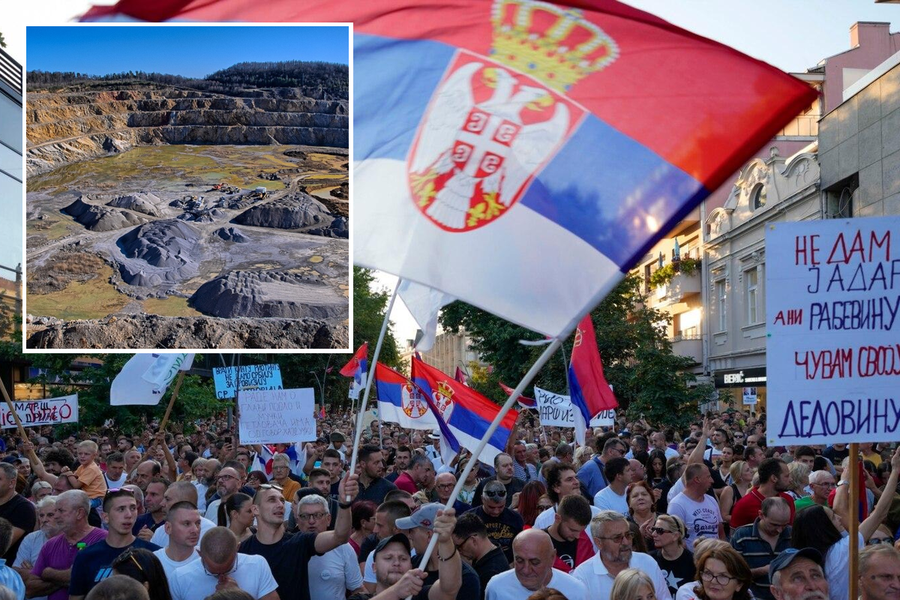
“We don't want the mine. We don't want this kind of colonialist 'development'. It's humiliating to talk like that. Just because we're villagers, it doesn't mean we're stupid.”
In early May 2019, Momčilo Alimpic was doing his usual chores on his family's land in Radevina, a village in the Jadar hills in northwestern Serbia. That afternoon, he was startled by an unusual noise nearby.
He followed the noise, and at one point he saw a group of men walking onto his land. They met him and told him they were researchers working for the Anglo-Australian mining giant Rio Tinto. They also added that his family's land was on the edge of an area very rich in lithium, the much-coveted metal found in phone and laptop batteries, and more importantly, key to the global transition to clean energy.
“Until then, we had no idea about this. The company had not contacted us or anyone else in the area,” Alimpic’s daughter, Marija, who works as a language teacher, told me when I met her and her father for coffee in the fall of 2024 at a hotel in Loznica, the closest town to their quiet rural community.
Over the following weeks and months, as researchers asked more and more questions, the truth gradually emerged. Rio Tinto had been quietly studying the possibility of opening a mine, with an investment of $2.4 billion, which, with its projected completion in 2027, would be the largest in Europe.
But since the early days when the truth was revealed, the opposition of the local residents has been fierce and well-coordinated, with clever media campaigns and mass protests becoming an increasingly common feature. “We told them we don’t want this mine in our village,” Marija declared. Her family’s land has been selected as the designated site for dumping waste produced by the project. The chemical waste and pollution would destroy their arable land. “When we told them we were going to stop the Rio Tinto project, people thought we were crazy. But we continued to resist,” she added. In early 2004, a group of geologists working in Jadar discovered a new mineral with the chemical formula sodium-lithium-borosilicate-hydroxide, which was soon christened Jadarite.
The news was quickly forgotten, but not by Rio Tinto. The newly discovered mineral contained lithium and boron, another highly valuable raw material used in all kinds of industrial production around the globe. The process of extracting them requires a lot of energy, including large amounts of sulfuric acid.
But the problem is that the proposed area for the construction of the mine and several square kilometers that will serve as a waste disposal site, lies on some of Serbia's most arable land, as well as near one of its main rivers that supplies the country with water.
Experts have raised the alarm about the disaster that would be caused: crops would be severely affected and rivers would leak large amounts of toxic industrial chemicals. A 2024 study - publicly criticized by Rio Tinto - by a group of Serbian scientists noted that exploratory drilling alone had "significantly increased downstream concentrations of boron, arsenic and lithium in nearby rivers, compared to their upstream counterparts".
Europe desperately needs lithium. The metal was once best known for its uses in psychiatry, mainly as a treatment for bipolar disorder. But in the past decade, it has been hailed as a crucial part of the global transition away from fossil fuels to a greener, more sustainable future.
The EU predicts a 60-fold increase in lithium demand by 2050. But beyond Europe, Serbian lithium is an issue of global geopolitical importance. In 2022, the Serbian government revoked Rio Tinto's mining permits after months of mass protests erupted across the country.
But in July 2024, the permit was reinstated after a court ruling in Belgrade, accompanied by a summit attended by German Chancellor Olaf Scholz and European Commission Vice-President for the Green Deal, Maros Sefcovic.
Serbian President Aleksandar Vučić pledged full transparency and promised to “personally fight for the environment and the lives of citizens in Jadar.” The reaction was immediate. Tens of thousands of people took to the streets of Belgrade, including artists, students, and farmers.
“Everything is interconnected. Every person who participates in these protests is also against the regime. It is the channeling of two things at the same time. They are protesting against the regime in general, but also the mines in particular,” said Stevan Filipović, a filmmaker and vocal opponent of Vučić.
Western media often portrays Serbia under Vučić as a vassal state of Russia, but the reality is more complex. Vučić - a right-wing nationalist and a veteran of politics, having held high office since the time of Slobodan Milošević in the 1990s - has dominated Serbian politics since 2012.
Corruption is widespread, and the local media is largely biased towards it. The deep ties between the government and organized crime are well-established. Hungarian politician and sociologist Bálint Magyar has labeled Serbia a “post-communist mafia state,” along with his native country and several others in the region.
Serbia's opening up to foreign investment - Chinese, Russian, Western - is being accompanied by the disappearance of all protections and a collapsing middle class. If international capital increasingly sees Serbia as a land of opportunity, ordinary citizens have yet to feel the benefits.
But who would benefit most from Rio Tinto's Serbian project? Rio Tinto, of course. The German car industry would also be guaranteed. Meanwhile, there would be obvious political benefits for the EU, which could see the Jadar mine as tangible evidence of its commitment to ending its existing dependence on lithium, which it currently buys from China.
The project would also benefit elements of Serbia's political elite. What is not clear is how much the project would benefit the country's population at large. "We don't want the mine. We don't want this kind of colonialist 'development'. It's humiliating to be talked about like that. Just because we're peasants doesn't mean we're stupid," Maria says./ Adapted from the New Statesman pamphlet




Lini një Përgjigje