


 Shkruar nga Marton Dunai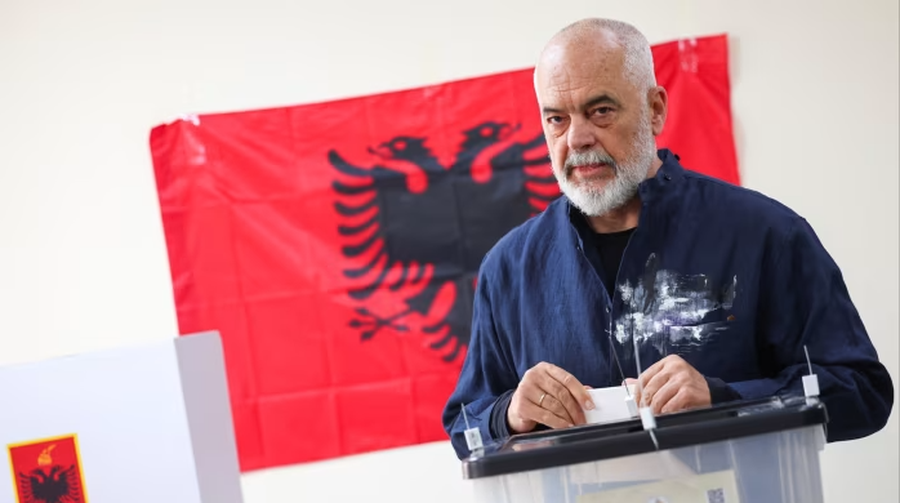
But some observers warned that as Rama, a former basketball player and painter turned politician, enters his fourth term in office — the first in the country's post-communist history — there was a risk that he would tighten his grip on power.
Albania's Prime Minister Edi Rama appeared to be on track to win a fourth consecutive term in parliamentary elections, after campaigning for his country's EU membership by 2030.
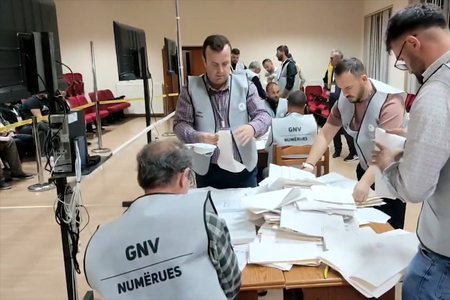
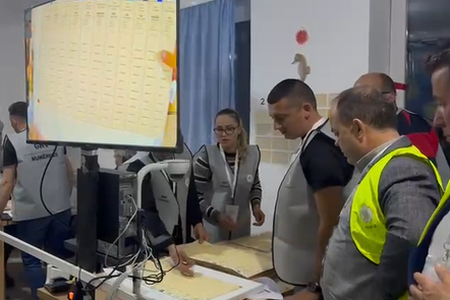
Early counts and polls showed Rama's Socialist Party would retain a majority in parliament, ahead of the right-wing Democratic Party of former leader Sali Berisha, who had attempted a political comeback modeled after Donald Trump's Maga movement. Final results are expected on Tuesday.
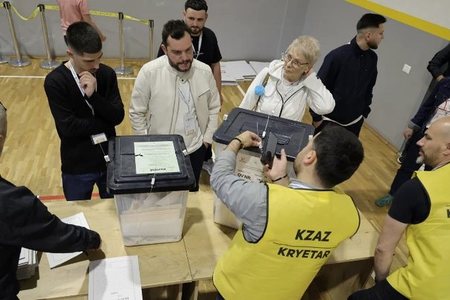
The Socialists are expected to secure around 52 percent of the vote, according to a preliminary poll, with the Democratic Party taking 38 percent and a handful of smaller parties splitting the rest. Turnout was 42.2 percent, even though the diaspora was allowed to vote for the first time.
Rama's parliamentary majority, even if it falls short of the two-thirds majority needed to pass constitutional changes, will be essential to push through reforms required to join the EU. The country joined NATO in 2009 but has struggled to accelerate the pace of its membership in the bloc.
"Nothing and no one will be able to stop the European destiny of Albanians," Rama said at the weekend, noting that his country had opened accession talks with the European Commission in 24 of the bloc's 35 negotiating areas.
But some observers warned that as Rama, a former basketball player and painter turned politician, enters his fourth term in office — the first in the country's post-communist history — there was a risk that he would tighten his grip on power.
“We have an old sheriff with even more power, which is a kind of paradox when you need to strengthen independent institutions,” said Lutfi Dervishi, an independent analyst and former head of Transparency International in Albania.
“Albania must try to keep political pluralism alive,” he said, noting that Rama first came to power in 2013 with a coalition. “With each mandate, he becomes stronger... We risk having a cosmetic pluralism,” he added.
As in several other countries in the Western Balkans, one issue hindering faster EU accession has been the inadequacy of anti-corruption efforts. Rama, at the forefront of politics for two decades, has tried to curb corruption in his administration and reduce the influence of powerful criminal gangs.
Rama’s only challenger in this election was hardly inspiring, even though he campaigned on “Make Albania Great Again”: the 80-year-old Berisha, a former president who has been banned from entering the US and UK on corruption charges. He denies any wrongdoing.
“I am disappointed with the results,” said consultant Edval Zoto of Integr Partners in Tirana. He adds, “I expected more support for the new initiatives, hoping they would offer a more serious opposition to socialist hegemony.”
Albania has struggled to curb emigration, driven by poverty and persistent corruption. The exodus has presented challenges for UK authorities, who are trying to curb illegal Channel crossings.
But Rama has remained a staunch ally of the US and the EU, fostering a close relationship with Italian Prime Minister Giorgia Meloni after offering to house migrants in Italian detention centres on Albanian soil. He has also shown a willingness to do business with senior Trump figures, including Jared Kushner, the US president's son-in-law, who plans to develop large swaths of the Albanian coast.
“He is interested in making powerful friends in the EU and beyond,” Dervishi said, adding, “unlike other Balkan leaders, Rama has another luxury: no one questions the country’s western direction.” /Pamphlet adapted from FT/



Lini një Përgjigje