


 Shkruar nga Pamfleti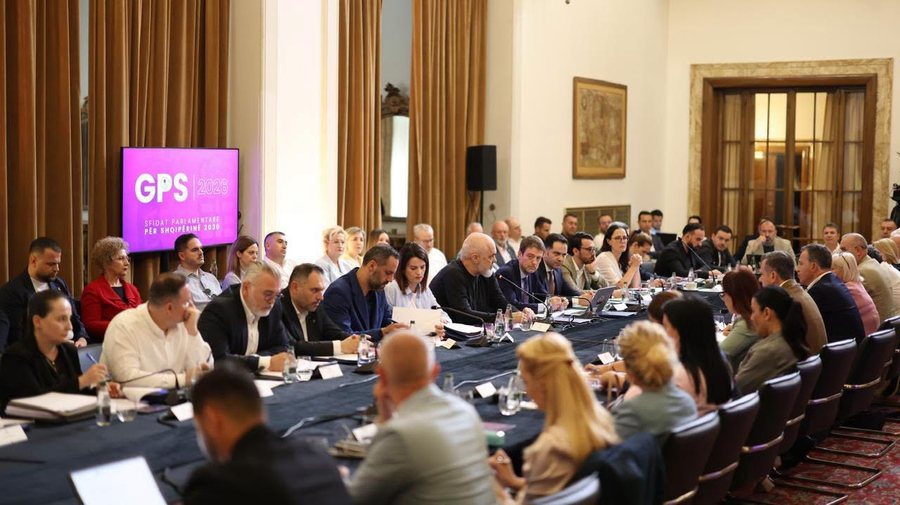
After Rama's order for more activity on social networks, the socialists move from attacking protesters to attacking the American media
When Edi Rama gathered MPs and ministers at the Brigades Palace, among the main concerns was not only the protest that had been taking place in front of the Prime Minister's Office for 24 days, but also the echo it was receiving on social networks.
The Prime Minister openly complained that the Socialist Party was bad with the "algorithm", while demanding more public engagement from MPs, ministers and party structures to counter the protest.
After that came the coordinated attack on Dritan Goxhaj. Today it seems that the second phase has begun. This time CNN has ended up being targeted.
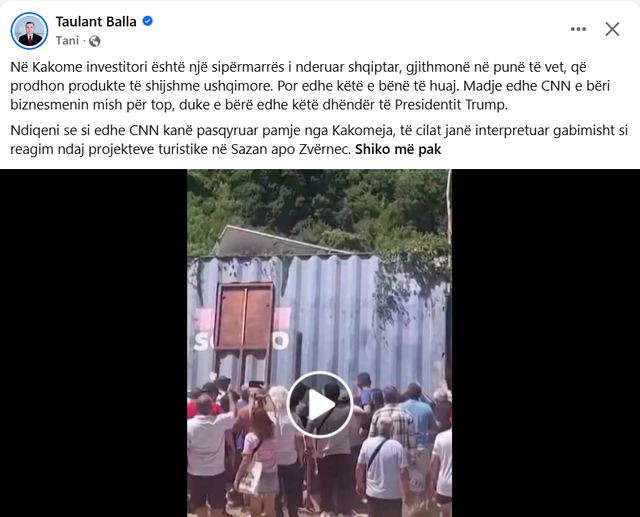
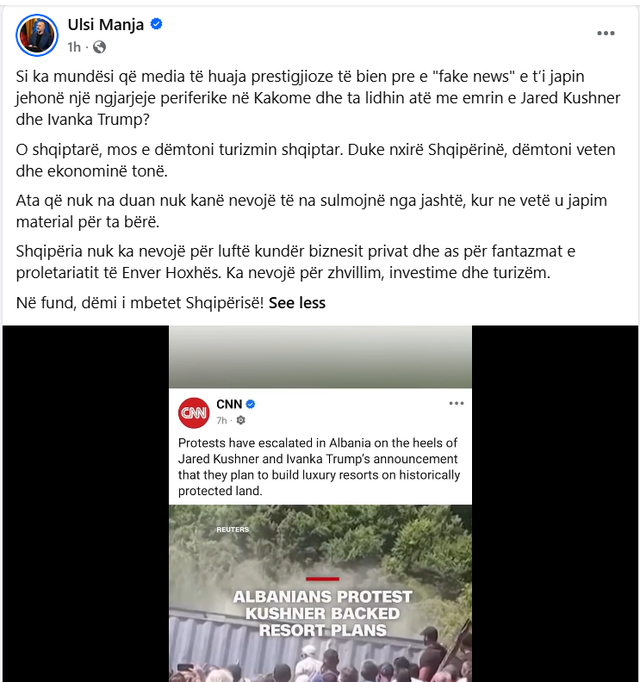
The American media giant published footage from the protest in Kakome, where citizens demolished a gate and a perimeter wall blocking access to the beach. In its reporting, CNN linked the event to protests against Jared Kushner's investments in Albania.
In fact, Kakom's protest had nothing to do with Zvërnec or Kushner's investments, and on this point CNN seems to have been wrong.
But what is striking is the immediate and almost uniform reaction of some socialist exponents, who have not only corrected the inaccuracy, but have gone on the offensive against the protesters and against those who, according to them, are damaging Albania's image abroad.

One of the strongest reactions came from MP Ulsi Manja: " How is it possible that prestigious foreign media outlets fall prey to 'fake news' and echo a peripheral event in Kakome and link it to the names of Jared Kushner and Ivanka Trump? Oh Albanians, do not harm Albanian tourism. By tarnishing Albania, you harm yourselves and our economy."
Those who do not love us do not need to attack us from abroad, when we ourselves give them the material to do so. Albania does not need a war against private business nor the ghosts of Enver Hoxha's proletariat. It needs development, investment and tourism. In the end, the damage remains with Albania! ”.
Similar reactions have come from other members of the majority, creating the impression that after Rama's alarm about the "algorithm", the Socialist Party has moved on to an organized campaign on social networks.
If yesterday the target was Dritan Goxhaj, today it seems that the target is CNN. This shows that the protest is producing a political effect and that the majority's concern is no longer related only to the people who are taking to the streets, but also to the fact that their echo is crossing the borders of Albania.
Therefore, the "algorithm war", initially declared within the walls of the Brigades Palace, seems to be expanding every day: from protesters, to analysts, to Dritan Goxhaj and now to one of the largest media outlets in the world. / Pamphlet


The Prime Minister, Private Income, and the Question of Public Trust A prime minister is entitled to have a life beyond politics. He may have written books, produced art, sold paintings, received royalties, or earned income from work done before entering office. None of that is, in itself, illegitimate. But when the person in question holds the highest executive office in the country, large private income is no longer a purely private matter. It becomes a matter of public trust. According to the 2025 declaration of private interests, Prime Minister Edi Rama reported around 3.4 million Albanian lek (approximately €32,000 or $35,000) in salary from his official position, and more than 10.9 million lek in other income (approximately €103,000 or $112,000). In simple terms, his other income was more than three times higher than the salary paid to him by the state. That is where the public question begins. The issue is not merely whether the money is legal. The deeper issue is whether such income creates a vulnerability. Who paid it? For what? Under what conditions? At what price? And could any of those people, companies, or networks have an interest in government decisions? If a private citizen sells a painting, it is a private transaction. If a prime minister sells a painting, it is no longer that simple. The buyer may not be buying only the artwork. He may also be buying proximity, access, gratitude, recognition, or the appearance of influence. Even if none of that happens, the possibility itself is enough to raise concern. A senior public official must not only avoid being captured by private interests. He must also avoid appearing capturable. He must not only stay outside a formal conflict of interest. He must also remove the circumstances that could reasonably create suspicion in the eyes of the public. That is why declaring the amount is not enough. Citizens do not need only to know how much money was received. They have a right to know where it came from, who paid it, how the value was determined, whether the transaction was transparent, and whether the buyer has any connection to public contracts, construction permits, strategic investments, public land, tax decisions, or government policy. This is not an accusation. It is a demand for clarity. In a country where the government decides on land, construction, public assets, taxes, concessions, permits, and strategic projects, the private income of the prime minister cannot be treated as a minor personal detail. It goes to the heart of democratic accountability. A prime minister may say that the money came from art, books, or royalties. Very well. Then the answer should be complete. Who bought the works? At what price? Through what channel? Was the valuation independent? Were the buyers people with no interest in government decisions? Public trust is not protected by saying, “trust me.” It is protected by transparency. The salary of a prime minister is paid by the citizens. When his largest income comes from elsewhere, citizens are entitled to ask a simple and legitimate question: who has the greater financial weight in his life — the public he serves, or the private sources that pay him far more than the state? In a democracy, power must not only declare its wealth. It must prove that it is not dependent on it.