


 Shkruar nga Pamfleti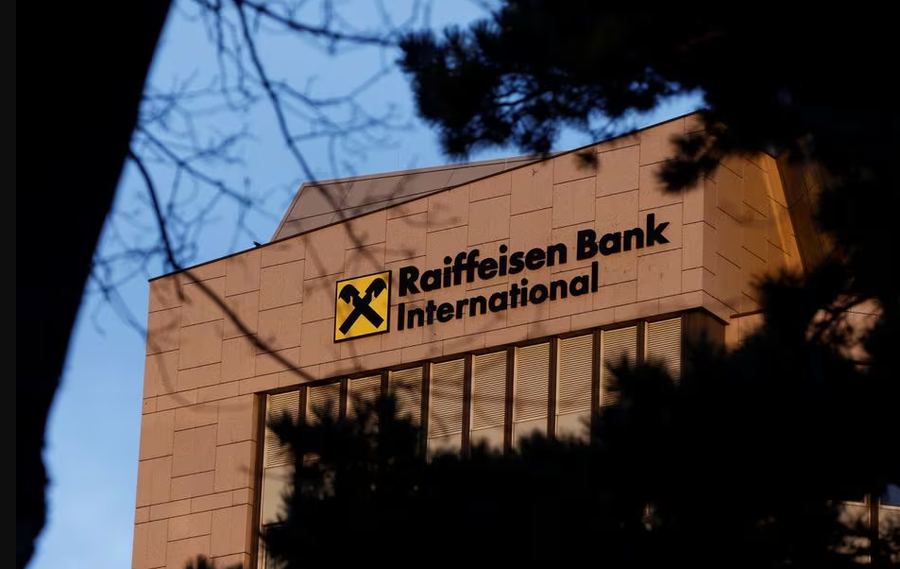
'Raiffeisen Bank', the unique interlocutor of Kremlin transactions, has financed the economic conglomerate of waste, supported by the corrupt government of Tirana...
'Financial Times', the prestigious British newspaper, published a sensational article in which it concluded that the Austrian bank Raiffeisen Bank is the only Western institution in Moscow that did not leave after the war in Ukraine.
At this writing, there are strong suspicious facts that this bank is doing war transactions for the Kremlin, to supply from businesses outside of Russia, the killing machine of Ukraine.
The Financial Times article is strong and with disarming references.
He says that Raiffeisen is not only the unique interlocutor of the Kremlin's transactions, but it does so by violating all the decisions of the European Union to sanction and prohibit war financing.
Meanwhile, in Albania, this bank that took almost free the most profitable banking institution in Albania, the Savings Bank, after this transaction has never been a supporter of business, a friend of the community and a helper of new initiatives. On the contrary, today this bank has given loans to operators of incinerators in Albania, taking as collateral the waste plants in the country. So he supported a business with a loan that was financed from the state budget. And here arises the suspicion of a connection that is not so clear and transparent; of money that goes in and out of this business. Where the actors in the field are not companies with a recognized track record in the relevant field, but phantoms in the full sense of the word.
Ghosts in registration, ghosts in ownership, ghosts in the distribution and investment of capital, and of course suspicious in the way they have been imposed on the public to keep a business that is considered corrupt.
Why did Raiffeisen finance an economic conglomerate that was not a mature urban waste processing industry?
Why Raiffeisen financed a business that was at least unknown, suspect. Referring to the 'Financial Times' article, financial influences from the connections the company has in Moscow are not excluded here.
Is this transaction of incinerators really excluded from the Russian relations of this banking institution?
The investigation of British prestige conceives Raiffeissen's stay in Moscow as a kind of shell, where all kinds of transactions circulate. And since we are talking about incinerators, their basis, that is, of the companies that are financial and economic actors of the operation, are shells. Where neither the beginning nor the end can be seen.
This doubt is a big stain not only for the economic system of funds coming from the state budget, but also for those coming from the banking sector.
Which today, is a black sheep, and any money that comes out of this window is considered at least as a suspicious fund, which brings it into investigation and discussion, let's say a stain on the entire financial environment of Albania. After the Financial Times, it is likely that a major investigation will be launched against this institution, where freezing and confiscation of funds are not excluded. From where the Albanian economy and in particular the waste business in Albania will dry up from cash sources. Because there are doubts and data that the rules are not respected.
It is not surprising that there is a connection with Moscow actors, who through shell financial formations communicate with such subjects who never reveal their identity, but who always do business with direct or indirect financing, which smells like money laundering.../ Pamphlet





Lini një Përgjigje