


 Shkruar nga Pamfleti
United States President Donald Trump announced that countries that do business with Iran will face a 25% tariff on trade they do with the United States.
This decision comes at a time when Iran is violently suppressing anti-government protests, in which thousands of people are suspected of being killed. But what does this mean for Kosovo, which imports some products from Iran?
Experts and business representatives in the country expect the effects to be minimal, as trade exchanges with the Islamic Republic are small and constitute a negligible part of the Kosovo economy.
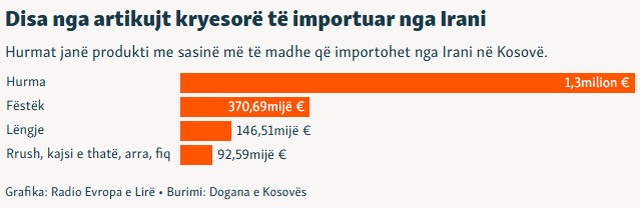
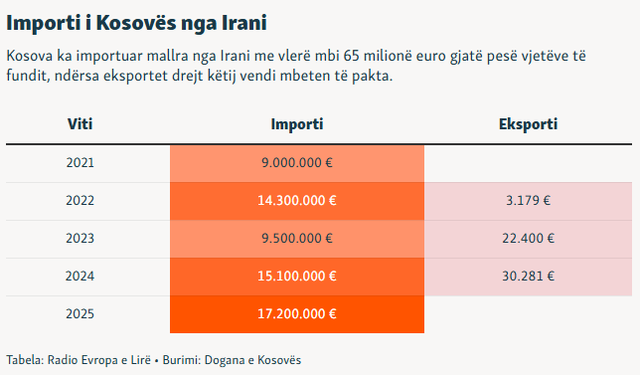
According to Kosovo Customs data, last year, the value of imports from Iran reached 17 million euros, while no exports were recorded. However, this figure has almost doubled compared to five years ago.

The Ministry of Industry, Entrepreneurship and Trade of Kosovo (MINT) informed Radio Free Europe that 23 businesses from Iran are registered with this institution, 5 of which are active, 16 passive and two closed.
REL requested explanations about what activities they carry out and is awaiting a response.
The President of the Kosovo Chamber of Commerce (KKC), Lulzim Rafuna, expresses his belief that Trump's policies, especially economic sanctions, do not directly hit the Kosovo economy.
" Kosovo-Iran exports and imports are negligible, there are no Iranian investments in Kosovo and there is no energy or financial dependence ," he tells Radio Free Europe.
Iran, with a population of over 91 million, does not recognize Kosovo as a state and has no official diplomatic relations with the country.
Its economy has been severely damaged as a result of years of mismanagement of public finances, falling oil revenues, and harsh international sanctions.
This has caused prices to rise and the local currency to weaken, prompting mass protests, which are considered the biggest threat to the Islamist regime in recent decades.
Sytrime Dervisholli, former director of the Trade Department at MINT, explains that the new 25% tariff will make Iranian products more expensive.
However, due to the small volume of imports and the non-essential nature of these products, Kosovar companies may orient themselves towards other, geographically closer markets, she adds.
" I cannot say for sure what the full effect of this decision will be, as there are still no detailed explanations on the method of implementation and on which products may be exempted from this decision. It is better to wait in the coming days for the official information that the United States will publish on the mechanisms for implementing this decision ," Dervisholli tells Radio Free Europe.
What did Trump say?
In a post on the Truth Social platform on Monday, Trump wrote: “ Effective immediately, any country doing business with the Islamic Republic of Iran will pay a 25% tariff on all business done with the United States of America. This order is final and irreversible. Thank you for your attention to this matter . ”
The president did not provide details beyond this announcement.
Iran is one of the world's largest oil producers.
Data from the Trade Data Monitor website, which is based on statistics from the Customs Administration of the Islamic Republic of Iran, shows that China is its largest export partner. It is followed by Iraq, the United Arab Emirates, Turkey and others. Almost all of Iran's top ten exports are related to fuel, but it also sells food.

Experts in Kosovo warn that if the crisis in Iran lasts, it could have indirect impacts on the Kosovo economy.
One of the most likely effects is a rise in global oil and energy prices - similar to the consequences that the war in Ukraine had on international markets.
Rafuna says this could lead to more expensive fuel for citizens, increased transportation costs affecting the supply chain, as well as additional pressure on inflation - especially on basic products.
Kosovo, on the other hand, imports most of its products, from food to construction materials and textiles. Last year, the total value of imports reached over 7 billion euros./ REL




Lini një Përgjigje