


 Shkruar nga Pamfleti
Opposition leaders have not yet started the promised work to reform the parties they lead, following their defeat in the December 28 elections.
A week after the elections, the Democratic Party of Kosovo, which came in second, has remained silent. Likewise, for the Democratic League of Kosovo, KOHA has learned that there is no movement towards a leadership meeting, which would precede the holding of the electoral assembly.
From the results so far, which do not fully include votes from abroad or those with conditions or from people with special needs, PDK is ranked second with approximately 188 thousand votes and LDK third with approximately 123 thousand votes. Compared to the results of February 9, 2025, PDK has suffered a decrease of 8 thousand and 514 votes, while LDK has 48 thousand and 540 votes less in these elections. The Alliance for the Future of Kosovo has also suffered a decrease of 15 thousand and 360 votes, but in the previous elections it competed together with Nisma.
The leaders of PDK and LDK, during their first addresses after the announcement of the preliminary results, had accepted responsibility and promised internal reforms.
According to Berim Ramosaj, an expert on political developments in the country, political parties need to make many changes, and not just in their leadership.
"Great reflection, don't say radical because I don't recognize this concept in right-wing parties. But I think that we should be very easy about the changes that are required and not just changes in the leadership, he is necessary. He should be a model for change, the current leadership, as the leadership would say, they should declare or leave in order to give chances, to pave the way for branches, sub-branches and all the others ", he said, reports 'Koha'.
Ramosaj said that the transition from one leadership to another should be done using conventional methods, respecting the "old" figures and introducing "new elements."
"These (LDK vj) have not done it. They have thought of entering directly with a new path, denying the old path that at the most delicate moments when they wanted to ask for votes, they slipped with some slogan," said Ramosaj, assessing that the LDK leadership is "a slave to a certain political school, which considers politics existential and which is not a model of Rugovism."
" I think that combinations should occur, between the old and the new, without denying the contribution of the old, but not under any circumstances should those who are young build new politics ," he added.
Political scientist Melazim Koci assessed that the LDK, with its decline, has paid for the mistake it made by not entering into a coalition with the Vetëvendosje Movement.
"I do not rule out the possibility that the fact that they did not enter into a coalition with Vetëvendosje was perceived by the public as their fault, otherwise I do not know how to explain such a large decline of the LDK ," says Koci.
Unlike PDK, LDK and AAK, the Vetëvendosje Movement has scored better results than in the February 9 elections. From the results so far, VV has almost 70 thousand more votes.
According to Professor Ramosaj, the victory of Vetëvendosje was also influenced by the inability of opposition parties to follow it on issues of national interest, the opposition's blaming for the political impasse, and citizens' fatigue from the lack of institutions.
"This narrative of the problem of state-building, which is camouflaged with elements of nationalism, namely the national identity of Albanians and Kosovo to preserve sovereign borders, respectively the integrity, in fact I think that they have given a positive premise to the ruling party that has played well with the nationalist feelings of many Albanians, whether they live in Kosovo or outside it. This is one of the key elements ," stated political developments expert, Berim Ramosaj.
Meanwhile, political scientist Koci considers that the non-voting of the second candidate for prime minister, Glauk Konjufca, has also influenced the deep result of the Vetëvendosje Movement and the decline of the opposition parties.
"I think it was a very serious mistake. The vote for the minority government, of Mr. Konjufca, was in favor of the opposition, because in this way they sent a signal to the public that they are constructive, that they are ready for cooperation and that they are in favor of overcoming the impasse and they also benefited from something else, postponing the elections to March of this year and eliminating the vote of the diaspora, which almost entirely, has convincingly leaned towards the Vetëvendosje Movement ," said Koci.
The acting Prime Minister, Albin Kurti, a day ago, referring to the lack of votes to elect the president in March of this year, did not rule out the possibility of new elections.
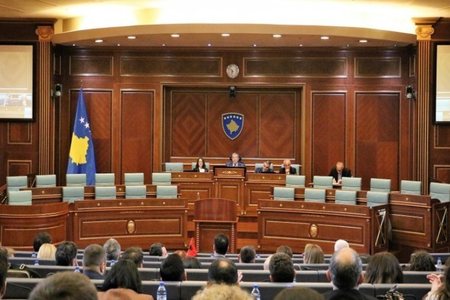
To elect the president in the first two rounds, 80 votes are needed, and in the third round, 61 votes are sufficient, provided that there are 80 deputies in the hall.


Lini një Përgjigje