


 Shkruar nga Pamfleti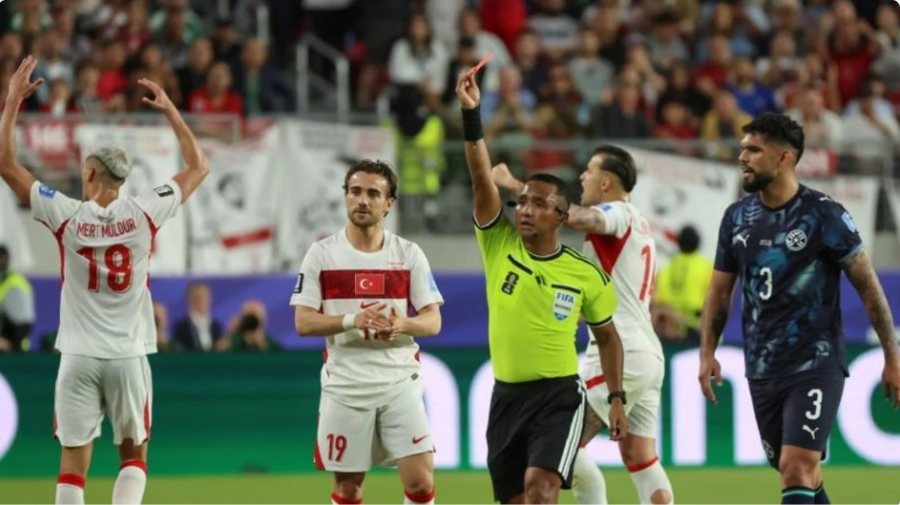
The first phase of the 2026 World Cup, which is being held in the United States, Canada and Mexico, has ended with a historic statistic. For the first time in 60 years, the lowest number of fouls has been recorded in this phase of the tournament.
A total of 1,484 fouls were called in the 66 matches played, or an average of 22.5 per match. This is the lowest figure since the 1966 World Cup in England. For comparison, in Russia 2018 an average of 26.9 fouls were recorded per match, while in Qatar 2022 this average was 24.1.
According to the analysis, this decline is not necessarily related to a cleaner game by the players, but to the refereeing criteria, which has favored the continuity of the game and the avoidance of unnecessary interruptions. In many cases, the referees have allowed the action to continue even after contacts that in national championships would be considered fouls. This interpretation has also led to reactions, such as those after the challenge between Spain and Uruguay.
Fewer yellow cards, but more send-offs
The disciplinary statistics also present an interesting contrast. The average yellow cards are just 2.5 per match, the lowest level since the 1982 World Cup in Spain.
Paraguay is the team with the most penalties in the group stage with seven yellow cards, while France is the team with the best disciplinary record, with only one yellow card.
However, while yellow cards have fallen in number, red cards have increased. The tournament began with three direct sendings in the opening match between Mexico and South Africa, and by the end of the group stage the number of red cards had reached eight, the same number recorded during the entire World Cups in Russia 2018 and Qatar 2022.
The historical record remains that of the 2006 World Cup in Germany, where a total of 28 red cards were given.
The so-called "Vinicius Law" has also been implemented in this edition. Paraguayan Miguel Almiron became the first player to be punished under this rule in the match against Turkey. Piero Hincapi and Folarin Balogun were also punished later, with the latter missing the match against Belgium due to suspension.
VAR with a more limited role
Unlike previous editions, VAR has had a smaller impact, being used mainly in controversial situations inside the area. This has been helped by semi-automatic offside technology and the chip placed on the ball, as in the case of Josko Guardiola's disallowed goal in the match between Croatia and Portugal.
The number of penalties awarded has also decreased. Only 10 penalties were awarded in the group stage, although this number has started to increase in the knockout stage matches.





Lini një Përgjigje