


 Shkruar nga Pamfleti
The latest injury index in European men's football, covering five full seasons, reveals a devastating figure: 22,596 injuries across the top five leagues, with a cumulative economic impact of €3.45 billion...
At the start of 2026 and while the challenge of the American World Cup keeps everyone on alert, European football is facing a silent "epidemic" that may not be visible in the overall picture, but which is affecting the game, performance and sports planning.
The uncontrolled growth of matches for the sake of television and sponsors not only makes it impossible to maintain quality, but at the same time it all ends up in a common problem: injuries, as rest time is sacrificed on the altar of continuous competitive action.
The latest injury index in European men's football, covering five full seasons (2020-21 to 2024-25), reveals a devastating figure: 22,596 injuries across the top five leagues (Premier League, La Liga, Serie A, Bundesliga, Ligue 1) with a cumulative economic impact of €3.45 billion. And what's worse? This is not a coincidence or a passing fad, but a growing trend.
According to research from leading insurance group Howden, annual volume has stabilised in a dangerous range since after the peak of the COVID era in the 2021-22 season (4,981 injuries), football has not returned to normal levels, consistently facing more than 4,300 injuries per season.
In fact, in the last season (2024-25), 4,456 injuries were recorded, even more than last year.
In this case, the difference lies elsewhere: The total cost decreased significantly, from 836 million euros to 676 million euros, not because there are fewer injuries, but because they are different.
What's happening in Germany and England?
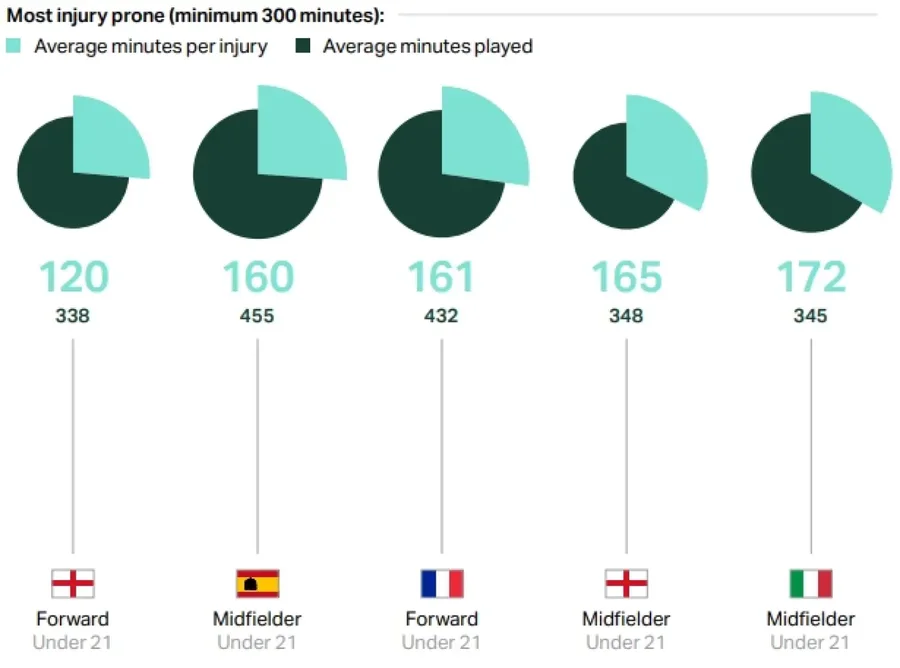
Analyzing each league individually, it becomes clear that the Premier League remains the financial epicenter of the problem. In five years, it has accumulated almost €1.4 billion in injury costs, far surpassing the other leagues.
However, the league with the most injuries is not the English Premier League, but the Bundesliga, which tops the list with more than 6,100 injuries during the period analysed. Germany suffers the most injuries, which can be explained by the physical play seen in its stadiums, but England pays the highest price.
Last season, Wolfsburg had the most injuries (85), but Manchester City paid the highest amount, at a cost of €41.22 million. Barcelona recorded 56 injuries with a financial loss of €31.33 million, while Real Madrid, with 75 problems, lost €25.65 million.
The report also presents a key detail: The average severity of injuries is not decreasing at the same rate as costs. Long-term muscle injuries and their recurrences remain prevalent, but the economic adjustment is being driven by the increasing number of injuries among low-paid or young players. And that is one of the main points of concern in the study.
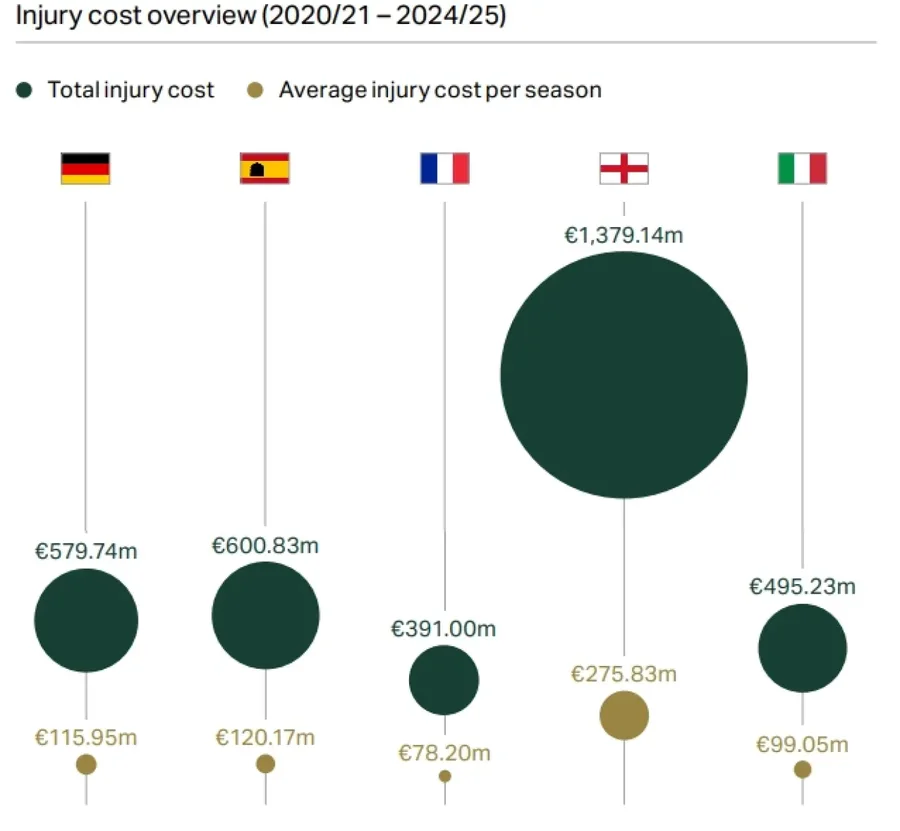
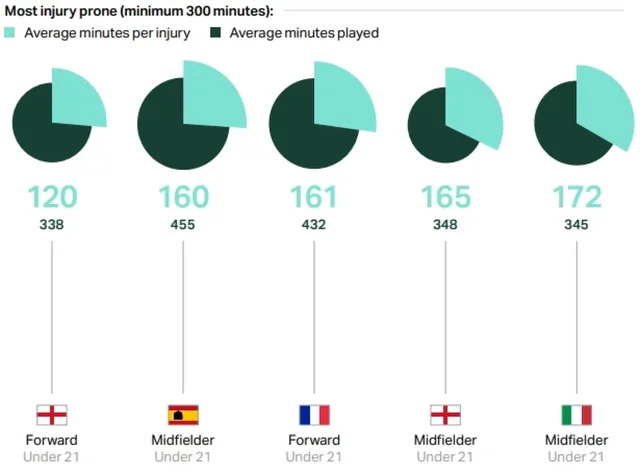
Going into more detailed dimensions of the research and identifying the five most injury-prone scenarios (with at least 300 minutes of participation), all five involve footballers under the age of 21.
The most extreme case is that of under-21 strikers in the Premier League, who are injured every 120 minutes! This means practically one injury every one and a half games. Players who are in the process of adapting to professional football are injured before they have time to settle in.
This phenomenon dispels one of the great myths of modern football, that of youth resilience. The data shows just the opposite. In five years, under-21 players are the age group that has seen the biggest increase in average injury severity, peaking at 49 days of absence in the Premier League and 47 in Ligue 1.
Young soccer players are not only getting injured more often, but also more severely. Experts say this is happening for three reasons that have their own sequence.
Firstly, many of them lack the right infrastructure and in a highly competitive environment show excessive zeal to stand out, resulting in their failure. "In such a situation, they are not able to manage their energy properly, something that older and more experienced players do more often and better," says Real Madrid's fitness manager, Ismael Kamenforte. "The Queen" has had a total cost of 169 million euros from injuries in the last five years, compared to 123 million euros for Barcelona, which has been hit by a high volume of muscle injuries, especially in the thigh and hamstring muscles.
One injury every seven matches
The conclusion that emerges from the combination of the calendar and the medical report is that competitions such as the Club World Cup have not increased the overall number of injuries, but have compressed recovery periods.
The data is revealing: A footballer in the top leagues plays, on average, 1,393 minutes per season and is injured every 625 minutes, roughly every seven matches. In the Bundesliga, this limit drops to 569 minutes, with wear and tear continuing.
It is easy to see how injuries also affect performance. A prime example is Borussia Mönchengladbach, which surpassed 100 injuries in two consecutive seasons (2023-2024), with an average of 2.86 injuries per game, coinciding with its drop to 10th and 14th place in the standings, respectively. On the other end of the spectrum, clubs with lower injury rates are better able to maintain their competitiveness, even with difficult schedules. Injuries are no longer a side effect, but also explain the progress of teams in the league.
The most common injuries continue to be knee, hamstring, and hip injuries, with the 26-30 age group accounting for the highest overall costs.
The Howden report is not an argument, but rather a warning. European football has normalised the flow of play with injuries, forced substitutions and the acceptance of absences as part of the competitive landscape. The problem is no longer how many injuries there are, but who they affect and at what stage of a player's development. And there, the diagnosis is clear: the system is jeopardising its own future.







Lini një Përgjigje