


 Shkruar nga Pamfleti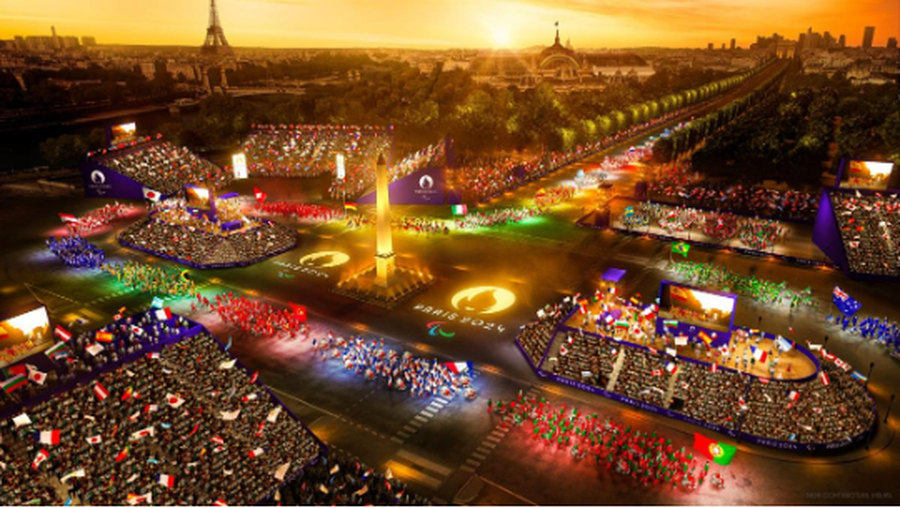
The 33rd edition of the Olympic Games closed with the closing ceremony on Sunday evening at the Stade de France.
10,714 athletes from 206 countries competed in the prestigious event, while in the end the United States of America was confirmed as the medal champion, leaving behind China. After a hundred years of waiting, the French capital once again hosted an Olympic event, while in "Paris 2024" in addition to sports magic, there was also controversy. Issues of health, religion, quality of life, gender and Olympianism have generated strong debates for just over two weeks of the event.
Sparks from the first day - The opening ceremony of these "Paris 2024" made history as the first held outside the Olympic stadium. A parade along the Seine and an extraordinary finale in front of the Eiffel Tower, before the cauldron was lit in the Tuileries Garden, turned the event into something iconic. But there were aspects that did not please everyone. The fire in the cauldron was not real, but a play of LED lights and sprayed water. Also, religious organizations expressed their dissatisfaction with the reference to the "Last Supper". Instead of the traditional apostles, the table was occupied by a number of characters representing the LGBTI+ community, including an obese woman at the centre, which sparked a wave of criticism that reached the Vatican.
The state of the waters of the Seine River – Undoubtedly the biggest source of controversy of these Olympic Games. The water quality levels of the Seine River caused the suspension of training and changes to the date of the triathlon race and events in these waters. Weeks before the start of the Games, there were many who pointed out that the hygienic conditions were not suitable for swimming there, and the heavy rains in the first days of the competitions made the situation even worse. After investing 1.4 billion euros in recent years in a series of infrastructure works to improve the quality of the river's water, the French government did not reach its goal and some athletes ended up vomiting, even infected by bacteria, as Belgian triathlete Claire denounced Michel.
The gender issue in boxing – Even women's boxing was surrounded by controversy. Imane Khelif and Lin Yu-Ting were banned by the International Boxing Association (IBA) from the 2023 World Cup after biologically testing that their chromosomes were male XY, as women normally have two X chromosomes. But since the Olympic competition is organized by International Olympic Committee (IOC), female boxers were allowed to participate. Like Khelif, YuTing also won gold medals, but their journey to triumph was marked by protests from some of their rivals in the ring. An issue that caused numerous reactions on social networks, but not only that, as there were also political involvements.
Questionable medal quality – American Nyjah Huston, bronze medalist in skateboarding, raised the issue of medal quality on her social media. Also, other athletes such as the Spanish rowing medalist, Pau Echaniz, joined in the criticism of the quality of the Olympic Games medals. Metals that, a few days after reaching their owners, have started to deteriorate, as they have lost their color. "These medals look great when they're new, but after wearing them on my skin with a little sweat and letting my friends wear them around my neck over the weekend, they look like they're from a fight," Huston complained.
Bronze in gymnastics – In the floor final in artistic gymnastics, Romania's Ana Barbosu took the bronze medal thanks to a score of 13.700. However, after the race, the American Jordan Chiles filed a complaint because she did not agree with the initial result of her exercise (13.666). The judges reviewed it, agreed with her, and her score was corrected to 13.766, giving the American gymnast the bronze medal. Given the seemingly unfair decision, the Romanian Gymnastics Federation took the case to the Court of Arbitration for Sport (CAS) and it ruled in favor of Barbosu, who took the bronze medal a few days later. But the case does not end there, as the US Olympic Committee has taken it to appeal.
Doping allegations – The Chinese and Americans, locked in a battle to lead the Olympic medal table, have also crossed paths with various doping allegations. In April it was revealed that 23 Chinese swimmers tested positive in 2021 and although the World Anti-Doping Agency (WADA) was aware, 13 of them took part in the Tokyo Games and won six medals: four gold and two silver. The US launched an investigation under a law passed in 2020 that gives federal authorities the power to investigate doping cases in sports, and China didn't like it. Moreover, in Paris, Jeanne Pan surprised everyone in the 100m freestyle race with a gold and a new world record, which for Australian coach and Olympian Brett Hawke, is "humanly impossible". On the other hand, the Chinese Anti-Doping Agency decided to counterattack and report directly to the USA, specifically the American sprinter Erriyon Knighton, who tested positive in March, but was forgiven by the American agencies, who came to the conclusion that it was caused by meat contaminated.
Unsportsmanlike behavior – Beyond what surrounds the sports competition, there were moments of tension during the confrontations. In the stadium near the Eiffel Tower where the sand volleyball matches take place, the Brazilian Ana Patricia and the Canadian Brandie Wilkerson had a strong argument that stopped the game, while it was the DJ who calmed them down, playing "Imagine". Even in football, the Argentina-Morocco match ended with the fans taking over the field and becoming the protagonists of one of the most embarrassing images of the Games.






Lini një Përgjigje