


 Shkruar nga Pamfleti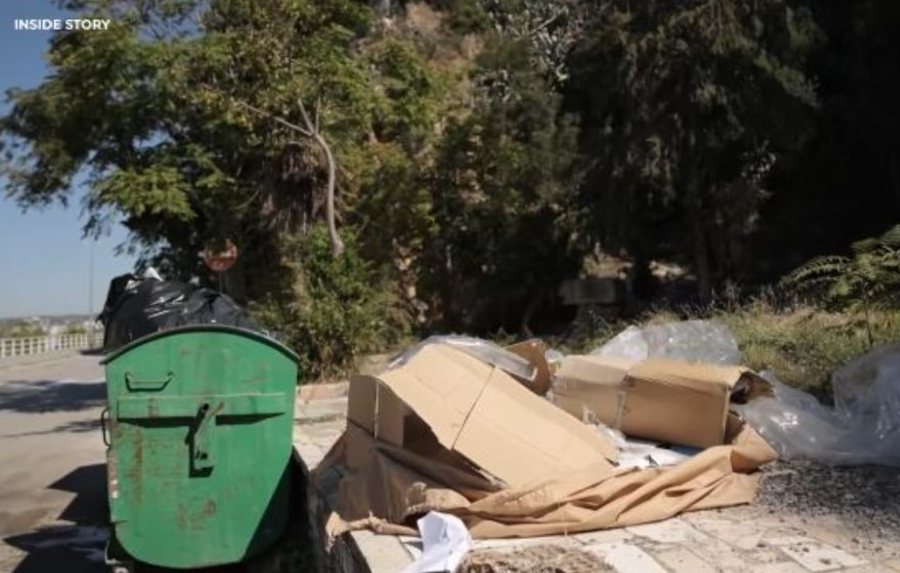
Waste management is one of the biggest environmental challenges facing Albania, exposing the country to an environmental disaster.
Rivers, streams, roads, cities, villages, or seas are filled with waste, proving that in the last three decades, the policies followed to clean up the country have not been adequate.
Through footage, reports from experts and residents, Inside Story has documented the alarming situation in the landfills of many cities.
"Albania is a dirty country, even though we talk about tourism, we see those very demonstrative initiatives once a year by central or local institutions that come out even at the ministerial level to collect this waste, but Albania is not cleaned in one day. They must be continuous and above all, not to throw waste again," said economic expert Klodian Muço.
In 37 cases, landfills were built on the banks of rivers. Three municipalities in the Gjirokastra region have landfills on the banks of the Vjosa River, which has been declared a national park, causing pollution of the environment and rivers.
According to a risk mitigation monitoring report prepared by the Ministry of Environment in 2018, municipalities inherited around 199 illegal and unsanitary landfills, some of which are still in use today, while others have been abandoned for years. However, they remain a dangerous source of infections.
"The very institutions that should deal with waste management have often created illegal landfills and this is an alarm bell. It has been going on for years and let's say desperately we continue to have illegal landfills, I'm not talking about those that have been approved but are non-standardized, but there are also landfills that do not appear at all on the lists of institutions but are hotbeds of environmental pollution," said environmental expert Kristi Bashmilli.
The report cites that it is often found that the approval of collection sites has not gone through any technical assessment process, but simply administrative. Municipalities faced with emergency needs for waste management and disposal have approved, through decisions of the Municipal Council, plots of mainly public property which have served for years as municipal waste disposal sites.
As a result, municipalities do not administer any technical documentation: geological studies, technical projects, construction or environmental permits related to the disposal sites located on their territory.
"The sanitary landfills that have been invested in have problems, but the most problematic is the extension of the landfills that do not meet the standards to be sanitary landfills and are often located on the banks of rivers where even the layers of gravel create high filtration, polluting surface and groundwater," said environmental expert Kristi Bashmilli.
Based on the requests of the municipalities, the report has estimated that 44 landfills need to be rehabilitated, 62 need to be urgently closed and 93 of them need to be removed. This intervention is estimated to have a cost of around 870 million lek, not including the costs of waste transportation.
But, 7 years have passed since the approval of this report and the documentation of the management situation in the country and on the ground has not changed anything. Faced with this situation, the institutions have "turned a blind eye", allowing the illegality that is causing irreversible damage to the environment, the health of the population and the country's budget.
The footage that Inside Story was able to secure proves that Albania continues to swim in garbage.
"The environment is our main problem that none of us wants to solve. We also see old waste, which has not been managed for years by local authorities, but also supplied by us people, whether in frequented areas or in less visited areas, which you find in corners, in holes in walls, rocks, river corners, village streams. Today you find waste in every environment as a sign of our carelessness," said environmental expert Flora Xhemani Baba.
The Ministry of Environment says it has 10 feasibility studies prepared in 2022 regarding illegal and unsanitary landfills. Based on these studies, part of the investments will be the closure/rehabilitation of uncontrolled landfills, expansion with new cells, and the closure and encapsulation of existing cells.
The interventions are expected to be completed by 2028 and will ensure full compliance with European Union standards.
According to the National Sectoral Plan for Urban Waste Management, approved in 2020, the country is divided into 10 waste management zones and 7 sanitary landfills operate.
The Ministry explains that the three waste areas: Berat, Dibër and Kukës, in which there are no regional landfills, are in the process of design and then construction.
A report by the Lloyd's Register Foundation's World Risk Survey ranks Albania among the 10 worst countries in the world for household waste separation.
According to the report, there are few structures in Albania to enforce or incentivize separation and recycling. Any separation that does take place is largely informal.
Kosovo ranks third on the list of countries where people do not separate household waste before throwing it in the trash, after Ivory Coast and Gabon. Montenegro and Albania share ninth place in the ranking, with slightly better results than Togo, Cameroon, Benin, Liberia and the Republic of Congo.
According to data from the National Waste Management Agency (AKEM), an agency established in 2024, which is also tasked with collecting and publishing waste statistics from local governments, 870 thousand tons of waste were generated last year.
However, not all of this amount goes to landfills. The municipalities themselves admit that some of it ends up in nature. According to the 2023 statistical yearbook, a total of 8% of waste was not managed. This means that every year, an alarming amount of over 70 thousand tons of waste is spread freely in the environment…
Referring to data from the municipalities themselves, the region with the highest level of unmanaged waste was Gjirokastra with 29.3%, followed by Elbasan with 27.4% and Kukës with 27.0% of total waste generated.
"Certain municipalities manage 60 or 70% of waste, practically admitting that they do not manage all waste; there is always waste in nature, and it is unmanaged, harming the lives of citizens," said Klodian Muço, associate professor of political economy.
Experts link this low waste management figure to a lack of funds and the discouragement of citizens by the institutions' own erroneous policies.
"The government spends money on the environment, but a good part is operational expenses, not capital. A good part goes to employee salaries, a lot goes to tourism, it went to forests, to draft management plans; we produce a lot of documents, a lot of paperwork, and the money goes to these paperwork and not to investment in the field," said Klodian Muço, associate professor of political economy.
"The moment citizens are forced to separate their waste and only one car goes and picks it up, in addition to not getting the expected results from the scheme we have applied, this turns into distrust among citizens. If we take the waste undifferentiated, it is a mistake, but if we collect it by car and put it together, it is a more serious mistake than the first one, because it is a mistake made by the institutions themselves, and citizens will always be skeptical," said Kristi Bashmilli, an environmental expert.
Experts say that, although we have signed a series of agreements and acts with the aim of reducing waste, increasing recycling and becoming part of the EU, such as the Paris Agreement, the Sofia Treaty, the 2030 Green Agenda, the Agenda that by 2050 we must become zero carbon, Albania is still far from proper waste management.
"We have a number of initiatives and obligations that we have taken, but we are far behind in this aspect," said Klodian Muço, associate professor of political economy. Inside Story


Lini një Përgjigje