


 Shkruar nga Pamfleti
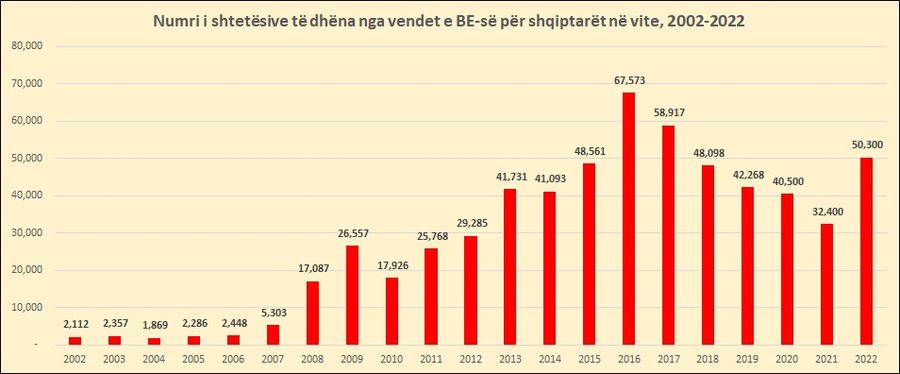
There are 604 thousand Albanians who have been provided with a passport of a European Union country in the last 20 years, according to Eurostat data, which reports the figures from 2002 and has updated them for 2022 as well.
The highest number of citizenships granted was in 2016, with 67 thousand, followed by 2017, with 59 thousand. Then a steady downward trend was noted, until 2022, when passports granted to Albanian citizens from EU countries increased again (see the chart Number of citizenships granted by EU countries to Albanians in years , 2002-2022).
Their growth coincides with the new wave of immigration that has swept the country in recent years, becoming a real concern for the local economy, both in the labor market and the consumption trend.
Albanian citizens who have a passport make up about 22% of the population that is reported to be living in Albania today, which is 2.76 million inhabitants, (INSTAT has not yet published the data of the new Census).
In 2022, citizenships increased by 55%, Italy leads
Only in 2022, according to Eurostat, there are 50,000 Albanians who have obtained citizenship in an EU country, ranking third in Europe, after Moroccans and Syrians.
Italy is the main country that granted citizenship to Albanian citizens in 2022, accounting for 75.8 percent, followed by Greece, with 19.2 percent, Sweden (1.2%) and Belgium (0.9%).
Compared to 2021, the number of citizenships granted to Albanians has increased by 17,900 people, or 55%. For Moroccans with 26,500 nationalities, (or 31%), Romanians (out of 9,100 people, or 32%), Syrians (out of 6,400 people, or 8%) and Turks (out of 3,700 people, or 15%).
The total number of naturalizations also increased significantly in 2022 for Ukrainians (by 8,300 people, or 40%), Indians (by 7,900 people, or 49%), Argentines (by 7,100 people, or 97%), and Moldovans (by 6,300 people, or 42%), while it has decreased significantly for British citizens (by 2,900 people, or 31%).
In 2022 compared to 2021, in the top thirty previous nationality groups, Argentines and Egyptians replaced Serbian and British nationals.
Nearly 1 million people received citizenship in the EU during 2022.
989 thousand people received citizenship in a European Union country where they lived, an increase of 20 percent compared to 2021.
Most new citizenships (in absolute terms) were granted by Italy (213,700; 22% of the EU total), followed by Spain (181,800; 18% of the EU total) and Germany (166,600 ; 17%).
The largest increases in the number of citizenships granted to non-citizen residents in 2022 compared to the previous year were recorded in Italy (+92,200), Spain (+37,600) and Germany (+36,600). On the other hand, the lowest rate was observed in France (-15,900), the Netherlands (-9,300) and Portugal (-3,700).
The data shows that 87% of all those who obtained the citizenship of the EU country where they lived were citizens of a non-EU country.
Citizens of another EU country from the country of residence accounted for 12%. While the rest who had an unknown previous citizenship or were stateless accounted for 1 percent and 0.7 percent, respectively.
In 2022, Moroccan nationals were the largest group of new EU citizens, with a total of 112,700 citizenship statuses granted. The second largest group was Syrian nationals with 90,400 nationals, followed by Albanians with 50,300 nationals.
Romania recorded the highest naturalization rate* in 2022 among EU countries, with 26.8 citizenships granted per 100 non-citizen residents. Sweden was 10.6, followed by the Netherlands with 4.4 and Italy with 4.2.
At the other end of the scale, the lowest naturalization rates per 100 non-citizen residents were recorded in Latvia and Estonia (both 0.4), Austria and Bulgaria (both 0.7) and Malta and the Czech Republic (both 0 ,8). /Monitor








Lini një Përgjigje