


 Shkruar nga Milica Plavshiç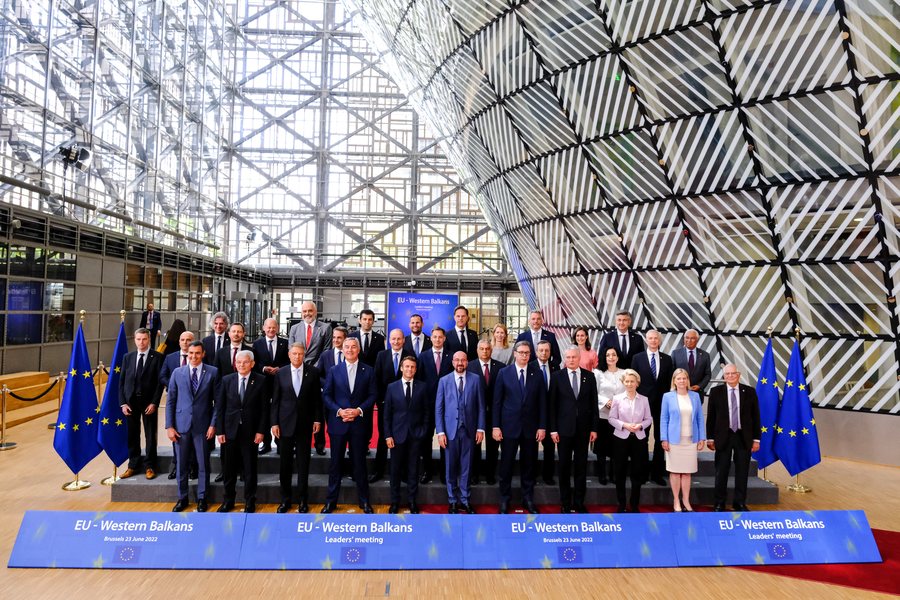
Some leaders behave like autocrats, they manipulate the people, elections are not fair and free, and there is no effort to build good neighborly relations.
One of the main threats to the region is the behavior of the leaders of some countries, such as Serbia, Albania, and Bosnia. There, the leaders behave like autocrats, manipulate the people, elections are not fair and free, and there is no effort to build good neighborly relations...
Editor-in-Chief of Osservatorio Balcani, Luca Zanoni, speaks about political developments in Bosnia and Herzegovina and the hypocrisy of EU policy towards Southeast Europe, citing student protests in Serbia as a possible turning point.
What do you think are the main threats to the stability of the Western Balkans?
I believe that unfortunately, the biggest threats come from within, not from without. It is true that there are also external influences, exerted by great powers, such as China, Russia and Turkey, which are usually considered as very influential countries, capable of destabilizing the Western Balkans.
However, I do not believe that they are the only threats to the stability of the region. In my opinion, the United States and the European Union can also be a threat at times. So the West can also destabilize the Balkans. I cannot consider Donald Trump a factor of stability.
Just as I believe that the EU's tendency to ignore the protests in Serbia can be seen as a factor fueling instability, I believe that one of the main threats is the behavior of the leaders of some countries, such as Serbia, Albania, and especially Bosnia and Herzegovina.
Some leaders behave like autocrats, they manipulate the people, elections are not fair and free, and there is no attempt to build good neighborly relations. The main factor of destabilization probably remains nationalism, which unfortunately has not only not been defeated, but seems to be spreading even in EU member states.
Finally, among the factors of instability, I would single out the demographic decline in the region. We know that for 10 years, many people have left the Balkans for various reasons. But whoever decides to emigrate, especially the young and educated, thinks that the region is not changing and offers no prospects.
How do you comment on the current political situation in Bosnia and Herzegovina?
The current political situation in Bosnia is catastrophic. But unfortunately this is not news. This country is hostage to ethno-politics and corruption. Bosnia is not progressing, and I don't know why.
how will it get out of this situation? Over 10 years ago, we hoped that the so-called 'Bebolucija' (Baby Revolution) and the developments that followed it, could be a turning point.
Sadly, that turning point never fully materialized. In Republika Srpska, we saw protests over the death of David Dragičević, which echoed in the Federation. Citizens seemed willing to raise their voices, but I believe that the country is too divided into what we call “ethno-poles” to be functional.
The Dayton Agreement was good 30 years ago. As is known, it also contains the Constitution of Bosnia and Herzegovina, originally written in English. I believe that it is time to reform the Dayton system, certainly not towards division and dissolution, but to consolidate the state, regardless of ethnic groupings.
Citizens are citizens regardless of ethnicity. They should be respected, have access to jobs and education as citizens of this country, and in this sense they should enjoy all rights.
The war ended 30 years ago. It is not time to take up arms again, but to close that chapter, and move forward. Among the ethnic groups in Bosnia and Herzegovina (there are more than three) there are more similarities than differences.
Do you think the EU is still a credible actor in the region? And can we still talk about a European perspective for the Western Balkans?
The EU can be a credible actor in the region. But it needs to adopt a more transparent stance, abandon stabilocracy, oppose developments that exploit local resources, and avoid the politics of double standards.
Until a few years ago, it was believed that money was enough to guarantee democracy in the Western Balkans. But the reality turned out to be completely different. The reconciliation process was insisted on for a long time, but then it became clear that post-conflict reconciliation cannot be imposed from outside.
For a while, eastward enlargement seemed to be on the agenda, but today we are far from the enthusiasm felt at the Thessaloniki summit in 2003. After Croatia joined the EU, the enlargement process stalled, until the Russian invasion of Ukraine. Only then did the EU wake up and grant candidate status to Ukraine, Moldova and Georgia, but it could not leave Bosnia and Herzegovina aside.
But the candidate status does not have much meaning, it is a purely symbolic gesture. As things stand today, it is unlikely that Bosnia will become a full member of the EU. Its path to the EU is still very long. At the same time, the EU must return to its fundamental principles: human rights, the rule of law, the fight against corruption, etc.
Because even the EU itself seems a bit lost. When we say EU, we need to clarify what we mean, because there are different levels of governance. Are we talking about the 27 member states, the European Commission or the European Parliament?
Even Ursula von der Leyen ended up in court over the Pfizergate scandal, precisely because her behavior as president of the European Commission was not transparent. When the EU does not listen to Serbian citizens who take to the streets en masse to protest, when it does not understand or ignores the fact that the Serbian president is holding the entire country hostage, when it does not react to similar situations in certain businesses (I am thinking especially of lithium) or when it sees leaders like Vučić as a factor of stability (for the sake of stabilocracy), in these cases it has little credibility, precisely because of its double standards.
How do you see the role of Russia, China, and Turkey in the Western Balkans? Are they merely pragmatic partners, or can they exert greater geopolitical influence?
I don't think that today we can talk about purely pragmatic partners. Of course, these countries behave as pragmatic partners. So they build infrastructure, they provide assistance, but nothing is free. All these countries also have geopolitical influence. Each has its own interests in the Balkan region. Therefore, the EU must be careful how it behaves and maintain credibility in the Western Balkans, because there are competitors. Of course, the Western Balkan country is within the EU, but if the enlargement remains only on paper, then more space is given to other countries to influence local politics as well.
Are you following the student protests in Serbia?
Yes, of course. I believe that something serious and important is happening in Serbia, which can serve as an example for other countries, and not only in the Balkans. Serbia has been protesting for decades, from 1991, 1996-1997, then on October 5, 2000, then Savamala, then the protests after the massacre at the “Ribnikar” school, those against the Rio Tinto company, etc.
So there is a long tradition of protests against the government. However, in the past, none of these mobilizations have managed to significantly weaken the regime. Now the situation seems different. A curious and positive aspect is that the students are demanding the same thing that the EU is demanding from Serbia. Therefore, it is absurd that Brussels is not listening to the Serbian students. / Adapted from "Pamphlet" by "Balcani Caucaso"


Lini një Përgjigje