


 Shkruar nga Pamfleti
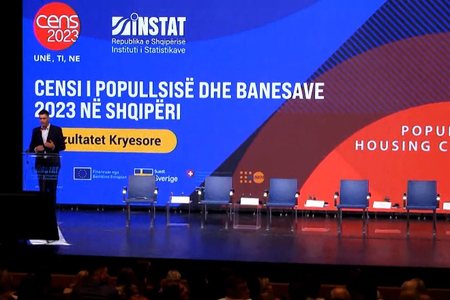
Nearly 40 percent of apartment buildings across the country are empty, census results published today showed.
The 2023 census counted 1,082,529 ordinary dwellings in 2023. Individual houses represented 47.0 percent of these dwellings, while 39.9 percent of them are buildings.
A small category of dwellings are semi-detached dwellings (8.1 percent) and terraced houses (5.0 percent).
From the total number of ordinary dwellings, at the time of the census, 726,325 (67.1 percent) were inhabited dwellings, estimating 32.9 percent of uninhabited ordinary dwellings.
The rate of unoccupied ordinary dwellings ranged from 24.3 per cent for semi-detached dwellings to 39.4 per cent for dwellings in blocks of flats, detached houses and terraced houses were each 29.2 and 29.8 per cent respectively.
The area used for living includes the useful space, excluding corridors, toilets, lobbies/halls, balconies and utility rooms. Ordinary inhabited dwellings include 755,531 household economic units and 2,384,418 resident population.
In approximately equal percentages, ordinary dwellings were built in the period since 2001 (36.4 percent), and in the 20-year period 1981-2000 (37.5 percent), while about a quarter (26.1 percent) were built before 1981.
About a quarter (26.1 percent) of ordinary dwellings were built before 1981 and in approximately equal percentages, in the 20-year period, 1981-2000, 37.5 percent were built, and since 2001 the following 36.4 percent were built.
For ordinary inhabited dwellings, the surface used was one of the collected information which will serve to analyze "dwelling overcrowding"12.
Almost half of these dwellings (47.1 percent) had a usable area of 40-69 m2 and about a quarter (23.7 percent) had a usable area of 70-99 m2.
Censi estimated that 86.4 percent of ordinary inhabited dwellings had running water in the dwelling or in the building. Almost all ordinary inhabited dwellings (96.2 percent) had a toilet inside the dwelling or inside the building.
A small percentage (less than 0.1 percent) of the dwellings counted in the Census were non-ordinary dwellings. In these other housing units lived about 400 IEFs and 1.4 thousand ordinary residents. A small percentage (less than 0.1 percent) of the dwellings counted in the Census were non-ordinary dwellings. In these other housing units lived about 400 private individuals and 1.4 thousand ordinary residents./ Monitor



Lini një Përgjigje