


 Shkruar nga Pamfleti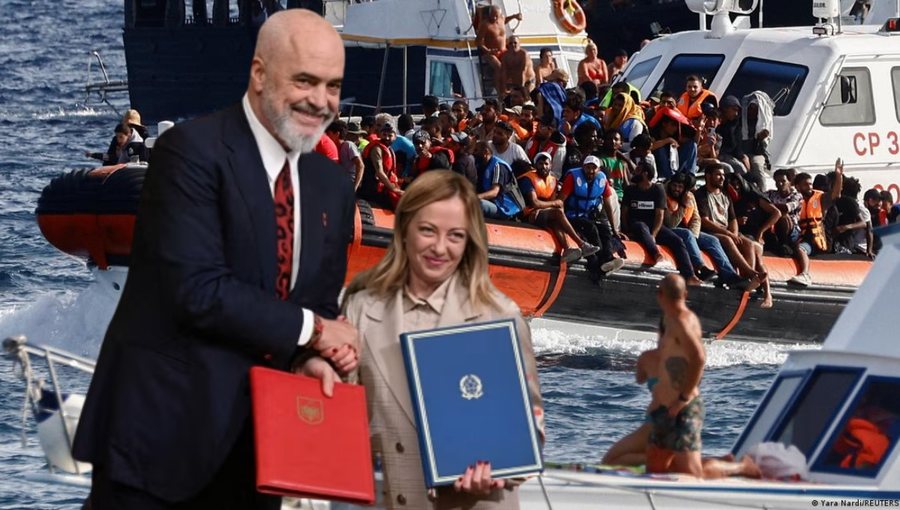
Migrants who will be accommodated in Gjadra can stay there for up to 18 months, until their countries of origin accept their return. However, without new agreements with the Albanian government, their return must once again take place from Italian territory.
The Italian government approves the decree, which paves the way for the transfer to the migrant camps set up in Albania of persons detained in Italy, who are awaiting repatriation. So, based on the new decree of the Italian government, the migrant camps will not only accommodate migrants caught in Italian waters, who will await asylum procedures, but also those migrants who are in Italy and whose asylum requests have been rejected.
It seems that this is the way that the Meloni Government has found to put into operation the immigrant centers set up in Gjadra, which have remained empty after the Courts in Italy have considered the transfer of immigrants by sea to Albania illegal.
This "development", sources from the Chigi Palace explain, has been shared "informally with the European Commission".
The Chigi Palace specifies that the agreement with Albania, signed by Meloni and Rama, does not prohibit this change, i.e. the accommodation in Gjadra, even of immigrants who are detained in Italy, after they have been refused asylum and are awaiting deportation.
In this way, Gjadra will accommodate immigrants who need to be repatriated, after their requests have been reviewed in Italy and rejected.
It is not yet clear whether this change by the Italian government conflicts with the bilateral agreement signed with Albania, which stipulates that only immigrants awaiting political asylum, and not immigrants already awaiting deportation, can temporarily stay in the Gjadri and Shëngjin camps.
According to the Italian Interior Minister, Matteo Piantedosi, it is only a question of "reactivating an existing function of the center, that of the return center". He added that, within a few weeks or months, a decision is expected from the European Court of Justice, which the Italian government believes will be in line with its position.
"The decision of the European Court of Justice is expected in the summer. We are very confident, because we think we are on the right side and considering how the new situation is developing in Europe, we believe that this is the final step for the resumption of the expansion of the centers in Albania. The CPR was already planned, nothing changes, a lot depends on the nationality of the people who will be repatriated, the methods will not change," said Piantedosi.
So, referring to the statements, the Italian government is not changing the destination of the center, but intends to use it to accommodate illegal immigrants who are awaiting deportation.
Initially, this center was intended to hold for up to 28 days asylum seekers rescued at sea by Italian military ships, coming from countries considered safe, to undergo accelerated border procedures. Now, migrants who will be accommodated in Gjadra can stay there for up to 18 months, until their countries of origin accept their return. However, without new agreements with the Albanian government, their return must once again take place from Italian territory, writes 'La Repubblica'.
This means that illegal immigrants detained at the Ponte Galeria CPR (the immigration detention center near Rome) will be transferred to Albania pending deportation, but must then return to Italy, from where the final departure to their country of origin will take place.
Considering that on average only 50% of immigrants detained in reception centers actually manage to return to their countries, an increase in costs is expected due to the continuous transportation between Italy and Albania, as each detained immigrant must be accompanied by two police officers.
In addition to these practical and financial challenges, the operation also raises legal doubts. The new European regulation will provide for reception centers in third countries, but not before 2027. At the moment, there is no legal basis that allows the transfer of migrants to a country that is neither their country of origin nor a country of transit, and "La Repubblica" writes that a legal loophole is being exploited for this purpose in both the Italian Immigration Code and the current EU directive on returns. /Adapted Pamphlet/







Lini një Përgjigje