


 Shkruar nga Pamfleti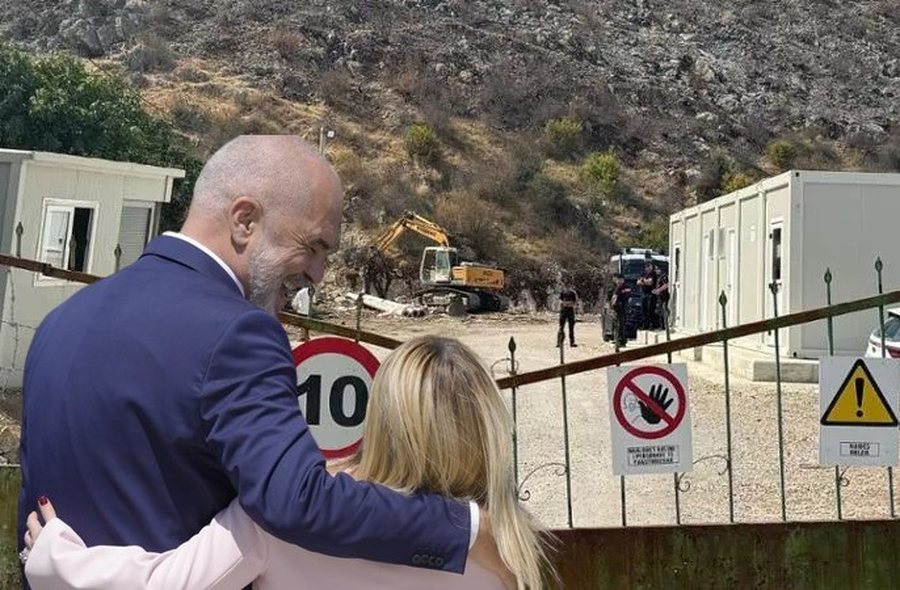
The Italian media continue to write about the refugee camp in Lezha. "La Stampa" has published another article today, which states that that camp will look more like a prison. According to her, the government is luring prison and police officers with bonuses and financial benefits to serve in Albania. But the question arises, if the volunteers run out, then who will protect the refugees?
Everyone runs to Albania. Where service in refugee centers involves a salary increase: an extra hundred euros per day for prison officers, policemen, carabinieri or financiers. And the calculations, regarding the lives and movements of those who will participate in the operation, are done quickly. Three hundred units, explain those who are well informed. For a cost of around 30,000 euros per day. 900 thousand euros per month. Only in relation to transfer compensation. The rest? Still to be reckoned with. Because every field and every activity has its own payments.
Penitentiary police officers will be assigned to a 'prison' in Gjadër, a small town in northern Albania. Anyone causing trouble at the repatriation center will be isolated. It will be a prison for men, with 24 cots. 45 vacancies for agents, as there are over three thousand submitted applications. The task is favorable: 130 euros more per day, expected service from four to six months depending on the rank with the possibility of returning to Italy once a month with expenses borne by the administration.
These are the numbers and the rules. At least on paper. Because there are many doubts. "It's all a paradox," exclaims the general secretary of the prison police, Gennarino De Fazio.
"Once upon a time, there was a tendency to close prisons under a hundred places because they were uneconomical. A very small prison is now being built, with a markedly disproportionate officer-to-prisoner ratio. If in Italy there is one policeman for every three prisoners, about 25 thousand for over 61 thousand people, there will be three for every prisoner. The expenses? They will be excessive and come at a moment of emergency for Italian prisons", he added.
At the moment, only four prison police have arrived in Albania. On the other hand, the prison that should have been ready in June, then August, then September, is still not there. Aldo Di Giacomo, general secretary of the SPP, the penitentiary police union, says: "Those who work with prisoners know that a miscommunication can create serious problems. However, none of us have been trained in how to deal with these people. Based on the linguistic factor". Di Giacomo continues: “A course, for example, would have been useful. As well as knowing what regulations will apply in this area. Instead, we focused only on the attitudes that had to be held in public, without taking into account the hard work with the prisoners."
Gjadëri, a hundred inhabitants and a handful of houses, a former military base during the Cold War, now finds itself at the center of the agreement between the Italian and Albanian governments. A key location for Italy's first immigration detention center built on foreign soil.
There is the prison. And the current CPR with 1,120 places for detention. It has always been repeated that there is no talk of prison. But you can't get out of there. And there are containers, fences, walls.
Each area will be policed with a "joint force contingent". From the First Mobile Brigade, 30 carabinieri, 176 policemen were selected, mainly from mobile teams, forensic police, immigration office, technical-logistic offices. "The term of employment will be one month, except in exceptional cases". One hundred euros per day more on salary, food and accommodation "will be paid by the administration" and "Central Management will identify, month by month, the percentages of personnel to be employed and the territorial offices from which the personnel will be".
Anyone who goes to Albania will do so on a voluntary basis. Those who have already worked in various camps in Italy murmur worriedly: What if there are no more volunteers? And this will be the next problem. /Adapted "Pamphlet" from "La Stampa"





Lini një Përgjigje