


 Shkruar nga Pamfleti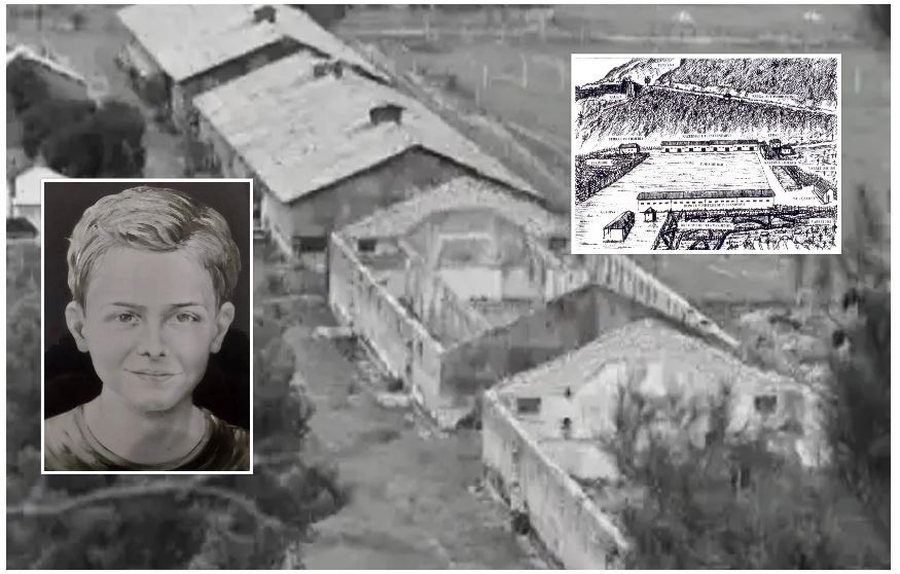
Ndue Progni was 7 years old when he passed away in the lap of his mother, Lulë Progni. It was a cold winter night in 1951, in the Tepelena Internment Camp, built over the former barracks of the Italian army. The family was forcibly sent from Tropoja to Tepelena, after father Gjoni, a participant in the Northern uprisings against communism, fled the country. Like the Progni family, Enver Hoxha's revenge for power sent hundreds of families, mostly women, children and the elderly, to these barracks surrounded by barbed wire, where, according to testimonies and documents, there were mass deaths due to starvation, poor conditions and diseases. Ndue's cousin, Gjelos Progni, says that the family's hopes of finding his remains are fading.
A single portrait of little Ndue was recreated by a painter based on his father's features, as the family didn't even have a picture of him to remember him by! The family had not looked for it until a few months ago, when Gjeloshi decided to make a request to find it, with the Authority for Information on Former State Security Documents, known as the Records Authority. Regarding this and others, Mr. Gjelosh, in this exclusive interview.
Mr. Gjelosh, you are familiar with the project on the progress of the process of finding and identifying missing persons during the communist regime. You have completed the survey and shared with us your experience on finding the remains of 7-year-old Ndue Gjon Prognit. Starting from this, I would like you to tell me a little about the story of the persecution of the Progni family, which then led to the death of the 7-year-old boy, Ndues?
Nduja was the only son of Gjon Progni, who was an academician, having graduated from the military school in Rome in 1932, a high functionary of the Kingdom of Zogu, performing the high functionary duties of its Gendarmerie, such as in Lushnja, Tirana , Burrel, Krumë, Tropoja and ended his career as an official, serving as the command of the Gendarmerie in the Nikaj-Mërtur area.
Gjoni, being a political opponent of the communist dictatorship, which was installed in 1944, automatically became an enemy of the system, because Enver Hoxha refused to have political opponents and sought to eliminate them, annihilate them, in one form or another. another and one of them was John.
He was arrested by the partisan forces and imprisoned for two years and was to be sentenced by firing squad, but fortunately he escaped and returned to his homeland, took his brother's son, Marash, and escaped, joining the anti-communist organization in Yugoslavia at that time. , led by Nik Sokol. He made great resistance and effort against communism in Albania.
After they found it impossible to resist further in the mountains against the communist forces, they immediately left Albania and settled in Brussels, developing political life together with other immigrants in the diaspora, always to return and with their heads back towards Albania. to their homeland, to their country, to exterminate communism in Albania once and for all. And until they died, their efforts never stopped.
When Gjoni left with his brother's son, who did he leave in Albania?
John left his son and wife in Albania. The entire Progni family would suffer the consequences of their escape. The family was exiled and all their property, movable and immovable, was confiscated, as was the commission of that time, confiscating all the napoleons of gold, plots of land, houses, and everything else they had and eventually exiled to the Berat camp, then to the extermination camp of Tepelena.
What was the reason for the death of the little boy Ndue?
Talking about this event is very painful and you should pray to God to give you the strength to tell it. Children are like angels, they are completely innocent. You know that in the Tepelena camp, approximately 800 people died, 30 children died within 24 hours.
There was only one "melody", the "melody" of the oil. It has been a terrible camp. The biggest pain is that they are all without a grave. They moved the graves three times and the movements were deliberate, so that they lost their tracks. That's what happened to little Ndua. His remains may have been washed away by the river and today he is without a grave.
Nduja died like all other children in Tepelena Camp, due to lack of hygiene, lack of food, etc. On his last night, he was in his mother's lap, languishing. As soon as the camp policemen took her from her lap, Nduja died and never felt the warmth of her mother's hands again.
The policemen placed his body in front of the barracks on the stack of wood. That night, a torrential rain fell and mother Lule looked sadly at the wet and lonely body of her son. In the morning they had taken little Ndue and his body, they had taken him to the river. Hopes to find his body have faded too much and I believe there is no chance to find them again.
Mr. Gjelosh, what was your request to the authorities responsible for finding the remains of Ndue Progni and have you received a response from the relevant authorities?
The request was made to the Information Authority of the former State Security Documents, for the finding of the bones in the Tepelena camp. I have not received a final answer, but we have constant contacts, who inform us that we are in coordination with the Ministry of the Interior and other state bodies, but so far there is no result.
What do you think is the real problem with not finding the bones and why have you given up hope of finding them?
As his death was extraordinary, very sudden. According to the legends, it is said that the cemetery was taken by the river because at that time they were buried on its edge, but the truth is not known, we are pessimistic about finding the remains of our deceased man, Ndue Progni, 7 years old.
Recently, you held a reburial ceremony for the remains of Gjon Progni, Marash Progni and the commemoration of the 7-year-old boy Ndues. What is the importance of this kind of ceremony for you and for the historical memory and the memorial that you made to Ndue, does it show that the hope of finding him is extinguished?
The reburial ceremony and memorial is a missing tribute and a revival of memory. For me, it was not a funeral ceremony, it was not a burial ceremony, it is a noble ceremony to evoke the memory of this nation and to put these figures who sacrificed everything, in the pantheon of honor, where they belong , their memory and image. Their return to the land, to their country of birth, is a strong symbolism that tries to keep alive the missing memory these 32 years, from the so-called democracy.
It was a special or multiple emotion for our family because, on the one hand, we have the same bequest, the bequest of our ancestors, who died 50 years ago, Gjoni and Marashi, the bequest which has weighed on our shoulders and our family's and became a reality. And this is an incredible emotion and some happiness for our whole family.
Along with it, the feeling of commemorating the 7-year-old boy Ndue, a great pain because his remains have not been found even after many searches that we have done as a family. The commemoration of Ndue was an event that caused many emotions and great pain./ Memorie.al






Lini një Përgjigje