


 Shkruar nga Pamfleti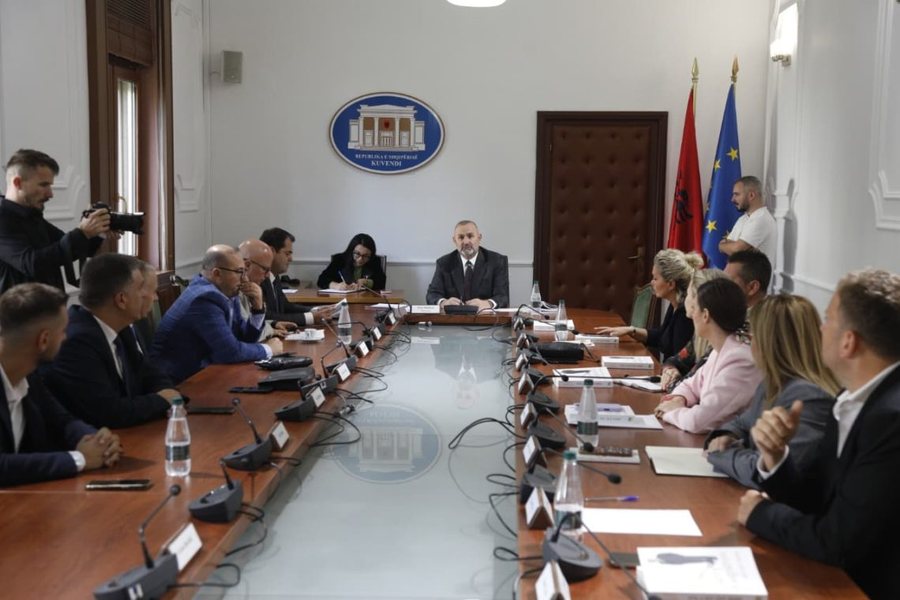
The Laws Committee heard on Friday the arguments of associations representing local government interests and the mayors themselves who opposed the wording of the government's new draft law on "Integrated Waste Management", which envisages the final management of waste by a state agency that will function as a joint stock company.
Local government representatives and experts asked the Assembly to consider the possibility of changes to several articles of this initiative, which according to them conflict with the law on local self-government, as well as the clarification of several other articles on how the provisions of this law will be implemented on the ground, which, according to them, place a financial burden on municipalities.
Adelina Farrici, executive director of the National Association of Municipalities, assessed the necessity of a new law in this sector, but asked the deputies to take into account several recommendations, which according to her would allow for the principles in organic laws, such as that of local self-government, not to be violated by another simple law.
Farrici emphasized that the law on local self-government gives municipalities responsibility for waste management in their territory and that there have been municipalities that have been successful in this function. Thus, she requested that not all municipalities be treated the same.
Also, Farrici requested that municipalities be part of the decision-making process in the National Waste Management Agency, AKEM, referring to the fact that some of them have landfills and incinerators on their territories.
"As long as it is a function that, according to the law, belongs to municipalities, there should be an addition to Article 22 to enable municipalities to be shareholders with a percentage and have representation in the joint-stock company as decision-makers," she said, among other things.
Farrici also requested legal guarantees for municipalities to bear the financial costs of implementing this law, requesting that it be legally provided that these costs be borne by the state budget through unconditional transfers.
The mayor of Dimal, Juliana Mema, also raised concerns about the implementation of the law by municipalities due to high costs.
"There should be mechanisms to make it enforceable," she demanded of the deputies, proposing that "a transitional period be foreseen to make it enforceable because this would lead to an increase in the community's tariffs with a social impact."
"We are faced with additional costs for promoting awareness campaigns, costs for separation at source, for transportation to transit stations, how will this be possible?" she asked the MPs.
The Association of Local Elected Officials, which represents opposition mayors, also supported the need for a new legal solution for waste management, but suggested changes to the government initiative.
Albert Malaj, deputy chairman of the association, demanded that municipalities have real powers in this sector, calling the transfer of waste management powers to a national operator "a step backwards" and the reduction of municipalities to mere "clients".
"Striping them of these powers not only undermines local autonomy, but risks creating a centralized model, where decision-making is removed from the citizen," he said, suggesting that the law should guarantee support for municipalities to carry out their functions.
Agron Haxhimali from the Institute of Municipalities also brought concrete proposals for changes to the draft law, with the aim of avoiding infringement of local government competencies.
He brought to attention a provision of the draft law, where the heads of local self-government units become responsible for the collection and management of waste generated within their administrative territory. “This point should be removed, as the responsibility is institutional, not personal. The law should refer to the municipality as an institution,” he suggested.
Haxhimali, as an expert on local government, also suggested that the draft law give municipalities the right and responsibility to set the level of service tariffs, with a discretion of ±30% from the central methodology.
The new draft law came to the Assembly after Prime Minister Edi Rama introduced a new waste management reform in September.
With this legal initiative, the government acknowledges the failure of the incineration scheme, where tens of millions of euros of investment were made in the last decade, and returns to recycling as the first link in the waste management hierarchy, in a management scheme that is expected to weigh on citizens' pockets with increased costs and fees. / BIRN /




Lini një Përgjigje