


 Shkruar nga Pamfleti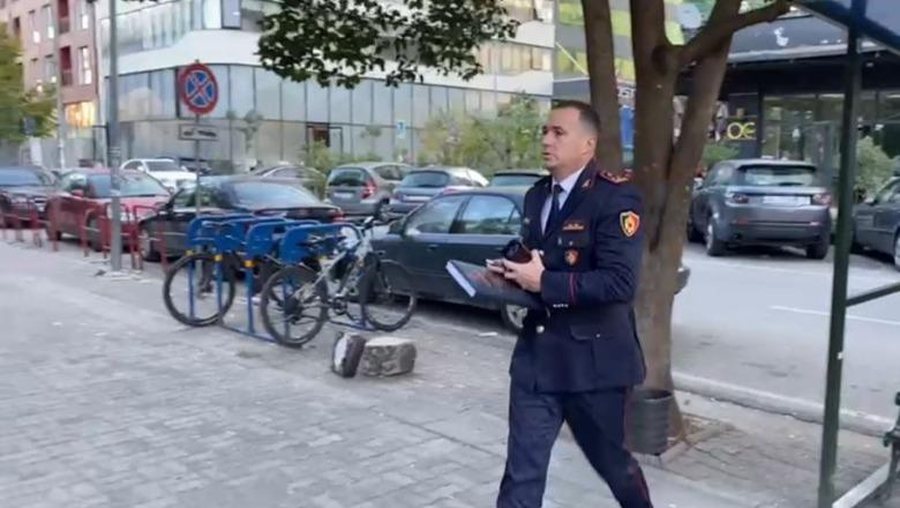
Anti-terrorist officer Igli Haxhia was arrested inside the Security Academy, in an operation synchronized with SPAK and according to information received from Italy. He is the latest police officer to be arrested after it emerged that he had been recruited by an international drug trafficking group.
From the Italian wiretaps, it turns out that while serving in the Special Operational Force, Haxhia betrayed his duty by going over to the side of crime; from an operative of the Operational Force to a source of information for the gang, which was today hit in collaboration with the Brescia Anti-Mafia and the Swiss authorities.
Joint investigations show that the Operational Officer leaked the investigative secret about the suspects. According to SPAK, Igli Haxhia received money in exchange for information while turning a blind eye to some of his duties in the service of drug traffickers.
Haxhia's case is directly linked to a major anti-drug operation, where a structured criminal group based in Albanian territory is suspected of having imported over 1,300 kilograms of cocaine from South America to Northern Europe, to then enter Italy with heavy-duty vehicles. In this mechanism, the role of a police officer who has access to information, investigative actions and classified acts is invaluable for criminals. But the recruitment of a police officer by gangs has long been no longer news in Albania.
In recent years, there have been numerous cases where police officers, from special units to ordinary police officers, have been caught as part of criminal organizations. A few weeks ago, Muçi Sheqeri, an officer of the Police Supervision Agency, was shot in the car of Gilmando Dani during the assassination attempt a few days ago. He was in the role of driver and escort for one of the most dangerous people in the circle of Emiljano Shullazi, a name that carries convictions for serious criminal offenses.
The case of Ervis Martinaj shows the same pattern of cooperation between police and crime. Jeton Lami, an operative of the Operational Unit in the FAST squad, accompanied Martinaj in his movements, although the latter was declared wanted. Investigations proved that Lami was the person who had accompanied him to Durrës a few hours before Martinaj disappeared.
In Shkodra, the investigation officers have not always been on the side of the law. Ardit Hasanbegaj, an officer in the investigation and public order structures, was exposed by the decrypted conversations on SKY ECC as part of the Bajraj and Pëllumb Gjoka gang. He was accused by SPAK of providing the conditions and material means to commit murders to the detriment of Dorian Duli and Ibrahim Lici. So again a police officer in the service of the criminal plans of a group, not to uncover their crimes, but to carry them out.
Even the police hierarchy has not been untouched by the accusations. Oltion Bistri, former head of the Special Operations Force and then former director of the Police in Durrës and Lezha, was arrested as part of the same criminal network. A senior police officer, who in theory should lead the fight against organized crime, turns out to be part of it in practice. In Lezha, former director Henrigert Mitri was recruited by a criminal group involved in the cultivation and trafficking of cannabis and in gambling activities. His activity was also documented by SKY ECC conversations, another case where technology reveals the connection between the uniform and the gang.
The list continues with other names. Dritan Metaj was arrested by SPAK as part of Gëzim Çela's group, one of the largest drug trafficking networks in the country. Arlind Ismailukaj, a police officer, was arrested in the "Flame at Sea" operation, again linked to drug trafficking. All these files taken together transform what is often presented as individual deviation into a recurring pattern, where organized crime has no difficulty at all in buying the loyalty of people in uniform.
The series of names shows that criminal organizations are no longer satisfied with the episodic corruption of ordinary officials, but that they have put the police force under their constant service by capturing its dome.
At the head of the police, the untouchable Ilir Proda
Despite the numerous cases that have been discovered where police officers have been in the service of gangs, Prime Minister Edi Rama has refused to acknowledge the need for a reform to cleanse the state police.
Asked about the recent assassination attempt, when Gilmando Dani was accompanied by AMP officer Muçi Shaljani, Prime Minister Rama deviated and spoke about the need for security cameras in the area around Rinas. Rama's response seemed strange since the assassination was fully filmed by the security cameras of surrounding businesses.
Rama's indifferent stance on the involvement of police officers in criminal networks is compounded by the fact that the Director General, Ilir Proda, continues to maintain the unquestioned trust of the head of government.
It seems that the Rama-Proda duo are in a comfortable symbiosis, where one guards the shoulders of the other, without being at all concerned by the fact that under Proda's command, the operatives are being arrested one after another as they serve as drivers, security guards, informants and couriers for the gangs that control drug trafficking and the underworld.
With each passing day, SPAK investigations, interceptions of encrypted platforms, and files coming from the European Union show that gangrene in the police has advanced on every floor of this structure. / Lapsi


Lini një Përgjigje