


 Shkruar nga Pamfleti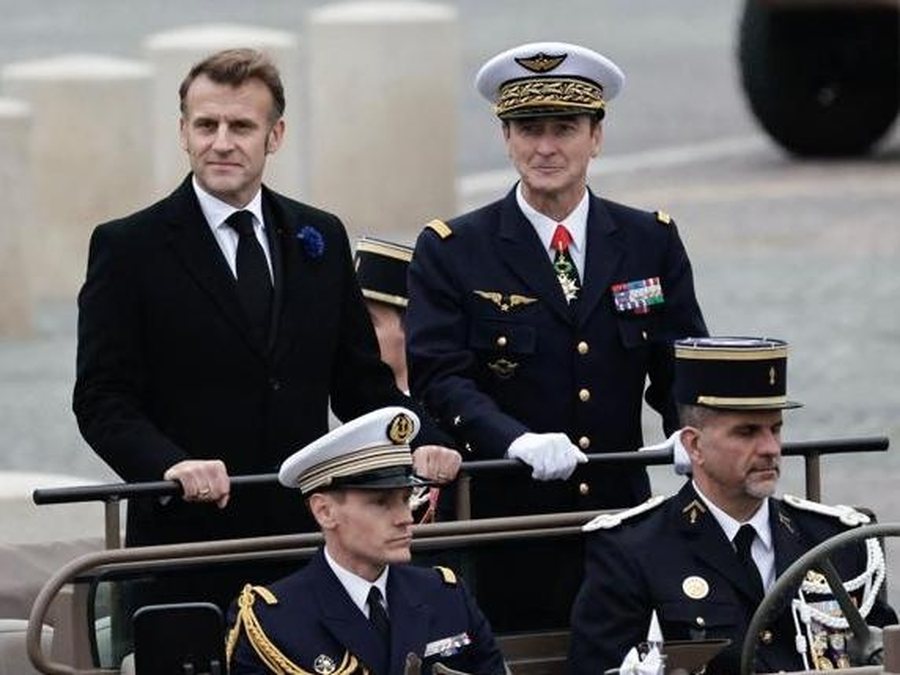
General Mandon, speaking about the Russian threat, criticized the lack of "courage to be willing to sacrifice ourselves to defend what we are." The statement caused a political storm in France. The government spokeswoman clarifies that "he was talking about soldiers. And our sons will not go to fight and die in Ukraine."
Should the French be prepared to “lose their children”? At a time when Europe is called upon to respond to the American peace plan for Ukraine, and President Emmanuel Macron is coordinating with allies to continue confronting the Russian threat, France is embroiled in controversies that touch the soul of the nation.
The debate was sparked by criticism made on Tuesday by the Chief of the Army General Staff, General Fabien Mandon, before the Congress of French Mayors.
"What we lack is the strength of spirit to be willing to suffer to defend who we are," the general said in his long speech.
And he continued, "if our country falters because it is not ready to accept the loss of its children, let us accept it, or it will suffer economically because defense production will take priority, or if we are not ready for this, then we are in danger."
Two sentences within a detailed examination of the growing threat posed by Russia, which is “preparing for a conflict with European countries around 2030 because Moscow is convinced that its existential enemies are NATO and the European Union.”
The general's words caused great emotion, as they were seen as a verbal escalation after months of warnings from Macron and various ministers about the "hybrid war" that Russia had already launched against France and other European countries.
Are we moving from hybrid warfare to total war? Should the French really accept the idea that they are willing to "lose their children" if they do not want to surrender to Moscow?
There were many reactions, mostly negative. Jean-Luc Mélenchon, leader of the radical left France Insoumise, immediately expressed his "complete disagreement". "It is not the duty of the general to call on mayors or anyone else to prepare for war without having any competence to do so." The leader of the French Communist Party, Fabien Roussel, added: "Aren't 51,000 war memorials in our municipalities enough? Yes to national defense, but no to the intolerable war discourse."
On the other side of the political spectrum, the vice-president of the National Rally, Sébastien Chenu, also criticized the general: "The Chief of Staff has no legitimacy to alarm the French people with statements that in no way correspond to the official line of the country.
Fabien Mandon's words were interpreted as a kind of preliminary declaration of war, as an unacceptable call for citizens to prepare for the inevitable loss of family members. In reality, placed within the broader context of a long speech, these words were intended precisely to avoid war and to reactivate the principle of deterrence that could be useful in discouraging the enemy: by demonstrating readiness to fight, to avoid attack.
However, on Friday morning, given the strong reactions the general had provoked, government spokeswoman Maud Bregeon attempted to put his remarks in context.
"The Chief of Staff of the Armed Forces was talking about French soldiers who are deployed all over the world and are between the ages of 18 and 27. The fact that some of these soldiers have fallen in operations abroad cannot be ignored. But "we must be very clear, our sons will not go to fight and die in Ukraine," the spokeswoman said. / Adapted from Corriere /




Lini një Përgjigje