


 Shkruar nga Pamfleti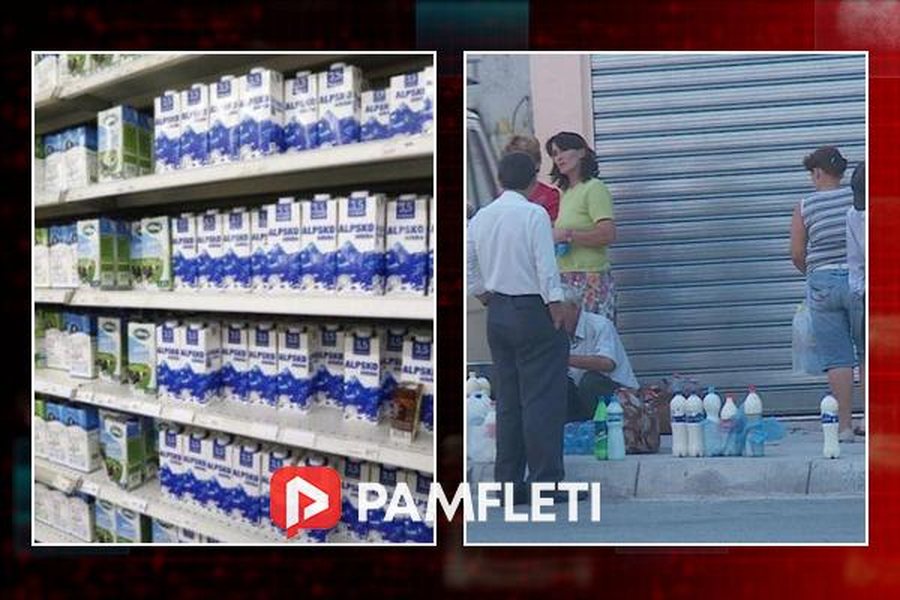
How safe is factory-produced milk?
After 12 years in power, the prime minister remembered the food safety of Albanians. When tangerines with pesticides were caught, or chicken with salmonella and milk with aflatoxin, Rama and his ministers did not say a word.
Even the names of the companies that were poisoning Albanians were covered up. But the elections are over, and now Babloku has launched an attack. An attack that seems to have confused the target.
Tax inspectors, the National Agency for Labor Relations and other bodies have been raiding the markets, to the point of becoming ridiculous. Like in the case of Bardha, where they asked for a receipt for the oregano they collect in the mountains. They are also following the villagers who go out in the morning and sell 2 cans of milk to support their families.
But the evil in this country does not come from that unlabeled oregano, nor from the milk cans on the street. Those who poison Albanians are the milk, meat factories, etc.
It is enough to look at INSTAT statistics to understand that the poison is the milk sold in supermarkets and not that of the poor peasant.
Today, Albania has only 224 thousand cows, a number that has decreased by 137 thousand heads within a decade. Likewise, according to INSTAT data, the number of goats has decreased by almost 210 thousand, as in total we have only 500 thousand heads from 711 thousand a decade ago. As a result, we have less organic goat milk and cheese in our markets. Only 8 thousand tons of goat milk were collected last year.
INSTAT figures show that a total of 95 thousand tons of milk were collected throughout Albania last year, a decrease of 6.6%, compared to 2023, of which only 12 thousand tons were released to the market for consumption. But this figure does not include milk and its by-products that factories put on the market.
Some of the major dairy factories put tons of milk, yogurt, cheese, butter, etc. on the market. When production drops, how is it possible that there is no impact on the market? The signals are that many factories use powdered milk and palm oil.
In the period January-May 2025, 250,393 kilograms of powdered milk, or 70.1 million lek, were imported into Albania. While in the period January-May last year, 242,494 kilograms of powdered milk, or 64.1 million lek, were imported. But, doing the calculations, in the 5-month period of 2025 there is an increase in powdered milk by 7,899 kilograms. So imagine how much 'milk' can be achieved with so many kilograms of powder, which is mixed with water and other products.
While in 2024, 2.9 million liters of palm oil were imported into our country. A frightening figure. While in the last five years, 13,667,239 liters of palm oil were imported into Albania. So it is clear how milk bottles are filled or how its by-products that are sold in supermarkets are made. Not to mention starch or other products that are added to yogurt or cottage cheese. /Pamphlet





Lini një Përgjigje