


 Shkruar nga Giovanna Coi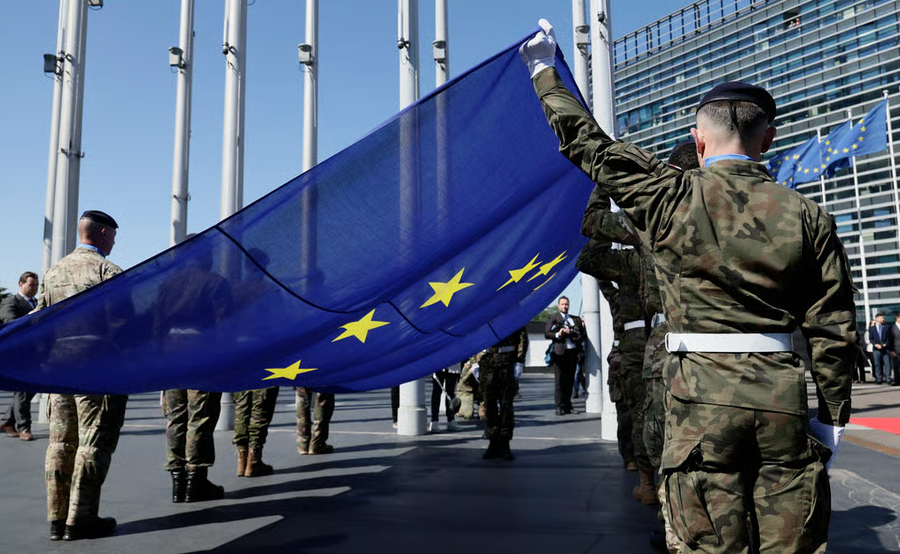
According to the report, "head-to-head" replacement of American equipment and personnel would cost about $1 trillion over a 25-year period.
Europe can survive without the military support of the United States, but it will take at least 25 years and up to $1 trillion to replace the American presence on the continent, according to a new report from the International Institute for Strategic Studies (IISS).
The study, published on Thursday, warns that in the event of a hypothetical US withdrawal from Europe, NATO member countries on the continent would face the Russian threat and "tough choices" to fill colossal gaps in defense.
According to the report, the "head-to-head" replacement of American equipment and personnel would cost about $1 trillion over a 25-year period. The cost of purchasing military equipment alone ranges from $226 billion to $344 billion, depending on the quality of the weapons, while the rest includes costs for maintenance, personnel, and logistics.
The most expensive items to be purchased are 400 tactical fighter jets, 20 naval destroyers, and 24 long-range surface-to-air missile systems.
In the event of a full-scale war to counter a Russian attack, replacing 128,000 US troops would cost Europe over $12 billion – not including other critical gaps such as command, control, coordination, reconnaissance and nuclear weapons.
-Europe without an American commander in NATO? Mission (almost) impossible
The Europeans would also need to replace the post of Supreme Allied Commander Europe (SACEUR) – a key position historically held by an American – as well as increase diplomatic coordination capacity.
But according to the IISS, even if there were unlimited political will and sufficient funding, the European military industry would not have the capacity to meet the demands immediately. Shortages in supply chains, a lack of skilled labor, and financial constraints would significantly slow down this process.
The “buy European” dream of European Commission President Ursula von der Leyen looks set to remain a baseless slogan for the time being. Investment in the naval and air sectors is minimal, and for some categories – such as rocket artillery or stealth fighter jets – local procurement is not even an option.
However, a light at the end of the tunnel
Despite the continued reliance on US suppliers, there are some signs of progress. Analysis of tenders made between February 2022 and September 2024 shows that 52% of the value of contracts went to European companies, compared to 34% to US ones – a signal that the market is starting to shift towards domestic suppliers.
The Russian invasion of Ukraine in 2022 has forced many NATO countries to increase military budgets to reach the 2% of GDP target for defense.
Another surprise factor is the return of Donald Trump to the White House, who, with his tough stances on NATO and threats to withdraw the US from the defense of Europe, has given impetus to the initiative for a "truly European defense", promoted by French President Emmanuel Macron.
But money is tight and people are tired.
The main problem remains the budget: European governments, burdened by debt and internal crises, find it difficult to justify drastic increases in spending on arms. In countries like Spain and Italy, where public pressure for social services is high, additional investment in defense could face fierce opposition. / Adapted from "Pamphlet" by "Politico"





Lini një Përgjigje