


 Shkruar nga Pamfleti
These were terrifying moments, unprecedented in Europe. Three MiG-31 fighter jets flying over the Baltic Sea suddenly deviated over the Estonian island of Vaindloo. A formal violation of Tallinn's airspace, and therefore NATO's, turned into an open provocation when Moscow's air force headed straight for the capital.
These aircraft are not only the fastest in the Russian air force, capable of reaching 3,000 kilometers per hour, but they are also the only ones that can launch the Kinzhal hypersonic missiles, for which the West has virtually no defense.
Rapid and feverish consultations began between the operational command and the Alliance headquarters. The first problem was to understand what the MiG-31s intended to do: the possibility that they were heading towards Amar Air Base, the closest NATO base to the Russian border, was not ruled out.
For ten years, Russian planes have often entered Estonia's airspace without warning, far from the border: they consider the sky between St. Petersburg and the Kaliningrad enclave, which is located in Poland, to be part of Russia. The small Baltic republic has only 1.3 million inhabitants and has neither an air force nor air defense systems: it is defended by NATO, with troops from different countries that are changed every four months. The distances in the country are very small: from Vaindloo Island to the capital are about 100 kilometers and another 40 to Amar airport. A distance that MiG-31 aircraft can cover in a few seconds. Faced with such a dangerous situation, NATO leaders ordered a response based on maximum caution: tensions on the eastern border are very high and could not be risked. It was decided to act decisively, but without any gesture that could be seen as aggressive, so as not to give the Kremlin a pretext to cause an incident.
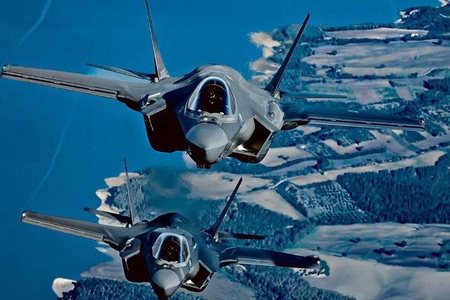
At that moment, the alarm was transmitted to Amari. There, since the end of July, four Italian F-35 aircraft have been stationed there, with crews from the 32nd Air Group of Amendola (Foggia) and the 6th Air Group of Ghedi (Brescia). Two fighter jets are always on high alert, with four air-to-air missiles on board, while pilots and technicians are ready to take off within three to four minutes when the climb siren sounds. In August alone, they have been scrambled twice to identify Russian aircraft that have unexpectedly entered civilian air routes over the Baltic.
Yesterday, the wail of the sirens brought the pilots face to face with a disturbing reality. When they entered the cockpit and started the engines, the command presented them with a scenario that was close to war: MiG-31s were flying around Tallinn, about thirty kilometers from their base. These are extraordinary times and distances, typical of close air confrontations known as “dogfights”, made famous by the movie “Top Gun”.
For this reason, the two fighter jets took off quickly, but did not immediately head towards the Russian air unit: the Italian officers made a wide maneuver, moving away from the attackers, in order to be seen. Paradoxically, they gave up the “invisibility”, the main feature of the F-35 aircraft. And, as soon as the Russians realized their arrival, they turned towards the sea and left. From a technical point of view, the Mig-31 would not be able to cope with the Italian sixth-generation aircraft, equipped with electronic equipment that could blind their radars. But in this confrontation, military capabilities were not a priority: the goal was to avoid any collision.
There is another Italian shield in Estonia: a battery of Samp-T surface-to-air missiles, the best European system, engaged in another NATO mission. The reconnaissance radars are always on, but the military personnel did not activate the targeting sensors, because this would be considered by the Russian pilots as a hostile act.
The MiG-31s stayed in Estonian airspace for twelve minutes: a very long time by NATO response standards. Every action was dictated by the alliance command, which seems very pleased with the way the Italian soldiers acted. The Kremlin's goal seems clear: with the entry of the planes, it responded to NATO's decision to strengthen the eastern border with Operation "East Guard". The Russian message is simple: we can strike when and where we want. A provocation, therefore, that demonstrates the willingness to make a show of force. And at the same time to test the cohesion of the Atlantic Alliance: to understand whether the United States will position itself on the side of Europe. US President Donald Trump has ignored the drone attacks that have entered Poland and Romania: now Putin will see how he reacts to this even more sensational challenge. / La Repubblica






Lini një Përgjigje