


 Shkruar nga Pamfleti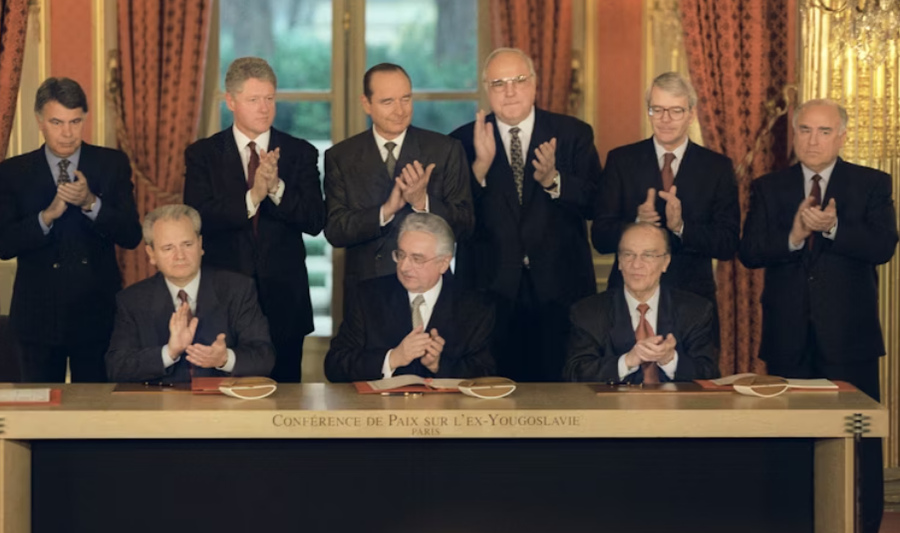
There are a number of lessons that Dayton can offer for efforts to end the war in Ukraine. The first relates to the negotiation process. In the run-up to the talks, US President Bill Clinton sent his national security adviser, Anthony Lake, to Europe to consult widely with allies...
Thirty years ago, on December 14, 1995, the presidents of Bosnia and Herzegovina, Croatia, and the Federal Republic of Yugoslavia signed the Dayton Accords. The treaty ended three years of bloodshed in what was then the largest war in Europe since 1945.
That distinction is now held by Russia's war against Ukraine. The conflict that began in February 2022 has already lasted longer than that in Bosnia and Herzegovina and is said to have led to the deaths and displacement of millions of people.
The war in Bosnia and Herzegovina took place at a very different time and in a very different environment than the war against Ukraine. It was at the end of the Cold War, in a multinational state torn by rising nationalism. It began as a civil war, not an external invasion, and it took place across the entire territory of the country.
Yet, despite their differences, there are some uncanny parallels between the two wars. These are lessons worth considering for how the war against Ukraine might end.
Both wars have a very strong ethnic element and both took place in a changing geopolitical environment. Both wars have had high levels of internationalization. They were fought not only between the warring parties, but indirectly between their supporting allies through the equipment and military support they provided.
The negotiation process that led to the agreement that ended the war in Bosnia-Herzegovina did not just involve the warring parties. It also involved the “parent” states, Serbia and Croatia, which signed on their behalf. Similarly, but in some ways worse, it seems that any agreement on Ukraine will involve the US and Russia first and foremost. Ukraine and Europe seem to be excluded.
The war in Bosnia and Herzegovina ended as a result of tough, US-led mediation at an air base in Dayton, Ohio. The Dayton mediation effort succeeded after many previous European-led efforts had failed and a UN peacekeeping operation was unable to protect civilians, even in so-called safe zones.
The Dayton Accords, as the agreement became known, provided an operational framework that, for all its flaws, has managed to keep the country free from violent conflict for 30 years. However, they have not provided a framework for a functioning state.
The rigid power-sharing structures agreed upon in Dayton have created frequent political paralysis. Dayton requires that key decisions, such as on electoral law or on the financing of institutions, be made by a senior international representative who still retains ultimate authority over Bosnia and Herzegovina.
The Dayton Accords did not inspire much loyalty to the new state either. Especially among the Serb population, the desire to secede from Bosnia and Herzegovina remains strong. This was clearly evident from the results of the last presidential elections in the Serbian part of the country on November 23. The candidate who campaigned on a platform of secession won the vote.
What has largely contributed to keeping Bosnia and Herzegovina united is a series of EU actions and funds aimed at maintaining stability. This includes the presence of a European Union peacekeeping force with a UN mandate: Eufor Althea.
The clear European commitment to stability in Bosnia and Herzegovina and the Western Balkans in general is commendable for its sustainability. But it is also an indictment of local politicians for failing to create a lasting peace based on the Dayton agreements.
Comparisons with Ukraine
There are a number of lessons that Dayton can offer for efforts to end the war in Ukraine. The first relates to the negotiation process. In the run-up to the talks, US President Bill Clinton sent his national security adviser, Anthony Lake, to Europe to consult widely with allies.
US leadership in NATO and the clear signal sent to the Bosnian Serbs with Operations Deadeye and Deliberate Force, bombing missions that brought the Serbs to the negotiating table. These were successfully completed by Richard Holbrooke, one of the most talented diplomats of his generation.
The signing ceremony in Paris, three weeks after its initialing in Dayton, gave the agreement additional weight. The three presidents of the warring parties signed under the watchful eyes of the presidents of the US, France and the EU Council, as well as the prime ministers of the UK and Russia and the German chancellor.
The very scope of the Dayton Accords, an agreement with 12 annexes, speaks volumes about the attention to detail. Not all of the original provisions have functioned in the way their drafters may have intended.
But, if nothing else, the military provisions in Annex 1A and the subsequent UN-authorized peacekeeping operations, led initially by NATO and then by the EU, provided a robust set of security measures. These have been essential in preventing either party from defecting from the Dayton Accords and have contributed to preventing renewed large-scale violence in Bosnia.
Much of what made the Dayton Accords acceptable, and at least minimally functional, is currently missing from the process to achieve peace in Ukraine.
First, Russia in 2025 is not the Serbia of 1995. Where Serbia was already tired of years of international sanctions, Russia has found ways to minimize their impact.
This was largely due to the support of allies like China, Iran, and North Korea, as well as the reluctance of US President Donald Trump to get tough with his Russian counterpart, Vladimir Putin. Serbia did not have the resources, population, or strategic depth comparable to what Russia could throw at it in its war against Ukraine.
Second, Western aid to the wartime Bosnian-Croat alliance was a very small fraction of what would have been necessary to enable Ukraine to achieve an equally favorable negotiating position. At this stage, it is not even clear whether US and European support will continue at a level that enables Ukraine to avoid complete military defeat.
While Ukraine's defeat on the battlefield is not immediately in the cards, it is a less distant prospect now, given the country's internal turmoil, the capriciousness of U.S. engagement under Trump, and Europe's weakness.
The final lesson from Dayton to consider, then, may be that even an imperfect agreement may be preferable to an endless and very likely unwinnable war. /Adapted from The Conversation/




Lini një Përgjigje