


 Shkruar nga Pamfleti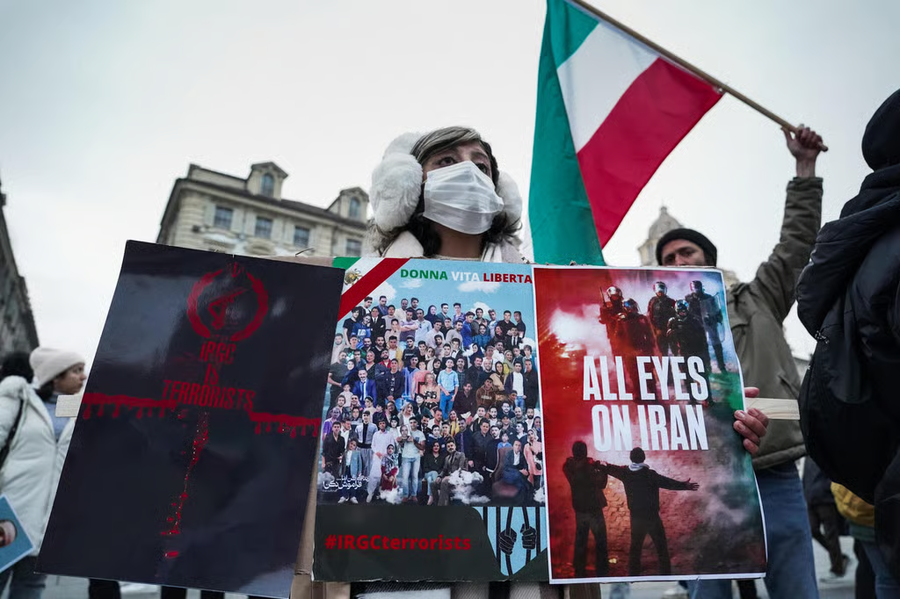
Supporting the Iranians is neither charity nor intervention. On the contrary, it is the fulfillment of the legal and political commitments that the EU has already made.
A month after nationwide protests, the Iranian people are still making history, at the cost of their lives. The free world can no longer pretend to be unaware of events on the ground, nor can it claim neutrality in the face of what has happened. Iranians are not asking others to speak for them, but to empower them to finish what they have started. And the urgency for international action has only intensified.
This week, the European debate finally changed direction. Italy officially joined the calls to condemn the Islamic Revolutionary Guard Corps (IRGC), and with that decision, the EU’s political landscape narrowed. France and Spain are now the only member states preventing the bloc from collectively designating the IRGC as a terrorist organization.
The question for Brussels is no longer whether the conditions for this have been met, it is whether the bloc will act once they have. For decades, the Iranian people have been subjected to systematic violence by their state. This is not the rule of law. It is a one-sided war against a civilian population, marked by extrajudicial executions, enforced disappearances, confessions, torture, mass censorship and the deliberate use of deprivation as a tool of oppression. On one side stands a totalitarian state; on the other, unarmed citizens.
As videos and eyewitness accounts continue to emerge despite severe communication blackouts, the scale of the violence is no longer in doubt. Backed by investigative reporting, sources inside Iran warn that more than 36,500 people may have been killed by regime forces since the protests began on December 28. Leading human rights organizations have verified thousands of deaths, warning that all available figures are almost certainly underestimates due to access restrictions and internet shutdowns.
The scale, organization and purpose of this repression meet the legal threshold for crimes against humanity, as defined under the 1998 Rome Statute that established the International Criminal Court. And under the UN Responsibility to Protect (R2P), a principle that seeks to ensure that populations are protected from mass atrocities, which the EU has formally endorsed, this threshold triggers an obligation. At this point, inaction ceases to be a deterrent and becomes a moral, political and legal failure.
The dangers here are immediate. Thousands of detained protesters face the imminent threat of execution. Iran’s top judicial authorities have warned that continued protest, especially if alleged foreign support is cited, constitutes moharebeh, or “war against God,” a charge that carries the death penalty and has historically been used to justify mass executions following unrest. Arbitrary detention and the lack of due process place detainees at clear and foreseeable risk, heightening the obligations of the international community.
The Iranian people are courageously facing the challenge set before them, demonstrating action, cohesion and determination. According to the pillars of R2P, responsibility now shifts outward, first to assist and, when necessary, to take collective action when a state itself is the perpetrator of atrocities.
Six actions flow directly from these obligations:
First, civilians must be protected by degrading the regime’s capacity to commit atrocities. This requires the formal designation of the IRGC as a terrorist organization given its central role in systematic violence against civilians both inside and outside Iran. This is in line with European legal standards. Italy has taken the lead. Now France and Spain must follow, so that the EU can act as one.
Second, the bloc must put in place coordinated and sustained economic measures consistent with R2P. This includes a global freeze of the regime’s assets under the EU sanctions framework, as well as the identification, seizure and dismantling of the shadow fleet of “ghost tankers” that finance repression and evade sanctions.
The third obligation is to guarantee the right to information. Iran’s digital blackout constitutes a serious violation of freedoms protected under the European Convention on Human Rights. Free, secure and continuous access to the internet should be ensured through the large-scale deployment of satellite connectivity and secure communication technologies. Cyber-safeguards should prevent arbitrary shutdowns of civilian networks.
Fourth, the EU must act to end state impunity through legal accountability. This means expelling representatives of the regime involved in the repression of citizens from European capitals and initiating legal proceedings against those responsible for crimes against humanity under universal jurisdiction, a principle already recognised by several EU member states.
Fifth, the bloc should demand the immediate and unconditional release of all political prisoners, who were detained in clear violation of Iran's international human rights obligations.
Finally, Europe should issue a clear ultimatum, demanding that independent non-governmental humanitarian and human rights organizations be granted immediate, unrestricted and time-limited access to the ground inside Iran. If this access is not granted within a specified timeframe, it should withdraw diplomatic recognition from the Islamic Republic of Iran.
Non-recognition is a legitimate response to a regime that has lost its legitimacy by systematically attacking its own population. It would also signal clear support for the Iranian people's right to a representative and accountable government.
Supporting the Iranians is neither charity nor intervention. On the contrary, it is the realisation of the legal and political commitments that the EU has already made. The regime in Tehran has practiced state-sponsored terror, exported violence, destabilised the region and fuelled nuclear threats for 47 years. Ending this trajectory is not ideological. It is a matter of European and global security.
For the EU, there is no procedural justification left. The evidence is abundant. The legal framework is in place. France and Spain are now the only ones standing between the bloc and collective action against the IRGC. What is at stake is not diplomacy, but Europe’s credibility and whether it will uphold the principles it invokes when they are tested by history./ Adapted from “Pamphlet” by “Politico”


Lini një Përgjigje