


 Shkruar nga Pamfleti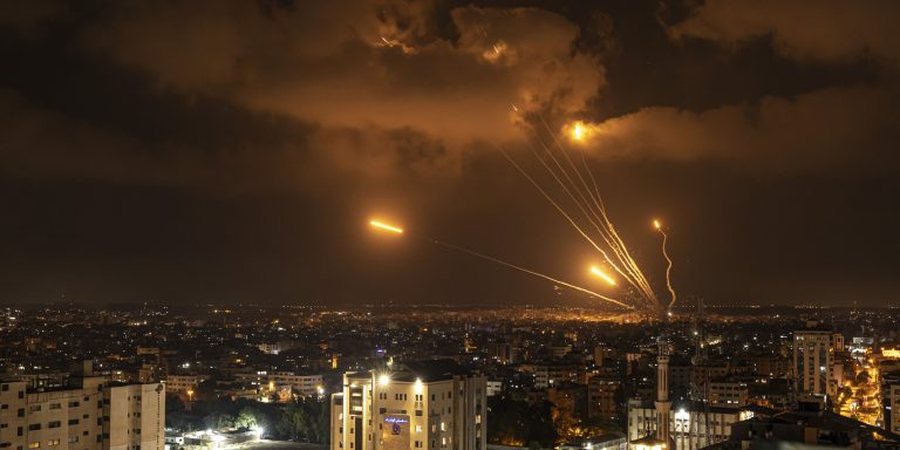
The situation in the Middle East changes very quickly. At one point you are faced with news of unprecedented missile and drone strikes between Iran and Israel. While at another moment the focus is on the suffering in Gaza.
But policymakers, analysts and military leaders are still focusing on the clash between the two old adversaries, one that probably came as a minor technological failure short of sparking a devastating international conflict.
This was the first time that Iran and Israel attacked each other directly. Some analysts say the Iranian attack was the largest combined missile and drone strike, larger than any attack Russia has carried out against Ukraine.
It was the first external bombing of Israel since Saddam Hussein's Scud missiles in 1991.
Most of the more than 300 Iranian drones and missiles were shot down, or even failed en route. But in Jerusalem the night sky was lit up by Israeli air defenses trying to shoot down ballistic missiles.
Still, some in the West feel they can draw positive news from the April 13 attack and Israel's limited retaliation last week.
They argue that it was a major intelligence achievement to anticipate the Iranian attack and that Israel's defense was an outstanding example of allied military cooperation.
Let's take the intelligence operation first. The US was informed of Iran's plans before Saturday night's attack. And most importantly, they revealed the "scale" of Iran's ambition.
It helped the US convince several countries to come together in defense of Israel, including Jordan and Saudi Arabia. Their fear was great, as they were aware of the danger of Iran's plans, an escalated regional war if Israel had no choice but to retaliate as harshly as possible.
So the Iranian private intelligence and whistleblowing (which the US denies happened) gave Israel and its allies time to prepare.
Meanwhile, the roles played by Jordan and Saudi Arabia are still not entirely clear.
Jordan has admitted to shooting down Iranian drones to defend its sovereignty. Jordan is understood to have also allowed Israeli warplanes some access to its airspace.
The Saudis are believed to have provided information to the US and monitored any threats from Iran-backed armed groups in Yemen. But it seems to have worked. The US, British, French, Jordanian and Saudi militaries showed they could act together in collective air defense.
"It was an extremely successful tactical operation," the security source said, adding that "No other group of nations could do this in the world."
Some have also argued that this could be the beginning of a new regional alliance against Iran. For others, however, this is a typical security and military perspective, a perspective of technological success.
Analysts, or rather skeptics, argue that if Iran wanted to inflict significant damage on Israel, it might not have given advance warning, expanded its targets, launched a second wave of attacks, or even ordered Hezbollah to launch a major attack from Lebanon.
Emile Hokayem of the International Institute for Strategic Studies said the operation revealed how much Israel relied on allies for its defense.
Hokayem also dismissed the idea that this crisis marked the beginning of a new regional military alliance.
"We are not at the peak of a new era. Arab states have cooperated primarily because they want to avoid a regional confrontation. And they want to demonstrate that they are good partners for their Western allies. It is also simply a matter of national sovereignty. They don't want things to escalate," he said.
The second claim of the optimists is that Iran and Israel have learned from this experience. Hokayem says that Iran and Israel have learned to understand each other.
He cites Israel's failure to understand the consequences of its decision to kill several elite Iranian Revolutionary Guard Corps (IRGC) commanders at the Iranian consulate in Damascus.
There is also skepticism that either side has restored deterrence. Amos Harel, a defense analyst for the Israeli newspaper Haaretz, said: "Both countries violated the previous rules of the game, at limited cost ... the balance of deterrence between the two countries is unsettled."
Perhaps the main lesson learned by many in this crisis was how close the region had come to full-scale war./BBC







Lini një Përgjigje