


 Shkruar nga Guy Chazan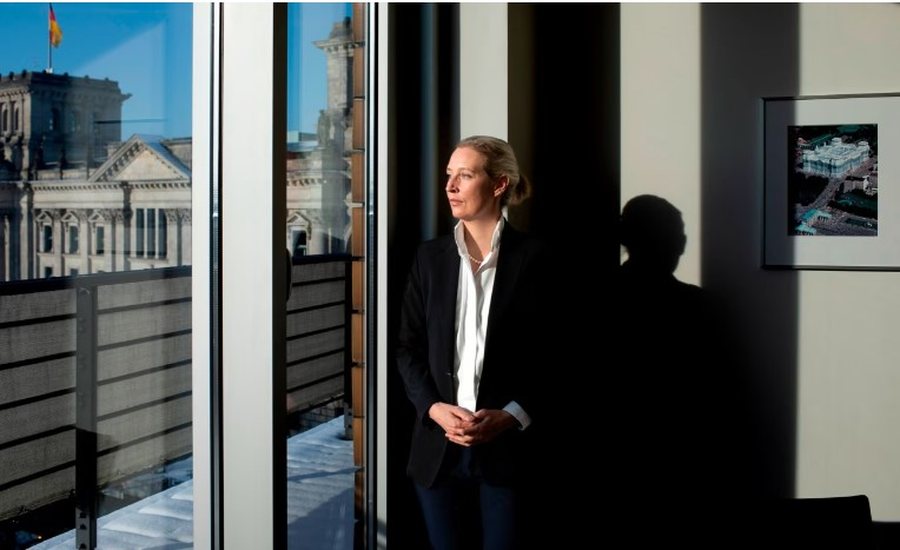
The AfD is expected to win local elections in September in the eastern states of Saxony, Brandenburg and Thuringia, although with all other major parties refusing to reach a coalition deal with the AfD, its path to power remains unclear.
If it comes to power, the Alternative for Germany (AfD), a far-right political force that has grown rapidly in recent years, will aim to hold a Brexit-like referendum on whether or not Germany stays in the EU. This is how its leader Alice Weidel expresses herself, who describes Great Britain's exit from the bloc as a very fair decision.
"Brexit is a model for Germany, an example of a truly sovereign country" - she says in an interview for "Financial Times". Weidel, the party's leader since 2022, points out that an AfD government will first aim to reform the EU and eradicate its "deficit in internal democracy", including curbing the powers of the European Commission, a " government not elected by vote".
"But if such reform is not possible, if we fail to restore the sovereignty of EU member states, then we must let the people decide, as Britain did. And we could have a referendum on Dexit, a German exit from the European Union.
This idea breaks a big taboo in Germany, where the main parties are very pro-European. The German constitution contains strong restrictions on national referendums. But even if one were to be held, polls suggest a large majority of Germans would vote to remain in the EU.
However, among AfD voters, support for the EU is weakest. Weidel is speaking openly about this plan amid a huge surge in support for the AfD, which currently enjoys 22 percent of approval in polls, ahead of the 3 parties in current Chancellor Olaf Scholz's weak coalition, the Social Democrats, the Greens and the Liberals.
The AfD is expected to win local elections in September in the eastern states of Saxony, Brandenburg and Thuringia, although with all other major parties refusing to reach a coalition deal with the AfD, its path to power remains unclear.
The German secret service has listed many extremists of the AfD as problematic and has put some of its officials under surveillance. However, the party has benefited from public anger at Scholz, and the way he has managed a steadily deteriorating economy.
But in recent days, Wiedel has come under fire following reports of a controversial meeting last November between AfD lawmakers and Austrian far-right leader Martin Sellner, where an "emigration" plan to leave with force from Germany millions of people of immigrant origin, including even citizens with German passports.
Anti-AfD protests have been held in several German cities, while politicians are sounding the alarm about the danger this party poses to the country's democratic institutions. Weidel did not attend that meeting, and promptly fired one of her closest aides who had been present.
However, she has had a hard time containing the public reaction. Lars Klingbeil, the leader of the Social Democrats, accused him of downplaying the deportation plan. "You are a wolf in sheep's clothing!" he told him during a debate in the Bundestag last week.
"But I'll say it: your facade has started to crumble. Finally, people are seeing the true face of the AfD" - he added. In her interview, Weidel blamed Correctiv, the investigative newspaper that first reported on the meeting, calling its methods "scandalous." "It was simply an attempt to criminalize the very idea of legally repatriating people who don't have permission to be here or who are subject to a deportation order. AfD is the party that supports the implementation of the laws of this country", she declares.
Wiedel says that for him the concept of "emigration" also means the deportation of people who have "illegally obtained citizenship through false claims", or individuals "with dual citizenship who are suspected of terrorism, or who have been convicted of various crimes ".
However, she ruled out the scenario of mass deportations. "We cannot make generalizations" - she specifies. However, she added that the 1.1 million Ukrainian refugees currently in Germany do not have a long-term future in the country, and it is wrong for them to be allowed to receive social assistance.
"It is clear that when the war ends, all Ukrainians must return to their homes. They should be there to help rebuild their country," says Wiedel. The AfD was founded in 2013 by conservative economists who were angry about the bailouts some eurozone countries were receiving during the debt crisis. But it gradually drifted to the right, using a wave of anger over former Chancellor Angela Merkel's open-door refugee policy to craft a tough anti-immigration and anti-establishment platform.
Weidel, who has a doctorate in economics and worked for prestigious companies such as Goldman Sachs and Allianz Global Investors before entering politics, has led the AfD parliamentary group since 2017. In a cohabitation with a Sri Lankan immigrant, she stands out in a male-dominated party with traditional family customs.
With her signature clothes and jewelry, wealth and career in the world of finance, she gives the AfD "the atmosphere of the bourgeoisie that is well liked by middle-class voters beyond its traditional right-wing base," says Hans Vorländer, a political scientist. at the Technical University of Dresden.
However, security officials warn that behind this image hides a party that is heavily infiltrated by right-wing extremists and is becoming increasingly radicalized. A German court ruled in 2019 that one of its most senior politicians, Björn Höcke, could be described as a fascist, citing "verifiable facts".
Other parties have responded to the threat from the AfD, excluding any form of coalition or cooperation with this party. As a result, despite its strength in the polls, the AfD does not rule in any of Germany's 16 local governments.
Speaking from her office overlooking the Reichstag, and with the background noise of anti-government protests, Weidel herself admitted that the AfD cannot come to power in Berlin "before 2029". But she insists that a future role for the AfD in government is something "inevitable".
She predicts that the center-right Christian Democrats (CDU) would be the first to abandon their boycott of the AfD. "The CDU will not be able to maintain its distance from us for a long time. The elections in Hesse in November last year showed that we can form a clear right-wing majority. And the CDU cannot refuse to accept this in the long term, especially in the eastern countries," she says.
Asked what the AfD's main priorities would be in government, Weidel said it would “establish effective border controls. . . and immediately deport immigrants sentenced to prison". It would also reform the tax system, reduce government spending and end Germany's shift from fossil fuels to renewable energy. "France is planning 15 new nuclear power stations, while we are planning to rely on wind turbines and solar panels that we can't even produce ourselves," she concludes. / Adapted "Pamphlet" from "Financial Times"








Lini një Përgjigje