


 Shkruar nga Pamfleti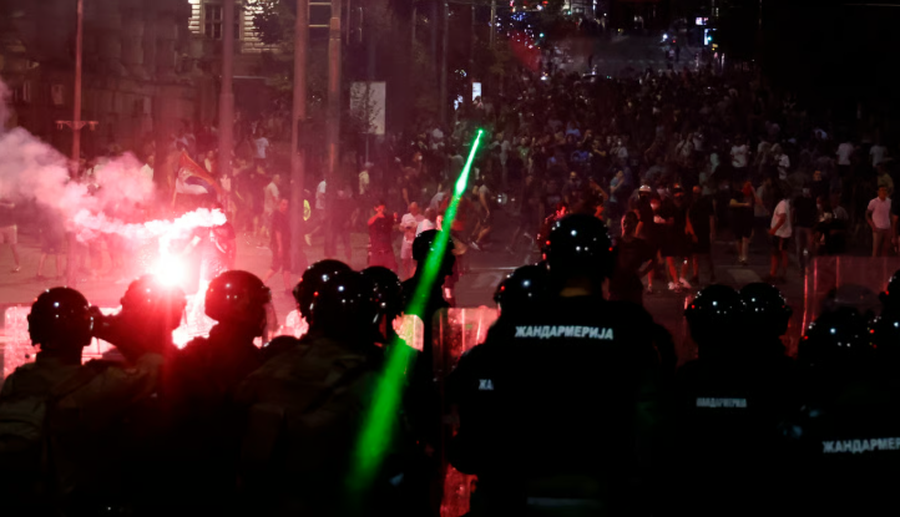
Serbian protests turned violent this week, with even President Aleksandar Vucic admitting in a television interview Friday night that a long-running standoff with his opponents has entered the "fighting phase."
Tense protests erupted on Friday evening, as tear gas was fired and heavily armed police were deployed in Belgrade, Novi Sad, Nis and other cities across the country.
The most explosive clashes occurred on Thursday evening, when demonstrators in Novi Sad chanted “Vucic is finished” as they smashed windows of ruling party offices and threw furniture into the street. It was a dramatic escalation in a nine-month protest movement that has gripped the country.
Scenes of riot police separating masked, seemingly pro-government hooligans from demonstrators were seen in several cities, while flamethrowers covered the streets in bright red.
As tensions rise, groups of pro-government soccer fans have appeared at protest sites and clashed with demonstrators, a pattern that opposition figures say is intended to provoke confrontations.
“People’s frustrations have reached their peak and they feel like they are in a pressure cooker that is about to explode,” Peđa Mitrović, an opposition lawmaker, told Politico.
Mitrovic was attacked on Thursday evening, receiving a blow to the head while trying to film a riot outside the offices of the Serbian Progressive Party in Belgrade, which were guarded by masked men.
“After a masked person came and told me to delete the recording, I refused and told them I was an MP, and at that moment he called for support and a group of them started hitting me from all sides,” Mitrovic explained.
He escaped and ran away, but similar scenes of violence were reported across the country, with pro- and anti-government protesters escalating the clashes.
The protests began last November after a railway station canopy collapsed in Novi Sad, killing 16 people, including two young children, and seriously injuring several others.
What began as brief demonstrations has since grown into the largest protest movement in modern Serbian history, fueled by the government's denials that it was in any way culpable, despite accusations linking the tragedy to a state-run renovation project.
"In all these months of protests, the prosecution arrested only one minister and another claims that he has a medical report and cannot be arrested. The lack of accountability has pushed people to the brink and the government is to blame," Mitrovic added.
For its part, the government said that recent days marked the largest increase in violence against police, with 121 officers injured and 114 people arrested.
"For no reason, the police were massively and brutally attacked, and there were violent attempts to break the cordons that had been set up," Interior Minister Ivica Dacic said at a press conference.
Warnings from independent domestic analysts that Serbia could be heading towards deeper instability if the government does not take the protesters' demands seriously are increasing.
An informal network of academics, including teachers, researchers and university lecturers from Vojvodina, the region where the protests first erupted, condemned the ruling party's refusal to call elections, a key demand fueling the movement.
They say Vucic “is prepared to provoke a civil war just to avoid calling elections.” /Adapted from Politico/



Lini një Përgjigje