


 Shkruar nga Pamfleti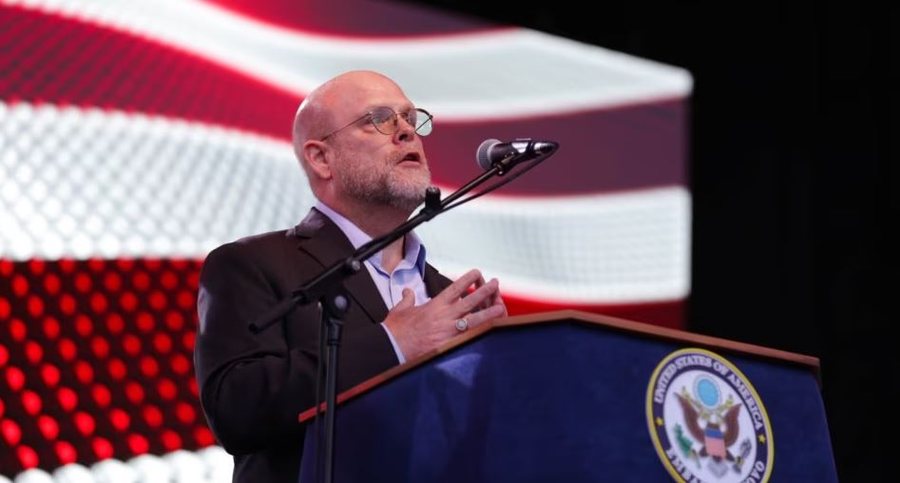
The United States has full confidence in the European Union regarding the mediation of the dialogue between Kosovo and Serbia.
This is what the American ambassador in Pristina, Jeffrey Hovenier, declared during a speech at the second edition of the Peace and Democracy Summit that is being held in Pristina.
"The USA has full confidence in the EU in its mediation of the dialogue, the USA has full confidence in the high representative of the EU, Josep Borrell, and the special representative for the Kosovo-Serbia dialogue, Miroslav Lajçak, as objective implementers of this policy", said Hovenier.
Hovenieri's statement comes two days after the Prime Minister of Kosovo, Albin Kurti, directed accusations against Lajçak, who described him as a one-sided mediator.
Is Kurti closing the doors to the European emissary?
Kurti said that during the last round of dialogue - held in Brussels on September 14 - there appeared to be coordination between the president of Serbia, Aleksandar Vučić, and Lajcak to create, as he put it, an "alternative scenario, where half of the agreement applies".
He said that in this meeting, where the Kosovar Prime Minister presented a plan for the implementation of the Agreement towards normalization that he said was rejected by the EU and Serbia, Lajcak "positioned himself" against Kosovo.
"It is important that all actors in this operation, in this process, accept the process they are in and play poker with the cards they have been dealt. And having this vision in mind, the work for the normalization of relations, for the full implementation of the Ohrid Agreement and the Annex, from both sides, which is our expectation, is the way forward. This brings Kosovo closer to the vision we share for full integration into the Euro-Atlantic structures", Hovenier said on September 20.
The European Union said on September 19 that it does not comment on Kurti's statements, which according to the bloc contain "baseless accusations". The EU spokesman, Peter Stano, said that Lajcak and Borrelli - the European mediators of the dialogue - have the support of the EU member states.
The Kurti-Vucic meeting on September 14 - which ended without a result - was the first between the dialogue bearers since tensions in northern Kosovo rose at the end of May.
After the meeting in Brussels, the European Union said that the Prime Minister of Kosovo, Albin Kurti, was not ready to move forward, unlike the President of Serbia, Aleksandar Vucic, who "accepted their proposal" for the implementation of the Basic Agreement for the normalization of Kosovo-Serbia relations.
The head of the EU's foreign policy, Josep Borrell, stated that Kurti insisted on formalizing, first, the de facto recognition of Kosovo by Serbia.
Kurti in Brussels said that "Serbia's conditionality" for the formation of the Association of municipalities with a Serbian majority "has turned into the position of EU emissaries".
According to Vucic, Kurti simply "avoided the formation of the Association... this is the essence of everything".
Kosovo and Serbia reached the Agreement towards normalization earlier this year and the annex for its implementation. The EU has requested that the agreement be implemented according to a plan that it has proposed.
The agreement towards the normalization of relations, consisting of 11 articles, envisages, among other things, a level of self-management for the Serbian community in Kosovo and mutual recognition of state symbols, while asking Pristina and Belgrade to also implement all previous dialogue agreements.
For the formation of the Association of municipalities with a Serbian majority, Kosovo and Serbia have already reached an agreement in 2013.
Despite the constant demands of the international community and Serbia, Kosovo has never implemented that agreement, fearing that it could affect the functionality of the state.




Lini një Përgjigje