


 Shkruar nga Pamfleti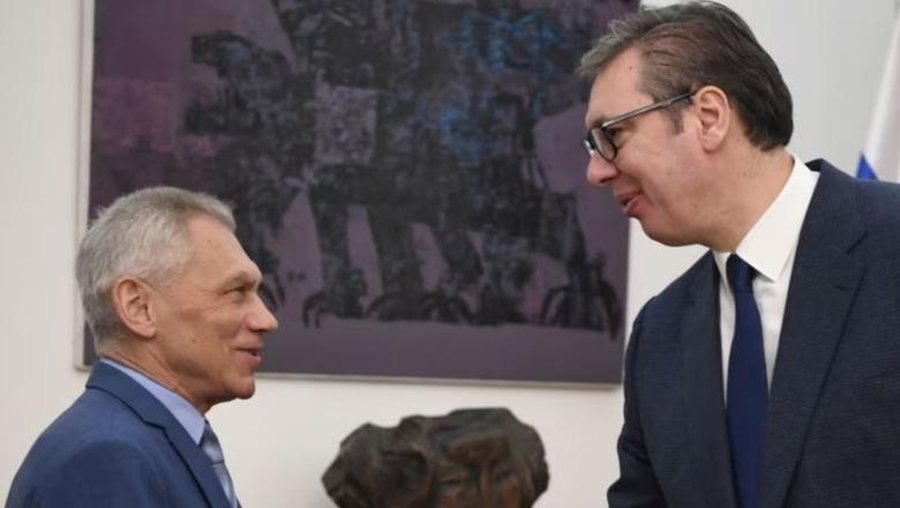
The Russian Ambassador to Belgrade, Aleksandar Bocan-Kharchenko, stated that the West wants to replace Serbian President Aleksandar Vucic with a weak politician who is controlled by the European Union (EU).
"In fact, the desire is to remove Vucic and install one of the 'leaders', who would be the same or similar to those who are formally in power in other countries, but are completely subservient to the EU," he told the Russian news agency RIA Novosti.
Asked about these statements by the Russian ambassador, Serbian President Aleksandar Vučić, during a press conference, said that he thanked the Russian diplomat for his "correctness".
Vučić met with Harcenko on August 21 and after this meeting announced that a high-level meeting between the leadership of Serbia and Russia would take place soon.
"I emphasized that we remain committed to developing friendly relations with Russia, with a clear determination to maintain peace and political stability in the Western Balkans region, especially in Bosnia and Herzegovina," Vučić declared after that meeting.
The opposition Freedom and Justice Party (SSP) criticized the Russian ambassador for his statements, saying it is not the first time he has publicly interfered in Serbia's internal affairs.
The Vice President of the Serbian People's Party, Borko Stefanović, wrote in an open letter to the Russian ambassador that he has long been "constantly insulting the citizens of Serbia, labeling them as foreign mercenaries and instruments of the West."
"With this action, you lose the sympathy of our people, because with the same persistence you defend the regime of an autocrat and his criminal actions," said Stafanovic.
From the Kremlin, official Belgrade received support for anti-government protests, through which demonstrators are demanding the holding of extraordinary parliamentary elections in Serbia.
In a statement by the Russian Foreign Ministry on August 13, it was stated that "some forces in Serbia, under the guise of slogans about 'seeking justice and democracy', do not hesitate to use open aggression, barbarism and violence."
Mass protests in Serbia, led by students, have been ongoing for more than nine months, following the collapse of a concrete shelter at the Novi Sad Railway Station in November last year, when 16 people lost their lives.
Through these protests, they are demanding accountability for the tragedy in Novi Sad, for state institutions to carry out their duties, and the organization of extraordinary parliamentary elections.
Belgrade has continued to maintain close relations with Moscow even after Russia was placed under sanctions by the European Union, the United States and other Western countries over its invasion of Ukraine.
Vucic met with Russian President Vladimir Putin at the Kremlin in May during the marking of the 80th anniversary of the victory over fascism.
Even though Serbia is a candidate for EU membership, the authorities refuse to join the sanctions against Russia./ REL


Lini një Përgjigje