


 Shkruar nga Abid Hussain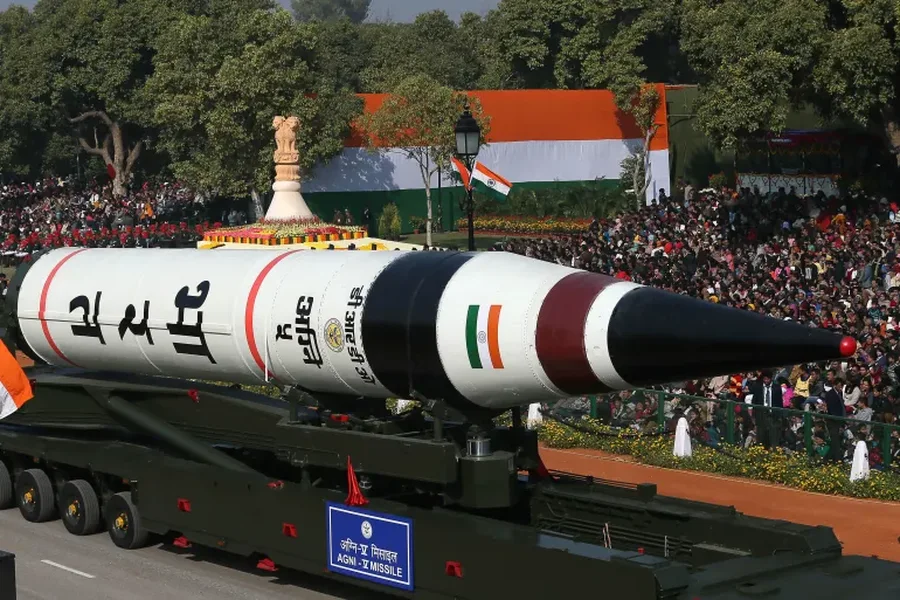
From New Delhi to Beijing: why India's missile arsenal is not just against Pakistan
On August 20, India announced that it had successfully test-fired the Agni-V intermediate-range ballistic missile from a test range in Odisha, on the eastern coast of the Bay of Bengal. The test was seen as a significant step in New Delhi's strategic arsenal and a clear message to regional rivals.
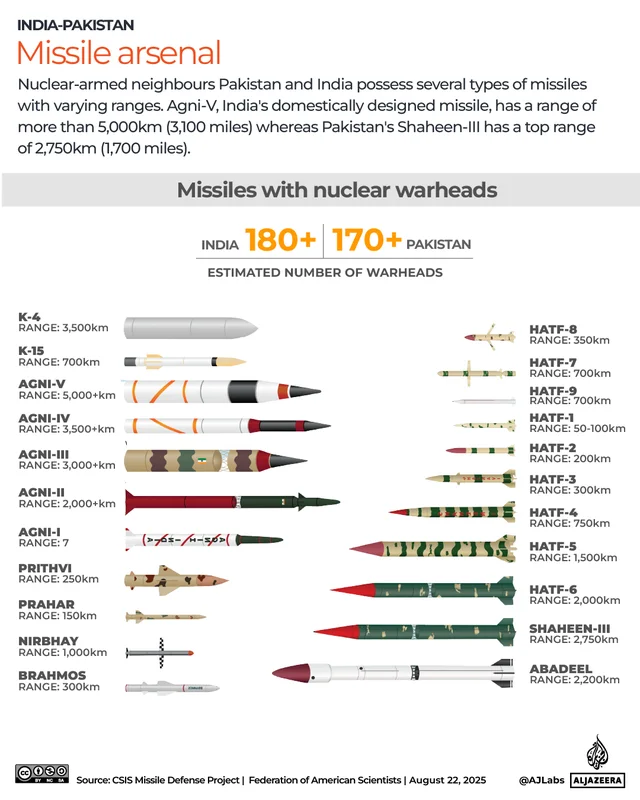
Agni-V, which means “fire” in Sanskrit, is a 17.5-meter-long, 50-ton missile capable of carrying over 1,000 kilograms of nuclear or conventional warheads. It can travel over 5,000 kilometers at hypersonic speeds of up to 30,000 kilometers per hour, making it one of the fastest ballistic missiles in the world. This was the tenth test of Agni-V since 2012 and the first since March last year, but what gave it political weight was the timing of its launch.
The test came just a week after Pakistan announced the creation of a new Advanced Missile Force Command (ARFC), which experts see as an attempt to fill the gaps exposed in the four-day conflict with India in May. However, analysts say the Agni-V's message is more aimed at China than Pakistan. Its range covers almost all of Asia, including northern China, and even parts of Europe.
The development comes just days before Prime Minister Narendra Modi's visit to China for the Shanghai Cooperation Organization (SCO) summit. After years of tensions over their shared Himalayan border, relations between the two countries have begun to ease, especially after the trade crisis sparked by US President Donald Trump, who recently doubled tariffs on Indian goods to 50 percent over Russian oil imports. However, India continues to see China as its main strategic threat, which explains the development of long-range missiles.

Experts point out that while Pakistan is a secondary target, the Agni-V's primary mission is China. Professor Manpreet Sethi of the Center for Air Power Studies in New Delhi says that "India needs a long-range missile, but not an intercontinental one, because of its perceived threat from China." Christopher Clary, a professor at the University of Albany, also says that the Agni-V is designed primarily to target China's cities and industrial centers, especially the east coast where its most important political and economic cities are located.
Compared to Pakistan, India has a major technological advantage. In the May clashes, despite losing several aircraft, India inflicted significant damage on Pakistani bases using the BrahMos supersonic missile, which has a range of 500 kilometers and the ability to evade interception. This has highlighted that the Indian program has objectives far beyond the subcontinent.
India is already working on the Agni-VI, which is expected to have a range of over 10,000 kilometers and the ability to carry multiple independently targetable warheads (MIRV). This technology increases the destructive power of a missile, allowing it to hit several targets simultaneously. Analyst Mansoor Ahmed of the Australian National University believes that this latest test served as a technological testbed for the development of India's new capabilities for nuclear submarine-launched ballistic missiles (SLBMs). Within the next decade, India could deploy up to 300 nuclear warheads on its SSBN fleet alone, two of which are already operational and two more under construction.
Pakistan, on the other hand, has neither long-range missiles nor nuclear submarines. Its longest range is the Shaheen-III with 2,750 kilometers. It has developed the MIRV-capable Ababeel missile, but this has only a range of 2,200 kilometers, making it the shortest system of its kind operated by a nuclear-armed state.

According to Pakistani analysts like Tughral Yamin, their program remains limited and defensive towards India, while India has global ambitions, trying to position itself as a superpower with credible deterrent capacity against China and other major powers.
This new missile race is not going unnoticed by the US. Last year, a senior White House official warned that Pakistan’s ambitions could eventually lead it to target targets beyond South Asia, even the United States. But in the meantime, India’s arsenal is being viewed differently. Analysts such as Ashley J Tellis of the Carnegie Endowment emphasize that the Indian program is seen as part of the US strategy for a secure Indo-Pacific. The 2008 US-India civil nuclear agreement and India’s exemption from the Nuclear Suppliers Group restrictions gave New Delhi the status of a de facto nuclear power, even though it is not a signatory to the Treaty on the Non-Proliferation of Nuclear Weapons (NPT).
According to analysts, this shows that while Pakistani ambitions arouse uncertainty, India's are perceived by the West as acceptable and even beneficial for the strategic balance in Asia against China. However, this arms race does not make the region safer. On the contrary, it increases the risk of accidental collision between the three nuclear powers of Asia. / Adapted from "Al Jazeera"









Lini një Përgjigje