


 Shkruar nga Pamfleti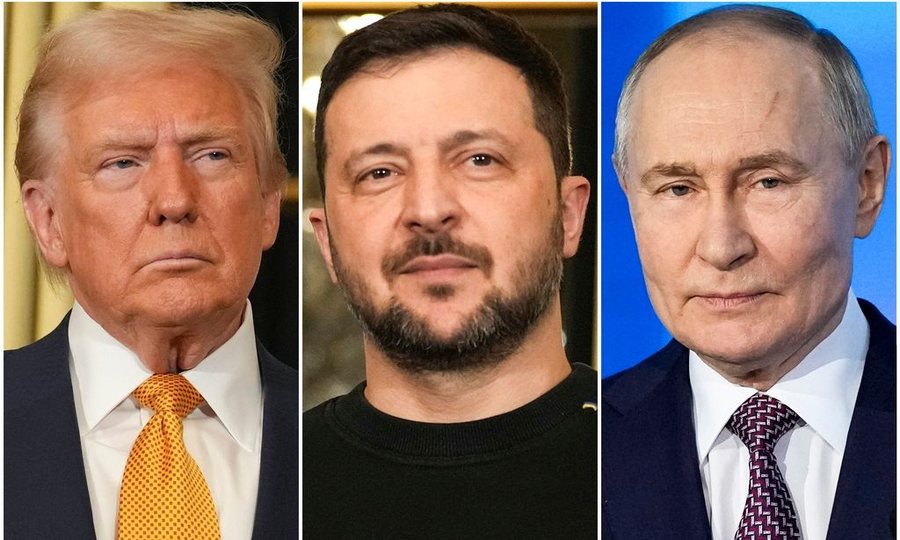
Two of the most complex issues in Washington's 20-page plan concern territory and the fate of Europe's largest nuclear power plant, currently owned by Russia.
Russia, the United States and Ukraine appear to agree that the end of the nearly four-year war is near, but, as President Donald Trump said, "one or two very difficult points" remain.
Two of the most complex issues in Washington's 20-page plan concern territory and the fate of Europe's largest nuclear power plant, currently held by Russia. The Kremlin agrees with Trump that negotiations are in the "final stages," while Zelensky will meet European leaders in France on Jan. 6, with any problems threatening the deal.
Russian forces occupy most of the Luhansk region in the east, but just over 75% of Donetsk, and Putin wants it all, including the remaining “fortress belt” cities of Sloviansk and Kramatorsk.
Proposal for a demilitarized zone
"We can't just withdraw, this contradicts our law," Zelensky said.
According to him, it is not just a law. "There are people living there, 300,000 people... We cannot lose them," the Ukrainian President emphasizes.
He suggested that Ukrainian forces withdraw to create a demilitarized or free economic zone under Ukrainian supervision if the Russians do the same, with the line of contact guarded by international forces.
It is hard to imagine Putin agreeing, while Russian generals assure him of swift invasions.
"If the authorities in Kiev do not want a peaceful solution, we will solve all problems militarily," he said. Analysts at the Institute for the Study of War estimate that capturing the rest of Donetsk will take until August 2027.
Zelensky's compromise also calls for Russia to withdraw from areas such as Kharkiv, Sumy, Dnipropetrovsk and Nikolaev. Without progress in Donetsk, peace seems unrealistic, although the Kremlin's ambassador, Yuri Ushakov, left room for doubt: "It is possible that there will be no troops there, neither Russian nor Ukrainian," with the region remaining in the Russian Federation.
Zaporizhia Nuclear Power Plant
Since March 2022, Russia has owned the Enerkhoddar nuclear power plant on the banks of the Dnieper, with its six reactors in cold shutdown for three years. External energy supplies from Ukraine keep it operational to prevent collapse, while significant investments are needed to restart it, including the reconstruction of the Kakhovka dam.
Ukraine believes that the region should be demilitarized and transformed into a free economic zone.
According to Zelensky, the US proposal is for the power plant to be run as a joint venture with Russia and Ukraine.
Kiev has said this is unrealistic and that, instead, the US and Ukraine could run it jointly on a 50-50 basis, with the US deciding where half of the power goes, implying that it will go to Russia. The head of Russia’s Rosatom, Alexei Likhachev, insists on exclusive Russian management, leaving room for Ukraine to use the electricity through international cooperation.
Lack of trust
Despite the positive statements, there is a lack of trust. Zelensky rejected Trump's assessment that Putin "wants success for Ukraine."
"I don't trust the Russians or Putin," he said. At the same time, Moscow accuses Ukraine of a drone attack on Putin's residence, while Kiev sees it as a pretext for bombing.
Remaining issues of the agreement
Kiev has asked American and European leaders for security guarantees to ensure a NATO-style response in the event of another Russian attack. Ukraine also wants to maintain an army of 800,000 men.
Even though the US and Europe may sign a security agreement, Russia will not accept the presence of European troops in Ukraine.
Economic losses for Ukraine have been estimated at $800 billion (£600 billion), so another key issue is how much Russia will contribute to this. The US is discussing a joint investment fund with Europe, and Russia has assets worth €210 billion (£183 billion) in Europe that could also be used, although Moscow has so far refused to allow this.
Russia also rejects Ukraine's request to join NATO. This may not be a major obstacle, as it is not yet likely to happen, but it is part of the Ukrainian constitution, so it will be difficult to reach an agreement.
European Union membership is also a potential obstacle, perhaps less so for Russia than for the countries ahead of Ukraine in the queue for EU membership. Few believe that will happen anytime soon.
Zelensky proposes referendum after 60-day ceasefire, as 87% want peace but 85% reject concessions for Donbas. The Kremlin sees the ceasefire as an extension of the war, while Trump seems to understand Putin's position. However, without a vote, Zelensky considers the agreement invalid. /Adapted from BBC /


Lini një Përgjigje