


 Shkruar nga America Hernandez , Riham Alkousaa & Marwa Rashad
We need Russian gas, we need cheap energy, no matter where it comes from.
More than three years after Russia's invasion of Ukraine, Europe's energy security is fragile. U.S. liquefied natural gas helped plug the Russian supply gap in Europe during the 2022-2023 energy crisis.
But now that President Donald Trump has shaken up relations with Europe forged after World War II, and turned to energy as a bargaining chip in trade negotiations, businesses are wary that reliance on the United States has become another weakness.
Against this backdrop, executives of major EU firms have begun to say what would have been unthinkable a year ago: that importing some Russian gas, including from Russian state-owned giant Gazprom, might be a good idea.
This would require another major policy shift, given that the Russian invasion of Ukraine in 2022 led the European Union to pledge to end Russian energy imports by 2027.
Europe has limited options. Talks with LNG giant Qatar for more gas have stalled, and while the deployment of renewables has accelerated, the rate is not fast enough to allow the EU to feel confident.
" If there is a reasonable peace in Ukraine, we can return to flows of 60 billion cubic meters, maybe 70, per year, including LNG ," Didier Holleaux, executive vice president at France's Engie, told Reuters in an interview.
The French state partly owns Engie, which was once among Gazprom's biggest gas buyers. Holleaux said Russia could supply about 20-25% of the EU's needs, down from 40% before the war.

The head of French oil major TotalEnergies (TTEF.PA), Patrick Pouyanne, has warned Europe against over-reliance on US gas.
“We need to diversify, many routes, not rely too much on one or two. Europe will never go back to importing 150 billion cubic meters from Russia like before the war ... but I would bet maybe 70 billion cubic meters ,” Pouyanne told Reuters. Total is a major exporter of U.S. LNG and also sells Russian LNG from private firm Novatek (NVTK.MM).
German pivot
Franca, e cila prodhon sasi të mëdha të energjisë bërthamore, tashmë ka një nga furnizimet më të larmishme të energjisë në Evropë. Gjermania u mbështet shumë në gazin e lirë rus për të ndihmuar në nxitjen e sektorit të saj të prodhimit deri në luftën në Ukrainë dhe ka më pak opsione.
Në Leuna Chemical Park, një nga grupimet më të mëdha kimike të Gjermanisë që pret fabrikat e Dow Chemical dhe Shell (SHEL.L), disa prodhues thonë se gazi rus duhet të kthehet shpejt.
Rusia mbulonte 60% të nevojave lokale, kryesisht përmes gazsjellësit Nord Stream, i cili u hodh në erë në vitin 2022. Ai tha se industria kimike gjermane ka shkurtuar vendet e punës për pesë të katërtat me radhë, diçka që nuk është parë për dekada.
"Ne jemi në një krizë të rëndë dhe mezi presim. Rihapja e tubacioneve do të ulte çmimet më shumë se çdo program aktual subvencionimi. Është një temë tabu", tha Christof Guenther, drejtor menaxhues i InfraLeuna, operatori i parkut, duke shtuar se shumë kolegë ranë dakord për nevojën për t'u kthyer në gazin rus.
Pothuajse një e treta e gjermanëve votuan për partitë miqësore me Rusinë në zgjedhjet federale të shkurtit.
Në shtetin e Mecklenburg-Vorpommern, rajoni i Gjermanisë Lindore ku gazsjellësi Nord Stream del në breg pasi kalon nga Rusia nën Detin Baltik, 49% e gjermanëve duan një kthim në furnizimet me gaz rus, zbuloi një sondazh i kryer nga instituti Forsa.
"Ne kemi nevojë për gazin rus, kemi nevojë për energji të lirë, pa marrë parasysh se nga vjen. Ne kemi nevojë për Nord Stream 2 sepse duhet të mbajmë nën kontroll kostot e energjisë", tha Klaus Paur, drejtor menaxhues i Leuna-Harze, një prodhues petrokimik i mesëm në Leuna Park.
Faktori Trump
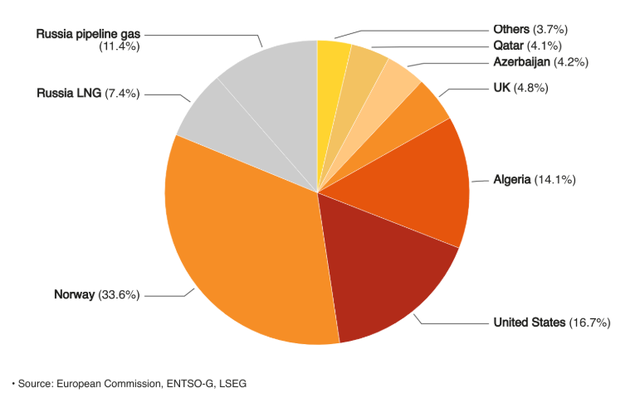
Gazi amerikan mbuloi 16.7% të importeve të BE-së vitin e kaluar - pas Norvegjisë me 33.6% dhe Rusisë me 18.8%. Pjesa e Rusisë do të bjerë nën 10% këtë vit pasi Ukraina mbylli tubacionet. Flukset e mbetura janë kryesisht LNG nga Novatek. BE-ja po përgatitet të blejë më shumë LNG të SHBA-së pasi Trump dëshiron që Evropa të ulë suficitin e saj tregtar me Shtetet e Bashkuara.
"Sigurisht, ne do të kemi nevojë për më shumë LNG", tha komisioneri i tregtisë së BE Maros Sefcovic javën e kaluar.

Lufta e tarifave ka forcuar shqetësimin e Evropës rreth mbështetjes në gazin amerikan, tha Tatiana Mitrova, një studiuese në Qendrën e Universitetit Kolumbia për Politikat Globale të Energjisë.
"Po bëhet gjithnjë e më e vështirë të konsiderohet LNG i SHBA-së si një mall neutral: në një moment ai mund të bëhet një mjet gjeopolitik", shtoi Mitrova.
Nëse lufta tregtare përshkallëzohet, ekziston një rrezik i vogël që Shtetet e Bashkuara mund të frenojnë eksportet e LNG-së, tha Arne Lohmann Rasmussen, kryeanalist në Global Risk Management.
A senior EU diplomat, speaking on condition of anonymity, agreed, saying no one could rule out “that this lever could be used.” If U.S. gas prices rise due to increased industrial and AI demand, the U.S. could restrict exports to all markets, said Warren Patterson, head of commodities strategy at ING.
In 2022, the EU set itself a non-binding target to end Russian gas imports by 2027, but has twice delayed publishing plans on how. An EU Commission spokesman declined to comment on the companies' comments.
Arbitration
Several EU firms have filed arbitration cases against Gazprom over its failure to deliver gas after the war in Ukraine. The courts awarded Germany's Uniper and Austria's OMV 14 billion euros and 230 million euros respectively. Germany's RWE has claimed 2 billion euros, while Engie and the other firms have not made their claims public.
The return of Russian gas worries Maxim Timchenko, the head of DTEK, the private Ukrainian gas company, which hopes to import U.S. LNG into Ukrainian storage and export it to Europe. / Adapted from "Pamphlet" by "Reuters"



Lini një Përgjigje