


 Shkruar nga Nathalie Hamou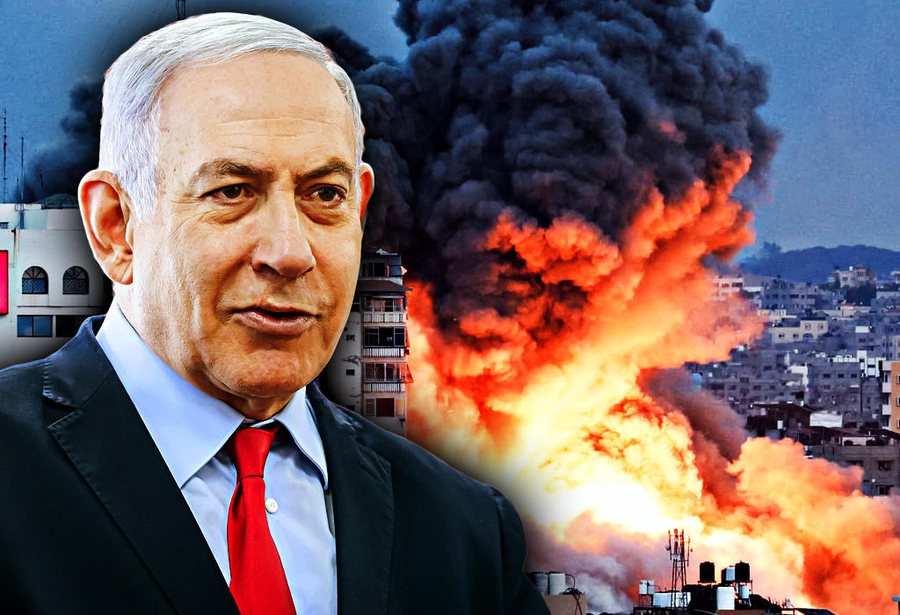
The renowned historian of medieval Judaism and right-wing Zionist, Benson Netanyahu, can rest in peace. Convinced that the very existence of the Jewish people was being threatened by the threats of extermination made by its enemies, the professor had entrusted his youngest son with the mission of preventing Iran from developing nuclear weapons. On Friday, June 13, the opportunity finally came his way. Israeli Prime Minister Benjamin Netanyahu, who for three decades has made preventing the Iranian nuclear threat and weakening the Shiite axis the cornerstone of his security strategy, decided to act.
The Likud leader ordered the Israeli air force to strike the “octopus’ head” alone, without any guarantee that the United States would join the offensive. Mossad agents, who had managed to insert explosive drones into Iranian territory, targeted targets on the ground, in coordination with the F-35 air force. In the first hours of Operation “Rising Lion,” “Ribi” (Bibi) was euphoric. During a closed-door meeting, as reported by Ben Caspit, author of the bestseller “The Netanyahu Years,” he spoke of “the end of the era of wars,” of the accession of Saudi Arabia, Syria, and Lebanon to the Abraham Accords. He mentioned the end of the conflict in Gaza.
A week later, Netanyahu published on X an old speech by his father, who at the age of 100, described how Israel should face an existential threat:
"Look at the danger without hesitation, think clearly about what needs to be done, and be willing to enter the chaos of war because the chances of success are reasonable."
From June 21 to 22, Bibi began to hope that he had won his bet: Donald Trump congratulated Operation Midnight Hammer, an attack carried out by B-2 bombers on three Iranian nuclear facilities in Fordow, Natanz and Isfahan. After that, the leader of the Israeli right could proudly return to the Western Wall in Jerusalem to wish long life to his people and to his American ally.
His "Churchillian" moment
The 76-year-old secular Jewish leader would not have had to wait for Washington to propose a ceasefire with Tehran on the morning of Tuesday, June 24, to enjoy his “Churchillian” moment. “Phoenix,” “magician,” “King Bibi”… This twelve-day war has rekindled all the praise that has been paid over the years to the champion of political survival in Israel, who has served as prime minister for more than seventeen years in total and has broken the record for longest tenure held by David Ben Gurion.
Bibi, who was considered politically "dead" on October 7, 2023, is once again playing out the eternal return scenario.
It seems that the troubles related to the arrest warrant issued against him by the International Criminal Court for alleged war crimes in Gaza have already been forgotten; as well as the troubles caused by his alliance with the ultra-Orthodox parties and the Messianic wing, whose demands threaten to break up his coalition; even more so the protests that have not stopped for several months; or the vicissitudes of the judicial process for corruption, fraud and abuse of power.
Donald Trump has called for the trial against him to be dismissed on two occasions: “Leave Bibi alone, he has a big job to do,” he posted on June 28 on his Truth Social network, referring to Benyamin Netanyahu's legal difficulties.
The latter "is negotiating a deal with Hamas, which will include the release of hostages. How is it possible that the Prime Minister of Israel is forced to stay in a courtroom all day, for nothing?", he added.
An unprecedented intervention by an American president in the judicial proceedings of a foreign democratic ally.
But in Jerusalem, the judges are not shaken by this; they continue to question Netanyahu, who appeared in court accompanied by the head of domestic espionage and the head of Mossad.
His biggest concern
But the icing on the cake is the prime minister's rise in the polls. If the elections were held today instead of on the regular day in November 2026, his Likud party would gain four more seats. Of course, this is still far from achieving an outright majority. The current coalition parties have only 49 seats in a parliament of 120, compared to 71 for the opposition (together with the Arab parties).
For Benjamin Netanyahu, the most important thing is elsewhere.
“His biggest concern remains knowing what mark he will leave in history,” points out political analyst Aviv Bushinsky, who was his chief of staff between 2003 and 2004.
"Begin's name is associated with peace with Egypt. Rabin's with the Oslo Accords and peace with Jordan. While Bibi, although he contributed to saving the Israeli economy and defended the Abraham Accords, has not yet left a clear legacy."
The spectacular Operation Rising Lion, preceded in recent months by strikes against Hamas and Hezbollah, could change that. Especially if the Israeli Prime Minister manages to end the conflict in Gaza and conclude a deal to return the 50 hostages (most of whom are believed to still be alive). Only this would be the way to close the chapter on the massacre carried out by Hamas on October 7 last year.
His bitter failure
"This was the most terrible moment in Israel's history, and this, under the supervision of God Security. It was not a scandal; it was its reason for existing. Today, after the fall of Hezbollah in Lebanon, of Assad in Syria, and the destruction of the Iranian nuclear program, October 7th looks more like Pearl Harbor: a grave failure that could end some time later with a total victory," right-wing journalist Amit Segal assesses.
"Fifty years from now, I believe history will see October 7th in the context of the Israeli-Iranian war."
It remains to be seen whether Israelis will be able to forgive Benjamin Netanyahu for the greatest catastrophe of the Jewish people since the Holocaust, in which 1,200 civilians were killed on October 7 and 880 soldiers lost their lives since the start of the war.
“The next elections will revolve around this issue,” emphasizes Barak Seri, former communications advisor to the former prime minister.
His rivals and supporters
If the polls are favorable, Benjamin Netanyahu could consider early elections. But to do so, he would have to return the hostages, end the war and risk losing the support of his ultranationalist ministers, Bezalel Smotrich and Itamar Ben-Gvir. Meanwhile, his political rivals are waiting, such as former Prime Minister Naftali Bennett, who repeated a few days ago that Netanyahu must go.
While Donald Trump, eager to put his peace plan into action, is also waiting. The White House resident had received preliminary approval in June for a historic agreement aimed at normalizing relations between Israel and Saudi Arabia, in exchange for some concessions for Gaza and an expansion of Palestinian access to religious sites in Jerusalem.
At the same time, several options are being considered to meet the Saudi need for a “Palestinian perspective.” An issue that Benjamin Netanyahu has continued to ignore.
"On the Israeli-Palestinian conflict, he is completely blocked and opposes any concessions," says Marc Lefèvre, a nuclear security expert and co-founder of the "Peace Now" movement.
"He is not helped by the Palestinians, who are incapable of presenting concrete and reassuring proposals."
But under pressure from Trump, the "defender of Israel" may be forced to reinvent himself./ Challenges





Lini një Përgjigje