


 Shkruar nga Gabriele Carrer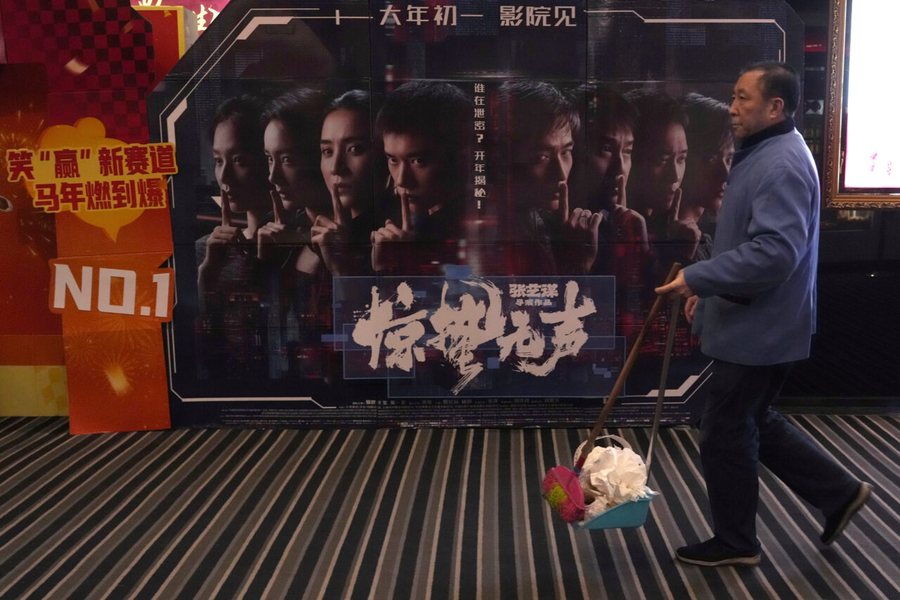
“Scare Out” is not a spy movie like the others: it is the first blockbuster supervised by Chinese intelligence, conceived as a response to American recruitment efforts through mass culture…
A film released for Chinese New Year, "directed and created" by the Ministry of State Security, has grossed around $160 million in two weeks, raising the need to understand what is really happening.
Beyond financial success, the question arises as to how Chinese intelligence is changing its public communication strategy.
“Scare Out,” released on February 17, tells the story of the pursuit of an inside informant who has handed over classified information on a new fighter jet. The subject is just a pretext. The real protagonist is Zhang Yimou, and his choice is not accidental.
Zhang is the director of "You Dou," "Red Lantern" and "Hero": three Oscar nominations, a distinctive visual style and a career that in the 1980s and 1990s made him a central figure in world arthouse cinema. He belonged to the so-called Fifth Generation, filmmakers formed after the Cultural Revolution, whose films were interpreted in the West as a silent alternative to the aesthetics of the regime.
In 2008 he made a public comeback by curating the opening and closing ceremonies of the Beijing Olympics. Today he is part of the establishment, but his name retains a cultural weight that few institutional directors can claim. His involvement in “Scare Out” gives the film both artistic credibility and a propaganda function: the project cannot be considered a mere institutional product of low quality. Zhang told the “Quotidiano del Popolo” that “state security personnel accompanied us throughout the filming to ensure that the film was as close to reality as possible.” The direction is his; the supervision belongs to the state.
The result is a visually curated thriller set in futuristic Shenzhen, where drones, artificial intelligence and urban surveillance play a central role. Cinematographically, according to “The Guardian”, it is positioned between “Mission Impossible” and “Infernal Affairs”, the Hong Kong saga that Scorsese reworked in “The Departed”. The psychological depth remains limited, the pace is fast and the message is built within the narrative: loyalty to the state prevails over friendships and personal connections. The film closes with a slogan from Xi Jinping: “never forget your original aspirations”.
However, the element that requires analysis is not the narrative, but the strategic one. About two years ago, the Ministry of State Security opened a WeChat profile with a programmatic statement: “counterintelligence requires the mobilization of the entire society.” Since then, it has been publishing real-life cases, comics, mini-films, and illustrations about spies discovered thanks to citizens’ denunciations almost every day. One post told of a travel blogger who had asked a student to photograph a military base; another about a military history enthusiast who had bought books with classified secrets at a recycling center.
“Scare Out” is the culmination of this strategy, not its beginning. The film includes real interrogation footage, masked faces; active-duty officers have trained the actors on surveillance techniques and operational behavior in urban environments; the script is based on real cases, including one linked by international media to a leak of information about the J-35 aircraft. This is a controlled transparency, appearing just enough to build credibility, without revealing the real procedures. The system remains closed, only the surface changes.
In an interview with the Associated Press, researcher Sheena Greitens from the University of Texas at Austin defines this as “a sophisticated effort to mobilize Chinese citizens and make national security something acceptable and attractive.” The goal is not to build heroic figures or mythologies like James Bond, but to transfer the role of vigilance to the public: citizens should see themselves as active parts of the defense system and feel legitimate to report suspicious behavior.
The geopolitical context is important. The film comes at a time when the CIA has been distributing Mandarin-language recruitment videos on Chinese social media, targeting officials and individuals with access to sensitive information.
“Do you want to understand the truth? Contact us,” one of them says. Beijing responds on two levels: diplomatically through the Foreign Ministry and culturally through a cinematic production that normalizes the perception of the threat and justifies the collective response. The two dimensions interact: the more visible the American recruitment becomes, the more convincing the film’s narrative becomes for the domestic audience.
The fact that the film has lower box office compared to previous propaganda productions (“main melody”) also indicates a change in the economic and social mood in China: deflation, a crisis in the real estate market, and consumers less sensitive to state narratives.
However, for the Ministry of State Security, the main indicator is not comparison with previous successes, but the impact: how many citizens have begun to perceive security as a personal matter and how many of them have learned to spot a spy. /Adapted from Linkiesta /




Lini një Përgjigje