


 Shkruar nga Pamfleti
European capitals are irritated by Mark Rutte's suggestion that they will join the US military in the Strait of Hormuz
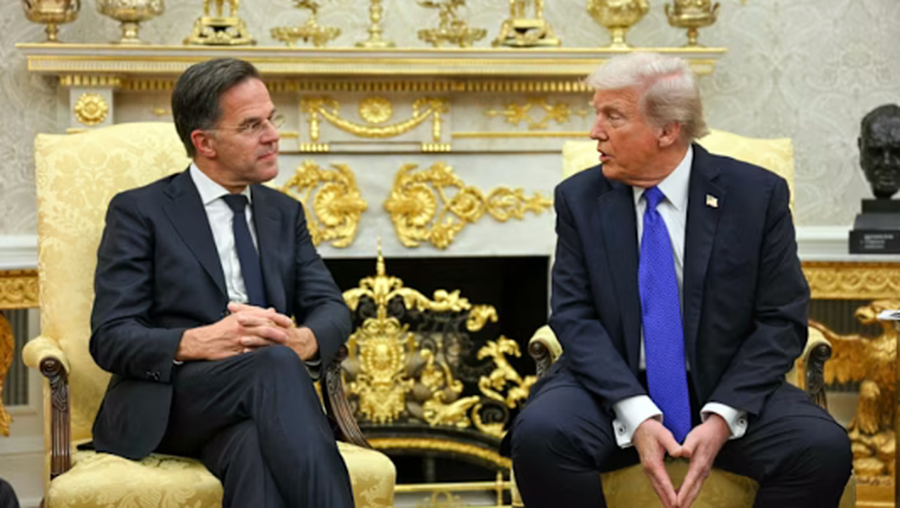
The NATO chief has angered European capitals with his support for Donald Trump's war on Iran as the continent faces an energy shock caused by the conflict, further adding to tensions in the transatlantic alliance.
Mark Rutte's suggestion that European allies would "unite" to respond to the US president's call to deploy naval assets to the Strait of Hormuz has irritated officials in several European capitals, alliance diplomats told the Financial Times, exacerbating divisions within NATO over the extent of support for its largest member.
“This puts us in a very difficult and uncomfortable situation,” said an EU diplomat. “We want to show readiness, but it is also true that we are not in a position to get involved [in the conflict] in any way.”
The uncertainty in many European capitals about the conflict, which has caused severe consequences in the Middle East and significantly increased oil and gas prices, stands in stark contrast to the statements of Rutte, who has repeatedly sought to reassure and praise Trump for keeping the US committed to the military alliance.
“He is doing this to make the whole world safer,” Rutte said Sunday of Trump’s decision to bomb Iran. “It is quite logical that European countries will take a few weeks to come together,” he added, referring to the US leader’s request that NATO allies join a fleet to escort ships in the Strait of Hormuz, which Iran has blocked.
Trump criticized NATO allies for not responding immediately to his call, describing them as “COWARDS” and warning that without the US, NATO would be “A PAPER TIGER!” Since returning to office last year, the US president has frequently tested transatlantic unity on issues such as trade, defense spending and even threatening to invade Greenland.
EU countries, all but three of which are also NATO members, last week collectively rejected Trump’s call for a ceasefire in Hormuz. The EU’s top diplomat, Kaja Kallas, said of the conflict: “This is not our war,” a stance also supported by ministers from Germany, Italy and Spain.
Three European diplomats from NATO member states said they were concerned by the discrepancy between Rutte's statements and the stance of most European capitals. They stressed that they saw no reason to directly criticize Trump, but also disagreed with his support for the decision to go to war.
“This war is, moreover, a politically catastrophic mistake for those involved,” German President Frank-Walter Steinmeier said on Tuesday. “And that is what frustrates me the most: a truly avoidable, unnecessary war.”
France's chief of defense staff, Fabien Mandon, said Tuesday that the US "is becoming increasingly unpredictable and does not even bother to inform us when it decides to launch military operations."
"This has an impact on our security. It has an impact on our interests," Mandon added.
A NATO official told the Financial Times: “NATO is not involved in the war in Iran, but is closely monitoring the situation to keep allies safe. The secretary general is in constant contact with alliance leaders.”
Several European capitals, led by Paris, have signaled a willingness to potentially engage in naval patrols in the strait after the war ends, to protect about a fifth of global oil and gas shipments that pass through this key route connecting the Gulf to international markets.
At the same time, some European officials have unofficially objected to labeling the conflict as “not our war,” given the huge impact it has on energy prices and costs for households and businesses in Europe.
"The consequences are ours, therefore the conflict is ours," said one official, adding that several capitals are in contact with Middle Eastern countries affected by the war to find a diplomatic solution.
The tensions over how to handle the conflict and Trump's stance come as US Secretary of State Marco Rubio travels to France for talks with G7 counterparts on Friday to "discuss shared security concerns and opportunities for cooperation," according to the State Department.


Lini një Përgjigje