


 Shkruar nga Pamfleti
Trump and the Iranian regime face off amid military threats and vague signals for negotiations
Diplomacy has come to the fore in the war with Iran, and both sides have their reasons. As the United States weighs the time and risk of forcibly reopening the Strait of Hormuz, the Iranian regime must assess whether it can risk losing this advantage and sustaining attacks for as long as action in Hormuz could prolong the war.
On Monday, President Trump pushed back on his threat to destroy Iran’s power plants, after what he called “productive talks” and “significant points of agreement” with Iran. The Iranian regime denied that any talks had taken place. This is the fog of diplomacy in this Trump-style war, and reports point to preliminary exchanges of messages via Pakistan, Turkey and Egypt.
Trump’s interest is to calm markets with news of diplomatic progress. The regime’s interest is to deny everything and keep markets in suspense. In that sense, Trump won this showdown, causing oil prices to plummet on Monday. This is his way of doing things, offering relief at the start of the trading week, and bringing pressure at the end. The new deadline to avoid escalation is Friday, when about 2,200 Marines are expected to arrive in the region.
They could be followed by another Marine expeditionary unit, as well as command elements and a combat brigade from the Army’s 82nd Airborne Division. This could be described as Trump-style diplomacy: one hand extended, the other prepared to strike. Will this regime again dare Trump to follow through on his threats? And was this the President’s strategy from the start?
The two sides remain far from an agreement. Trump reiterates his pre-war demands: dismantling what remains of the nuclear program, handing over its stockpile of enriched uranium, and curbing its missile program. Iranian officials reiterate their refusals and demand various guarantees, reparations, the removal of US forces from the region, and payment for passage through Hormuz, an international waterway. All of these are unacceptable, which explains the skepticism of Arab and Israeli officials.
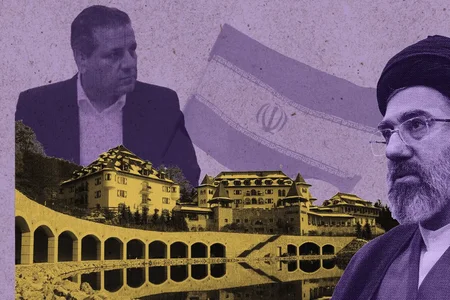
Trump said his envoy, Steve Witkoff, is speaking with a “key person” in Iran, widely believed to be Mohammad-Bagher Ghalibaf. He is the speaker of parliament, former mayor, former police chief and commander of the Revolutionary Guard, and a seasoned opportunist. Some see his many political transformations and corruption allegations as signs that he could be the flexible figure the U.S. is looking for. Others see him as a hard-line regime figure with no evidence of a desire to change Iran’s policies.
It is not certain whether Ghalibaf can speak for the Iranian regime. He is one of the most senior officials left, but will the Revolutionary Guards follow his lead? How much room does he have to act? One reason to explore the talks may be to understand that. On Tuesday, Trump said that the Iranian regime had given the United States an unspecified “gift,” as it had promised, regarding oil and gas. This showed, he said, that “we are dealing with the right people.” But he also gave them a “gift,” by easing U.S. sanctions on Iranian oil exports.
The next step is to arrange a meeting, if Iran wants one. The regime may think time is on its side; the Strait of Hormuz is blocked and Trump backed out on Monday. But Friday will soon be here again, and with President Trump, there is no telling what might happen. He may not even know.
However, it remains important for him to understand that a retreat in the face of the regime now would leave an Iranian “weapon” aimed at the world, a proven veto over the flow of energy.
China and Russia may conclude that he cannot withstand the domestic political pressure from high oil prices.
“One bullet to one of our people or our ships, and I would hit Kharg Island,” Iran’s oil export terminal, Trump had said in 1988, adding “I would go in and take it.”
Now he is President, and history and the world want to know if that promise still stands. /Adapted from WSJ /


Lini një Përgjigje