


 Shkruar nga Pamfleti
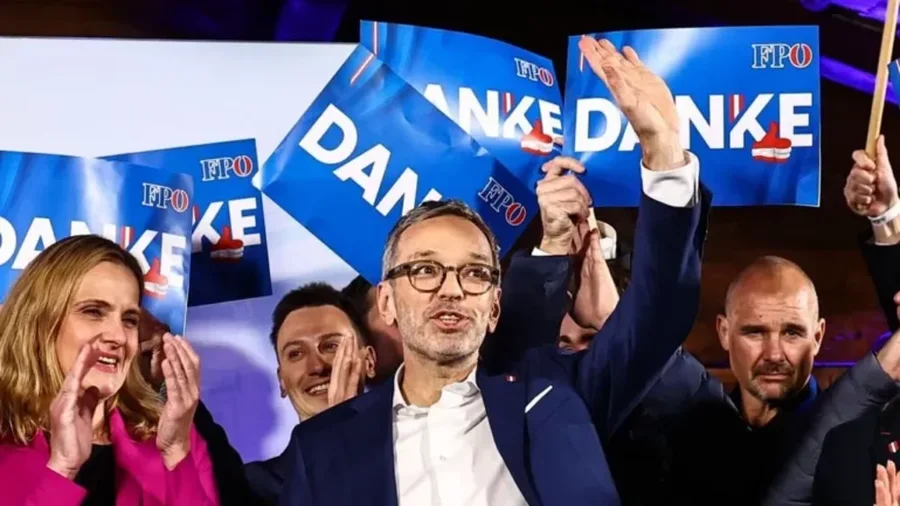
Austria's far-right Freedom Party (FPÖ) has opened the door to a new era, its leader Herbert Kickl told supporters as they celebrated an unprecedented election victory.
The predicted results gave Kickl's party 28.8% – two points ahead of the conservative People's Party (ÖVP) with 26.3%, but well short of a majority. Kickl's victory is the latest in a string of electoral successes for the far-right in Europe and he praised voters for their "optimism, courage and faith" in delivering a "piece of history".
The FPÖ has been in coalition before, but the second-placed ÖVP has refused to participate in a government led by him.
Kickl's main rival, current chancellor Karl Nehammer of the ÖVP, has said that it is "impossible to form a government with someone who worships conspiracy theories".
The election saw a high turnout, with 78% of Austrian voters taking part in an election dominated by issues of migration and asylum, as well as a struggling economy and the war in Ukraine.
As half of Austria's map turned dark blue, FPÖ general secretary Michael Schnedlitz said "the men and women of Austria have made history today", although he declined to say what kind of coalition the party would try to build. his.
An analysis of voters suggested that those aged 35-59 were more likely to vote for the far right and slightly more women than men.
Kickl's party is on track to secure around 56 seats in the 183-seat parliament, with the conservatives on 52 and the Social Democrats on 41.
The fiery leader of the Freedom Party had promised Austrians to build "Fortress Austria" to restore their security, prosperity and peace, and he has aligned himself closely with Viktor Orbán in neighboring Hungary.
Social Democrat leader Andreas Babler warned that Austria should not go down the same path as Hungary.
Kickl had also talked about becoming Volkskanzler (people's chancellor), which for some Austrians has echoes of the term used to describe Adolf Hitler in Nazi Germany.
The party was founded by former Nazis in the 1950s. Two days before the vote, some of its candidates were caught on video singing an SS song at a funeral.
As the FPÖ's victory became clear, a small group of protesters appeared outside the parliament holding anti-Nazi banners.
Forming a coalition is likely to be tricky for Kickl, who is a divisive figure.
The Social Democrats, Greens and Neos have all ruled out a partnership with the far right.
The only possible coalition that Kickl's party could form is with the conservatives, although the FPÖ would have to find a solution to the ÖVP's refusal to have Kickl as chancellor.
When Geert Đilders' Freedom Party won the Netherlands' election last November, he dropped his bid to become prime minister so that three other parties could agree to form a coalition. However, Kickl is keen to lead his country, promising the Austrians to act as their "servant and protector".
Political analyst Thomas Hofer told the BBC it was far from clear whether Austrian President Alexander Van der Bellen, who is overseeing the formation of the government, would give Kickl a "direct mandate to form a coalition".
The ÖVP could in theory form a coalition with the Social Democrats if recent predictions are correct and could attract the liberal Neos or the Greens.
Equally, Karl Nehammer may come under pressure from within the ÖVP to withdraw his opposition. A leading FPÖ figure said that after such a historic defeat he should resign, although this was rejected by Nehammer's party secretary general.
President Van der Bellen has expressed reservations in the past about the FPÖ over its criticism of the EU and its failure to condemn the Russian occupation of Ukraine. The party opposes EU sanctions against Moscow, citing Austria's neutrality, and many of its MPs walked out of a speech to parliament in Vienna last year by Ukraine's Volodymyr Zelensky.
Kickl's predicted victory is the latest in almost a year of voting successes for radical right-wing parties in Europe.
Italy's Giorgia Meloni leads a right-wing coalition, while the leader of Italy's far-right Brotherhood and Germany's AfD topped the polls in the eastern state of Thuringia last month. France's National Rally won the vote in the European elections last June.
Unlike Kickl, Italy's prime minister has given her full support for the EU's defense of Ukraine in the face of a full-scale invasion by Russia.
AfD co-leader Alice Weidel congratulated Kickl, posting a photo of the two together, and National Rally's Marine Le Pen said "this land that bears the defense of national interests", after votes everywhere in Europe, confirmed "the triumphs of the people everywhere". .
Geert Íilders said that times were changing and that "identity, sovereignty, freedom and no more illegal immigration/asylum" was what millions of Europeans wanted.
Kickl has exploited fears about immigration in Austria, and he has capitalized on anger over the government's handling of the Covid pandemic, embracing conspiracy theories about unclear treatments for the virus.
For Kickl and his party, Sunday's election victory represents a significant recovery from 2019, when they came in third after a video scandal involving their former leader.





Lini një Përgjigje