


 Shkruar nga Pamfleti
As international conflicts expand and trust in the United States gradually weakens, Europe is entering a new phase of rearmament and strategic review, preparing for a scenario where it may be forced to defend its own interests, without fully relying on its traditional American ally.
The European continent is now facing a question that until a few years ago was considered unthinkable: can it still continue to rely on its allies for long-term security and defense?
From the war in Ukraine and tensions in the Middle East, to the growing rivalry between the US and China, the European Union is facing a new global order, where military power and strategic interests are increasingly taking precedence over international cooperation and a rules-based order.
"For the first time in our memory, we are truly alone," former Italian Prime Minister Mario Draghi recently declared, reflecting the sense of uncertainty that is growing in European capitals.
This atmosphere is signaling a profound transformation in the way Europe is conceiving security and its strategic future. European governments are reconsidering traditional beliefs about military alliances, defense, and economic stability, at a time when old-fashioned guarantees are no longer perceived as secure.
This shift is clearly reflected in the increase in military spending across the continent. Since the Russian invasion of Ukraine in 2022, European Union member states have steadily increased their defense budgets, with joint military spending this year reaching around €739 billion.
Germany is expected to invest 117.2 billion euros in the defense sector during 2026, while France is about 68.5 billion euros. Meanwhile, countries on NATO's eastern flank are moving at an even faster pace.
Poland, concerned by the possibility of further Russian aggression, already dedicates 4.48% of its Gross Domestic Product to defense.
This development represents a major turnaround compared to the decades after the Cold War, when most European countries had gradually reduced their military capabilities.
However, the current shift is not only related to the perceived threat from Russia. It is also increasingly driven by growing uncertainty about the role and commitment of the US to European security.
For decades, Europe's security has rested on NATO and the American military guarantee, based on the Article 5 principle of collective defense. But this trust, long considered unshakable, is now being seriously questioned.
Since the return of Donald Trump's second administration, European leaders are facing a more unilateral and transactional approach from Washington to foreign policy.
The United States has taken significant military and diplomatic decisions with limited consultation with European partners, raising concerns about coordination and unity within the alliance.
Tensions have not only surfaced in the security field. Transatlantic relations have also deteriorated economically, due to US tariffs on European products and constant threats of sanctions.
This situation has strengthened the conviction in Brussels that the partnership with the US is becoming increasingly unstable and difficult to predict.
According to European officials, the result is not a formal break with Washington, but a gradual erosion of confidence in the US's ability and willingness to guarantee Europe's security - an uncertainty that is increasingly influencing the shaping of European Union policies.
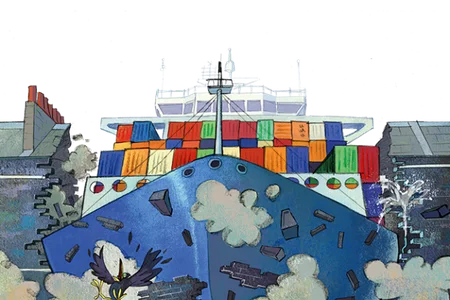
At the same time, the European Union is facing increasing economic pressures from both the US and China.
US tariffs and trade disputes during the Trump administration have revived concerns about the use of economic pressure even by Europe's traditional allies. In parallel, China's industrial overcapacity and its dominance in critical supply chains continue to exert strong pressure on European industry.
The European Union continues to have a significant trade deficit with China, which is fueling internal debate over long-term economic dependence and perceived unfair competition in international markets.
Faced with these challenges, Brussels has adopted a new strategy that is increasingly being described as "de-risking", i.e. reducing dependence and exposure to the US and China, without completely severing economic relations with either party.
As part of this strategy, the European Union has begun the gradual removal of Chinese technology companies, such as Huawei and ZTE, from European critical infrastructure, while efforts are increasing to build domestic alternatives in strategic sectors such as technology, digital payments, finance, and industrial production.



Tironsit kane thenien me te thjeshte e filozofike te planetit: 'T'majt e jotja.' Fantastike, eh.