


 Shkruar nga Kristal M. Fleming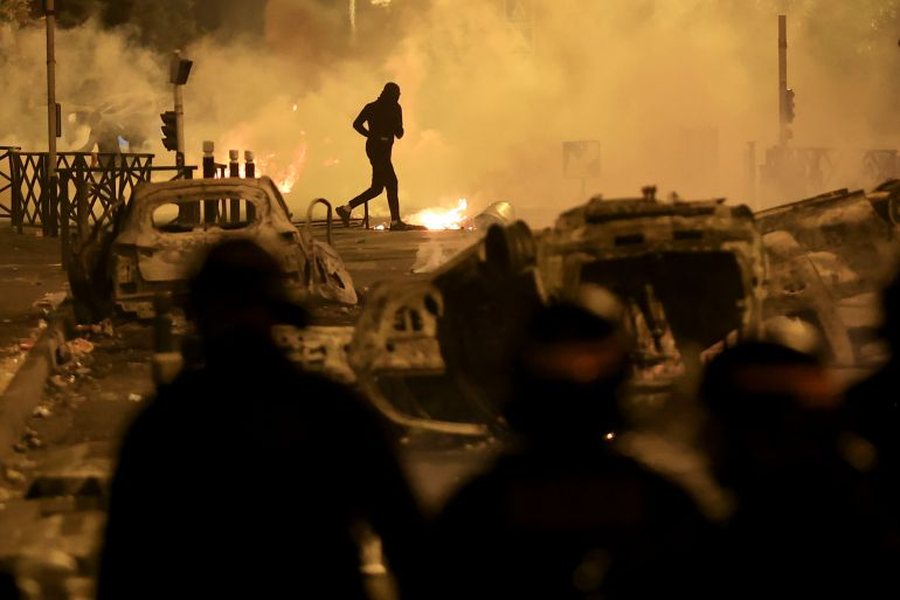
In the wake of mass protests, French President Emmanuel Macron called the killing "inexplicable". But this too is another French fiction and a form of persistent denial. Nahel's death is not an unsolvable mystery – it was the result of systemic racism...
This week, French police brutally killed a 17-year-old in broad daylight as they tried to cover up the incident.
The police lied and accused the young man of disobeying the patrol. And, as is often the case, the national media reported the police fiction as fact - until a bystander who filmed the incident revealed the truth.
People around the globe have seen horrifying images of French police brandishing pistols and threatening the occupants of a yellow vehicle on the outskirts of Paris before gruesomely executing the driver with a bullet to the head. Contrary to false claims by the police, no officers were standing in front of the car or physically threatened by the young man who was driving away.
The images of the shooting have produced what the classical French sociologist Émile Durkheim would call a "shock to the collective conscience."
Unfortunately, it is no surprise that Nahel, the French teenager whose life was tragically cut short by the police, was of Algerian descent.
France has a long and sordid history of colonial racism and violence against people racialized as "non-white", stretching from Haiti, Guadeloupe, Martinique to the Caribbean, North and West Africa as well as Vietnam. France has mercilessly oppressed the Algerian people in particular – including those who are French citizens.
Indeed, the French colonization of Algeria dates back to the early 1800s and involved the widespread use of brutal violence and mass murder to establish French rule.
During the Algerian war of independence (1954-1962), hundreds of thousands and possibly more than 1 million Algerians were systematically massacred and tortured by the French regime in a desperate attempt to preserve their colonial empire in the name of "liberte, egalité et .fraternité" - freedom, equality and brotherhood.
Police violence has historically targeted Arab and black people in France. In 1961, French police killed more than 100 French Arabs who were peacefully protesting in Paris.
Tens of thousands of people had marched in support of Algerian independence and in protest against a curfew imposed to quell dissent. In response, police killed French Algerians in the streets, even drowning protesters in the Seine River. The youngest documented death was that of another teenager, 15-year-old Fatima Beda. In an era long before smartphones, French authorities engaged in a brazen and largely successful cover-up that lasted for decades. It took more than 50 years for a French president to even acknowledge what happened. Even now, there has been no official apology.
In the wake of mass protests, French President Emmanuel Macron called the killing "inexplicable". But this too is another French fiction and a form of persistent denial. Nahel's death is not an unsolvable mystery – it was the result of systemic racism.
Studies have long shown widespread racial bias in French police targeting Arab and black people in particular. In 2020, France's own human rights ombudsman found that young people who racialize themselves as Arab or black are 20 times more likely to be profiled and stopped by the police.
Komisioni Evropian kundër Racizmit dhe Intolerancës ka paralajmëruar prej kohësh për diskriminimin racor të kryer nga policia franceze, dhe komunitetet në terren shpesh e pranojnë numrin e rëndë të demonizimit dhe ngacmimit si rezultat i ideologjisë raciste. Emrat e pakicave të racializuara që kanë rënë viktimë e dhunës policore në Francë gjatë dy dekadave të fundit—Zyed dhe Bouna, Adama Traoré, Théo, ndër të tjera—kanë lënë një histori të ankthshme të mosndëshkimit të policisë.
Kur këto lloj vrasjesh policore ndodhin në Shtetet e Bashkuara, siç ndodh shpesh, në media dhe në mesin e liberalëve dhe të majtëve, shpesh pranohet përgjithësisht se racizmi është një shkak themelor.
Në Francë, liberalët dhe të majtët shpesh bashkojnë forcat me ekstremistët e krahut të djathtë për të mohuar ekzistencën e racizmit francez.
Many prominent African-American writers and intellectuals who moved to France in the early to mid-20th century also promoted the myth of French blindness. James Baldwin was a notable exception to the rule. Reflecting on his experience in France, he wrote: "I lived mostly among the poor - and, in Paris, the poor [were] Algerians".
Today, the poor, those who find themselves the targets of racism, Islamophobia and police rifles, are still Algerians.
The time has come for France to move beyond the familiar cycle of state violence and denial towards an honest acknowledgment of systemic racism and a commitment to implementing policies to tackle widespread discrimination and prejudice in policing, employment, education and politics. / Taken from "Al Jazeera"







Lini një Përgjigje